
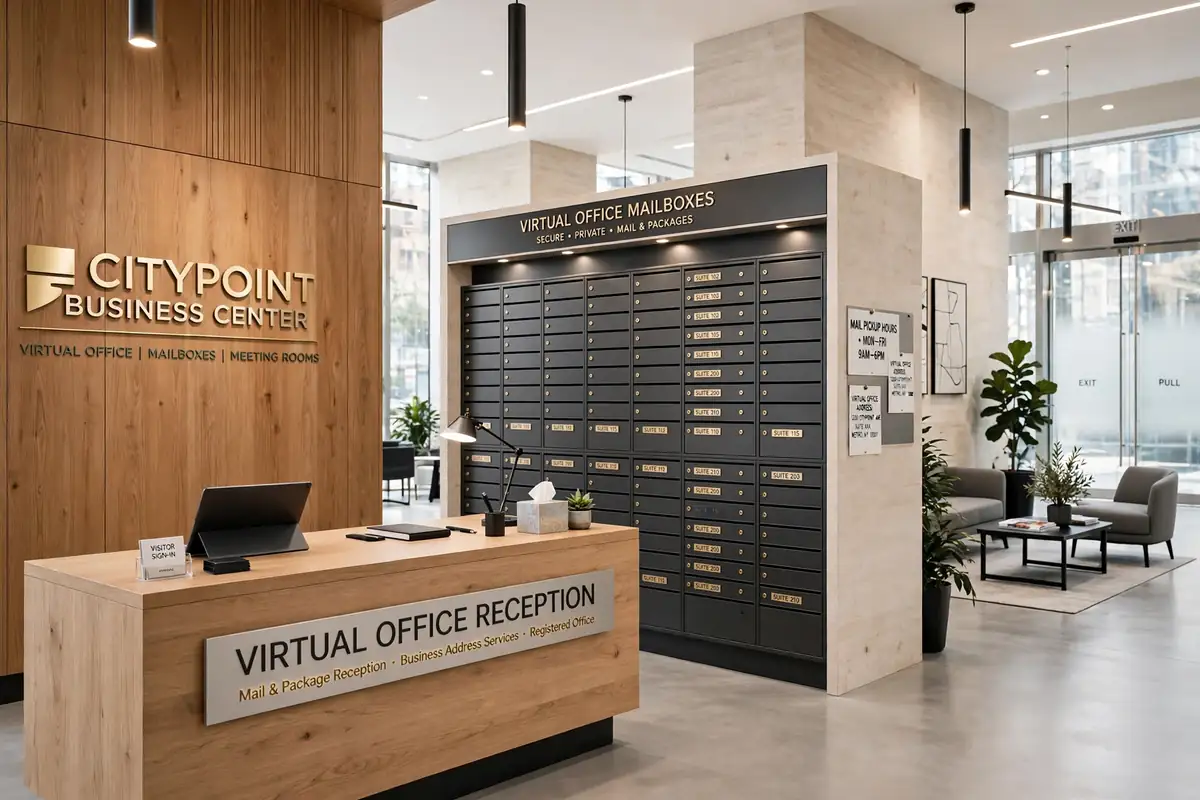
Renting a full office is expensive, but using your home address on every public document has real downsides too. That tension is why so many founders ask: what is a virtual office, and is it a smart middle path? A virtual office gives your business a professional address and support services without a physical space of your own.
This guide explains how virtual offices work, what they typically include, what they cannot do, and how to decide whether one fits your business. You will finish knowing exactly which problems a virtual office solves and which it does not.
What Is a Virtual Office?
A virtual office is a service that provides a business with a real street address at a commercial building, mail handling, and optional add-ons like meeting rooms and phone answering — without the business actually occupying space there full time. You work from home, a job site, or anywhere else, while the address presents a stable, professional front.
The arrangement is legal and common. Freelancers, consultants, ecommerce sellers, and remote-first startups use virtual offices to look established, protect their privacy, and receive mail reliably. Providers range from local business centers to national networks with addresses in major cities.
It is important to separate a virtual office from related ideas. It is not a coworking membership, though many providers sell both. It is also not the same as a registered agent service, which receives legal documents on your behalf; our registered agent guide explains that distinct role, and confusing the two causes real filing problems.
What a Virtual Office Typically Includes
- A commercial street address for mail, packages, and often for marketing materials and your website.
- Mail handling: receiving, scanning, forwarding, or holding mail for pickup, depending on the plan.
- Meeting and day-office access by the hour or day, so client meetings happen somewhere professional.
- Phone services: a business number, live answering, or voicemail-to-email on higher tiers.
- Administrative extras: package signing, notary access, or printing at some locations.
Pricing is usually a modest monthly fee that scales with services, far below rent for even a small office. Weigh it against your other fixed costs the way you would any line in your startup cost budget: small, predictable, and cancellable beats large and locked-in when you are young.
The Main Benefits
Privacy for home-based owners
Your home address otherwise ends up on registrations, invoices, websites, and marketing emails where anyone can find it. A virtual office moves that exposure to a commercial building. For solo owners — especially those growing a venture from our side hustle ideas into a full company — that separation is often the deciding factor.
A credible address in a better location
An address in a recognized business district can lift client confidence, particularly for consultants, agencies, and B2B services. It supports the brand-building work described in our look at advanced digital marketing: consistent, professional details across every touchpoint.
Flexibility for remote teams
Remote-first companies may have no natural headquarters at all. A virtual office gives them one mailing home while the team works anywhere, a pattern explored in our article on mastering digital marketing in the remote economy. When you need a room for a workshop or a client pitch, you rent it by the day instead of paying for it all month.
Mail you never miss
Checks, contracts, and official letters arrive at a staffed address that can sign for packages during business hours. No more delivery notices on your door, and no clients wondering why their payment went to a residence.
What a Virtual Office Cannot Do
Be clear-eyed about the limits. Many banks, licensing offices, and government registrations require a physical address where the business actually operates, and some will not accept a virtual office address for formation or licensing. Rules vary by state and by agency, so verify before you rely on one for official filings.
Google Business Profiles are another constraint: businesses that do not serve customers at their location generally cannot use a virtual office address as a storefront listing, and doing so risks suspension. Online sellers face fewer address problems overall, as our guide on how to start an ecommerce business in the USA explains, but local SEO is where virtual addresses hit their ceiling.
A virtual office also is not a trade name or a legal entity. It does not register your business, and it does not replace the DBA filing if you operate under a brand name. Think of it as presentation and logistics layered on top of a properly formed business, not a substitute for one — the formation steps in our guide on how to start a business in the USA still apply in full.
Who Should (and Should Not) Get One
A virtual office fits consultants, freelancers, remote agencies, online businesses, and founders testing a new market before committing to a lease. It also suits businesses expanding into a second city that need a local mailing presence and occasional meeting space.
It fits poorly for businesses customers visit — retail, food, clinics, and trades with a physical shop — and for owners whose state or industry regulator demands a real operating location. If clients will ever walk in unannounced, you need a door that is actually yours. Structure plays a role too: whichever entity you choose from the LLC vs sole proprietorship comparison, your official records must use addresses each agency accepts.
How to Choose a Provider
Compare more than the monthly price. Check the actual building: is it a genuine commercial address or a mailbox store dressed up? Ask how mail is handled and forwarded, what meeting rooms cost, whether the contract is month-to-month, and how the provider verifies identity, since reputable services require documentation. Visit if you can; the lobby your clients will see is part of what you are buying.
Also confirm what happens to your mail if you cancel, and whether the address can receive packages from all carriers. Fold the fee into your monthly review of fixed costs alongside your bookkeeping and business insurance renewals, and judge it by the same standard as any overhead in your cash flow management: does it earn its place every month?
Virtual Office vs Coworking vs Home Office
These three options solve different problems. A home office costs nothing and works fine operationally, but it exposes your address and can look informal to corporate clients. Coworking gives you a real desk, community, and walk-in meeting space for a mid-range monthly price — valuable if you work better out of the house or host people weekly — but you pay for space whether or not you use it every day.
A virtual office sits between them: no dedicated desk, but a professional address, handled mail, and rooms when you need them, at the lowest monthly cost of the three. Many businesses graduate through the sequence — home office, then virtual office for image and privacy, then coworking or a small lease when the team’s daily work demands shared physical space. Choosing for your current stage, rather than the stage you hope to reach next year, keeps overhead lean while your revenue catches up with your ambitions.
Before signing, run one final practical test: search for the provider’s address online and look at it the way a cautious client would. If the building presents as a professional business center with real tenants, you are buying credibility. If the results show a mailbox rental shop or a dozen complaints about lost mail, keep looking — the cheapest address is expensive if it undermines the trust it was meant to create.
Frequently Asked Questions
Can I use a virtual office address to form my LLC?
Sometimes, but many states and banks require a physical address for the business’s principal place of business, and a registered agent address has separate rules. A virtual office often works for mail and marketing while falling short for official filings — verify with your state and bank first.
Is a virtual office the same as a P.O. Box?
No. A virtual office provides a real street address at a staffed commercial building that can sign for packages from all carriers. A P.O. Box is a postal box that many agencies and carriers will not accept for business registration or deliveries.
How much does a virtual office cost?
Basic plans that cover an address and mail handling are typically a modest monthly fee, with higher tiers adding phone answering, scans, and meeting time. It is almost always a fraction of renting physical space, but compare total add-on costs, not just the headline price.
Final Thoughts
A virtual office buys professionalism and privacy without rent: a real address, handled mail, and meeting space on demand. It will not satisfy every regulator or replace a storefront, but for remote and home-based businesses it is often the smartest small expense in the budget. Verify what your state, bank, and licensing office accept, then choose a provider whose building you would be proud to put on your website.