
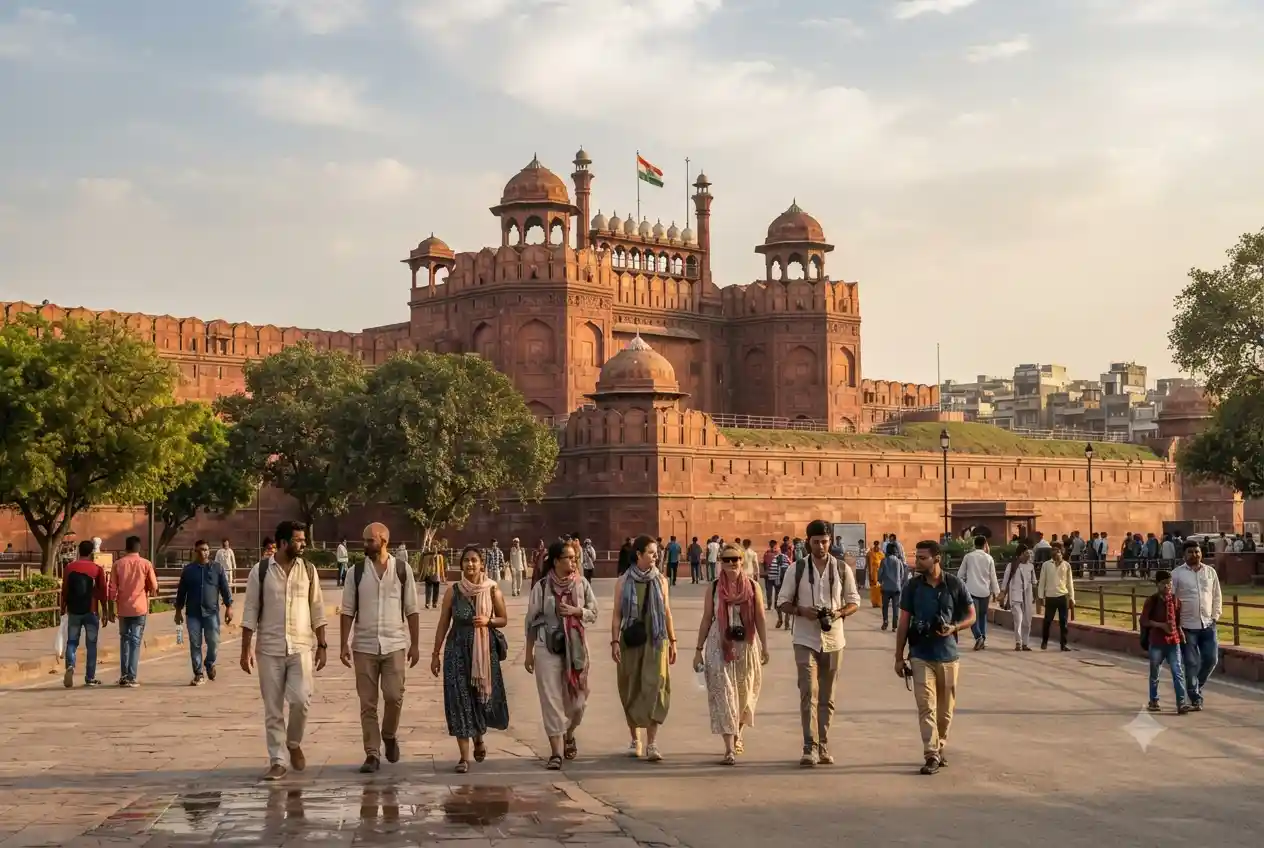
If you’re wondering what are the best places to visit in Delhi, this guide covers the city’s most important attractions, hidden gems, cultural experiences, family-friendly spots, and practical itinerary ideas.
Why Visit Delhi?
Delhi offers an unusual combination of old and new. Historic neighborhoods and Mughal-era monuments sit alongside government buildings, museums, shopping districts, modern restaurants, and contemporary cultural attractions.
The city is particularly appealing to first-time visitors because you can experience several different sides of India without traveling far. A single day might include a historic fort, a centuries-old mosque, a modern temple, a traditional market, and a memorable local meal.
Delhi Tourism describes the city as a place where its heritage, art, crafts, cuisine, and culture coexist with modern urban life.
Best Places to Visit in Delhi
1. Red Fort
Best for: History, Mughal architecture, photography, and first-time visitors
The Red Fort, or Lal Qila, is one of Delhi’s most recognizable landmarks and one of the essential stops on any first visit. Its imposing red sandstone walls represent the grandeur of the Mughal era and form an important part of Old Delhi’s historic landscape.
The fort was built during the reign of Mughal emperor Shah Jahan and remains one of the city’s most significant heritage attractions. Delhi Tourism lists the Red Fort among Delhi’s World Heritage monuments and describes its massive sandstone walls as a defining reminder of Mughal power.
Allow enough time to explore the complex rather than treating it as a quick photo stop. Combining the Red Fort with nearby Old Delhi attractions can make your sightseeing route much more efficient.
2. Qutub Minar
Best for: Architecture, history, photography, and heritage sightseeing
Qutub Minar is another essential Delhi attraction. The red-and-buff sandstone tower rises dramatically above the surrounding archaeological complex and is one of the city’s most recognizable historical structures.
Delhi Tourism records the tower’s height at 72.5 meters and notes the surrounding complex’s inscriptions, architectural elements, and historical structures.
Do not leave immediately after seeing the tower. The surrounding Qutub complex contains additional architectural remains, making the entire area worthwhile for travelers interested in India’s medieval history.
3. Humayun’s Tomb
Best for: Mughal architecture, gardens, photography, and peaceful sightseeing
Humayun’s Tomb is one of Delhi’s most beautiful historic sites. Its symmetrical garden setting, monumental architecture, and detailed stonework make it especially appealing to photographers and architecture enthusiasts.
Delhi Tourism identifies Humayun’s Tomb as a World Heritage monument and notes its importance as an early garden-tomb that influenced later architectural development in the Indian subcontinent.
The site is also a good choice when you want a quieter experience than the crowded streets of Old Delhi.
4. India Gate
Best for: Evening walks, photography, families, and iconic Delhi views
India Gate is one of the most recognizable landmarks in New Delhi. The monumental arch stands within a large green area and is particularly atmospheric in the evening when the surrounding area becomes lively.
Delhi Tourism lists the monument as free to enter and describes the surrounding lawns as a popular gathering and picnic area.
Pair India Gate with nearby central Delhi attractions such as Rashtrapati Bhavan, museums, and government landmarks for an efficient sightseeing day.
5. Lotus Temple
Best for: Architecture, peaceful visits, families, and photography
The Lotus Temple is known for its distinctive flower-like architectural design and its connection with the Bahá’í faith. Even visitors who are primarily interested in architecture can appreciate the building’s unusual form and calm atmosphere.
Delhi Tourism includes Lotus Temple among the city’s principal tourist places, while Incredible India highlights its lotus-inspired design as one of the landmark’s defining features.
Because the experience is different from visiting a conventional monument, it is worth including if you want your Delhi itinerary to cover both culture and architecture.
6. Akshardham Temple
Best for: Architecture, culture, gardens, families, and spiritual experiences
Akshardham is a large cultural and spiritual complex known for its detailed architecture, gardens, exhibitions, and presentations about Indian traditions and heritage.
The official Delhi Tourism listing states that complex entry is free while exhibitions and the musical fountain require separate tickets. It also notes that photography and electronic devices are not permitted inside the complex.
Because the complex offers several experiences beyond the temple itself, set aside several hours if you want to explore it properly.
7. Jama Masjid
Best for: History, architecture, Old Delhi, and cultural exploration
Jama Masjid is one of the most important historic mosques in Delhi and an essential stop when exploring Old Delhi. Its scale and architectural character reflect the city’s Mughal heritage.
The mosque is particularly convenient to combine with a visit to the Red Fort and Chandni Chowk. Delhi Tourism’s historical itinerary groups Jama Masjid with several major Old Delhi monuments.
8. Chandni Chowk
Best for: Street food, shopping, Old Delhi culture, and local experiences
Chandni Chowk offers a completely different experience from Delhi’s formal monuments. Its crowded lanes, historic markets, religious sites, traditional shops, and famous food create an immersive introduction to Old Delhi.
It is especially useful for travelers who want to experience the everyday energy of the city rather than simply moving from one monument to another.
Consider visiting with enough time to explore nearby attractions rather than rushing through the market. The Chandni Chowk Metro station also provides access to several nearby tourist sites.
9. Lodhi Garden
Best for: Green spaces, historic tombs, photography, and relaxed walks
Lodhi Garden is a refreshing change of pace from Delhi’s crowded streets. The landscaped park contains historic tombs and architectural remains surrounded by lawns, trees, and walking paths.
It works particularly well early in the morning when you want a quieter start to the day. Delhi Tourism lists Lodhi Garden among the city’s popular destinations, while its Metro itinerary places the garden within easy reach of several central Delhi attractions.
10. Agrasen Ki Baoli
Best for: Architecture, photography, hidden gems, and short visits
Agrasen Ki Baoli is a historic stepwell tucked into the modern city. Its distinctive descending stairway and stone construction make it one of Delhi’s most interesting lesser-known attractions.
It is a good choice for travelers who want to see a different side of Delhi beyond the major forts and monuments. Incredible India also highlights Agrasen Ki Baoli as one of the city’s places to explore beyond the usual tourist trail.
11. Gurudwara Bangla Sahib
Best for: Spiritual experiences, architecture, and cultural diversity
Gurudwara Bangla Sahib is one of Delhi’s best-known Sikh religious sites. Its distinctive golden dome, peaceful atmosphere, and tradition of community service make it an important cultural experience even for visitors who are not Sikh.
Delhi Tourism includes Bangla Sahib among its popular destinations and places it close to several central attractions in its Metro itinerary.
12. Jantar Mantar
Best for: Science, history, architecture, and educational trips
Jantar Mantar introduces visitors to India’s historic interest in astronomy. The complex contains large-scale astronomical instruments designed for observing and calculating celestial movements.
Its central location also makes it easy to combine with Connaught Place, Bangla Sahib, and other central Delhi attractions. Delhi Tourism includes Jantar Mantar in its list of major tourist places and central-city itineraries.
13. Purana Qila
Best for: History, architecture, photography, and quieter sightseeing
Purana Qila, or Old Fort, is another important historical attraction in Delhi. Its massive walls and gateways offer visitors a different perspective on the city’s layered history.
The fort is especially suitable for travelers who have already visited the major Mughal landmarks and want to explore another historic site with a less commercial atmosphere.
14. National Museum
Best for: Art, archaeology, history, and rainy or extremely hot days
The National Museum is a useful addition to a Delhi itinerary for travelers who want deeper context about India’s history and artistic traditions. Museum visits also provide a welcome indoor alternative during periods of extreme heat.
Incredible India includes the National Museum among Delhi’s major attractions alongside the National Gallery of Modern Art, National Crafts Museum, and other cultural institutions.
15. National Rail Museum
Best for: Families, railway enthusiasts, and educational trips
The National Rail Museum is a strong family-friendly attraction that explores India’s railway history through historic locomotives, carriages, and exhibits.
It offers a different type of sightseeing from Delhi’s forts and temples and can be especially useful for families traveling with children who may enjoy interactive or transport-related attractions.
16. Dilli Haat
Best for: Handicrafts, shopping, regional food, and souvenirs
Dilli Haat is a good stop for travelers who want to combine shopping with India’s regional crafts and cuisine. The open-air market-style environment brings together handicrafts, textiles, decorative items, and food representing different parts of the country.
It is a practical place to look for souvenirs while experiencing a more contemporary version of India’s traditional craft culture.
17. Garden of Five Senses
Best for: Couples, families, gardens, and relaxed afternoons
The Garden of Five Senses is designed as a landscaped recreational space where visitors can enjoy plants, sculptures, pathways, and outdoor areas away from the intensity of central Delhi.
It is particularly suitable for travelers who want to slow down after visiting several historical attractions.
18. National War Memorial
Best for: History, remembrance, and patriotic landmarks
The National War Memorial provides visitors with an opportunity to learn about India’s military history and remember members of the armed forces. It can be incorporated into an itinerary focused on India Gate and other central New Delhi landmarks.
Incredible India lists the National War Memorial among Delhi’s principal attractions.
19. Mehrauli Archaeological Park
Best for: History, archaeology, photography, and travelers seeking lesser-known sites
Mehrauli Archaeological Park is an excellent choice for visitors who want to go beyond Delhi’s most famous monuments. The area contains historic structures representing different periods of Delhi’s long history.
Delhi Tourism’s two-day itinerary specifically recommends exploring the park before visiting the nearby Qutub complex.
20. Rashtrapati Bhavan and Central Delhi
Best for: Architecture, government landmarks, photography, and first-time visitors
Central Delhi showcases the city’s more formal and modern political landscape. Rashtrapati Bhavan, India Gate, Parliament-related landmarks, museums, and broad avenues create a sharp contrast with the narrow streets of Old Delhi.
Delhi Tourism’s Metro itinerary groups Rashtrapati Bhavan, India Gate, Lodhi Garden, museums, Purana Qila, and several other attractions within the broader Central Secretariat area, making this part of the city practical to explore as a cluster.
Best Places to Visit in Delhi for Different Travelers
- For first-time visitors: Red Fort, Qutub Minar, Humayun’s Tomb, India Gate, and Chandni Chowk.
- For families: Akshardham, National Rail Museum, India Gate, and National Science Centre.
- For couples: Lodhi Garden, Humayun’s Tomb, Garden of Five Senses, and India Gate in the evening.
- For history lovers: Red Fort, Qutub Minar, Humayun’s Tomb, Purana Qila, and Mehrauli Archaeological Park.
- For architecture lovers: Qutub Minar, Humayun’s Tomb, Lotus Temple, Red Fort, and Akshardham.
- For food lovers: Chandni Chowk, Old Delhi, Dilli Haat, and the city’s many regional restaurants.
- For spiritual experiences: Jama Masjid, Bangla Sahib, Lotus Temple, Akshardham, and Birla Mandir.
- For photography: Humayun’s Tomb, Qutub Minar, India Gate, Lodhi Garden, and Agrasen Ki Baoli.
Best Places to Visit in Delhi in the Morning
Morning is one of the best times to explore Delhi, particularly for outdoor monuments and busy markets. Cooler temperatures can make walking more comfortable, while early visits can help you avoid some of the day’s heavier crowds.
For a dedicated morning itinerary, see our guide to the best places to visit in Delhi in the morning.
A practical morning route could include Humayun’s Tomb or Lodhi Garden, followed by India Gate and central Delhi. Another option is to start around Old Delhi and explore the Red Fort, Jama Masjid, and Chandni Chowk.
Best Time to Visit Delhi
For most sightseeing trips, the cooler months are generally more comfortable than Delhi’s hottest periods. Winter can offer pleasant conditions for exploring outdoor monuments, although mornings can sometimes be foggy.
Spring and autumn can also be attractive, while summer can be challenging for travelers planning long periods outdoors. Always check current weather conditions before finalizing a packed sightseeing itinerary.
How Many Days Are Enough for Delhi?
Two to three days is a useful starting point for a first visit, although travelers with more time can easily spend longer exploring museums, markets, neighborhoods, gardens, and historical sites.
One-Day Delhi Itinerary
- Start with the Red Fort.
- Explore Jama Masjid and nearby Old Delhi.
- Walk or explore parts of Chandni Chowk.
- Visit India Gate and central Delhi later in the day.
- Finish with an evening meal or market experience.
Two-Day Delhi Itinerary
- Day 1: Red Fort, Jama Masjid, Chandni Chowk, India Gate, and Central Delhi.
- Day 2: Humayun’s Tomb, Lodhi Garden, Qutub Minar, Mehrauli Archaeological Park, and a cultural or shopping stop.
Delhi Tourism also publishes one-day and two-day itinerary suggestions, including a two-day route that combines Mehrauli Archaeological Park with the Qutub complex.
Getting Around Delhi
The Delhi Metro is one of the most useful ways for visitors to move between major sightseeing areas. Delhi Tourism publishes a Metro-based tourist itinerary showing attractions accessible from stations including Chandni Chowk, Rajiv Chowk, Central Secretariat, Qutab Minar, Nehru Place, Akshardham, and Pragati Maidan.
For shorter distances, walking can be enjoyable in specific heritage areas, while taxis and auto-rickshaws can help connect attractions that are less convenient by Metro.
Because Delhi is a large city, grouping attractions by neighborhood is usually more efficient than crossing the city repeatedly.
Delhi Travel Tips for First-Time Visitors
- Group nearby attractions: Combine Old Delhi sites on one route and South Delhi attractions on another.
- Start early: Morning sightseeing can be more comfortable, particularly for outdoor monuments.
- Use the Metro where practical: It can save time on busy city routes.
- Dress appropriately at religious sites: Follow local rules and remove footwear where required.
- Carry water: Delhi’s weather can become hot, especially outside the cooler months.
- Leave time for food: Delhi’s culinary scene is part of the destination, not merely an afterthought.
- Check attraction rules: Some sites have restrictions on photography, electronics, bags, or entry.
- Keep valuables secure: As with any major tourist city, remain aware of your belongings in crowded areas.
Is Delhi Worth Visiting?
Absolutely. Delhi is one of the best destinations in India for travelers interested in history, architecture, food, religion, culture, and urban experiences.
Its greatest strength is variety. You can explore a Mughal fort in the morning, eat traditional food in Old Delhi, visit a historic garden, admire contemporary architecture, and end the day around a major national landmark.
The city can be crowded and intense, but that energy is also part of what makes Delhi memorable. With a sensible itinerary and some planning, first-time visitors can experience its most important attractions without feeling overwhelmed.
Final Thoughts
The best places to visit in Delhi range from world-famous monuments such as the Red Fort, Qutub Minar, and Humayun’s Tomb to lively cultural areas such as Chandni Chowk and peaceful spaces such as Lodhi Garden.
For history, focus on Old Delhi and the city’s Mughal monuments. For architecture, explore Qutub Minar, Humayun’s Tomb, Lotus Temple, and Akshardham. For food and shopping, spend time in Chandni Chowk and Dilli Haat. And for a balanced first trip, combine historic attractions with gardens, museums, markets, and central Delhi landmarks.
Delhi rewards travelers who slow down enough to experience more than its famous monuments. Plan your routes by area, use the Metro when convenient, allow time for local food and culture, and you can turn a short visit into a memorable introduction to India’s capital.