
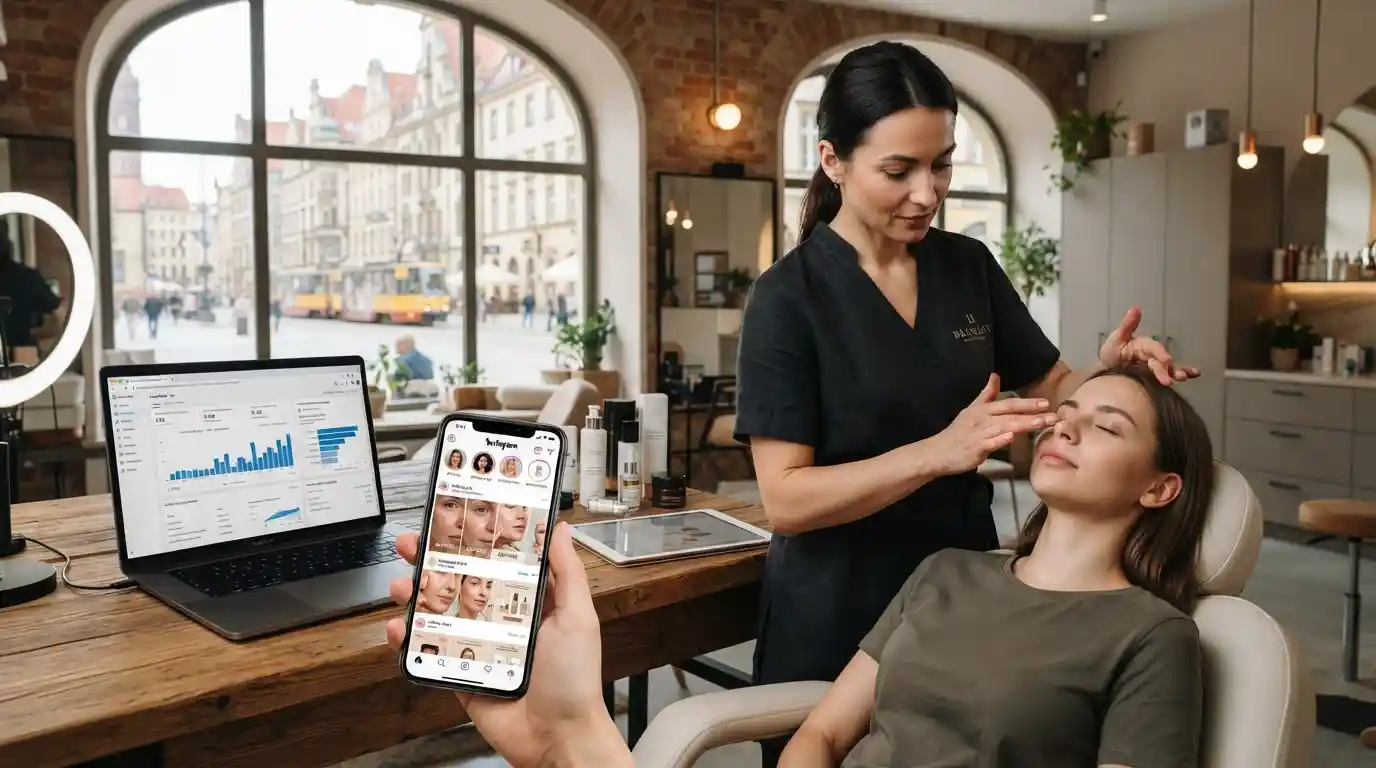
Digital marketing is no longer simply an additional promotional channel for beauty businesses. It can influence how customers discover a salon, evaluate a product, compare services, read reviews, interact with a brand, and ultimately decide where to spend their money.
For businesses operating in Wrocław’s competitive beauty market, the opportunity lies in connecting strong beauty expertise with a digital presence that feels useful, authentic, and locally relevant.
Why Digital Marketing Matters More for the Beauty Industry
Beauty is an especially visual and trust-driven industry. Customers often want to see results before booking a service or purchasing a product. They may look at photographs, watch short videos, read reviews, compare prices, investigate ingredients, and explore a business’s social media profiles before making a decision.
This makes digital marketing particularly valuable. A beauty business can use multiple digital touchpoints to answer customer questions before the first appointment or purchase.
For example, a salon can publish educational content about skincare routines, hair treatments, nail care, or seasonal beauty trends. A cosmetic brand can explain ingredients, demonstrate product applications, and create tutorials. A local beauty professional can use search optimization to become easier to discover when potential customers search for services in Wrocław.
The same principle applies across other industries. Businesses can use digital marketing strategy to connect customer needs with measurable online activities, while advanced digital marketing can help organizations adapt their customer journeys to changing technology.
The Rise of Search-Driven Beauty Discovery
Search engines remain an important part of the customer journey because people frequently turn to online search when they need a specific service or answer.
Someone searching for a facial treatment, hair salon, skincare specialist, cosmetic product, or beauty service in Wrocław has a different level of intent from someone casually scrolling through social media. Search marketing allows businesses to address these different stages of the buying journey.
Effective search optimization begins with understanding what customers actually want to know. Instead of publishing generic promotional content, beauty businesses can create useful pages around questions such as:
- Which beauty treatment is suitable for a particular concern?
- How should customers prepare for an appointment?
- What should they expect during a treatment?
- How often should a particular service be repeated?
- What ingredients are commonly used in skincare?
- How can customers choose between different beauty services?
This approach turns a website into an information resource rather than simply an online brochure.
Local SEO Is Critical for Wrocław Beauty Businesses
For salons and service-based beauty businesses, location can be one of the strongest purchasing factors. Customers usually want a provider that is convenient to reach, easy to contact, and clearly established in their local market.
That is why local search optimization should be part of a Wrocław beauty marketing strategy.
A strong local presence can include an optimized business profile, accurate contact information, location-focused website content, customer reviews, useful service pages, and locally relevant content.
Instead of trying to target every possible beauty-related search, businesses can build focused content around their actual services and the areas they serve.
This creates a stronger connection between search intent and the services available to customers in Wrocław.
Social Media Is Changing Beauty Brand Communication
Beauty is naturally suited to visual platforms. Before-and-after transformations, tutorials, product demonstrations, styling ideas, educational videos, and customer experiences can all be communicated effectively through short-form content.
However, successful beauty marketing is not simply about posting attractive photographs.
Modern audiences often expect brands to provide something useful. A skincare business might explain how to build a routine. A haircare brand might demonstrate techniques for different hair types. A salon might explain what happens during a treatment and how customers can prepare.
This educational approach can help businesses develop credibility while creating content that people have a reason to save, share, or revisit.
The broader digital marketing strategies used by high-growth advertising firms demonstrate why businesses increasingly need coordinated campaigns instead of relying on a single channel.
Influencer and Creator Marketing in Beauty
Beauty customers often look for demonstrations and real-world experiences before trying something new. This creates opportunities for collaborations with relevant creators and influencers.
For a Wrocław beauty business, local creators can be particularly useful because their audiences may already have a connection with the city and its surrounding communities.
The most useful partnerships are not necessarily those with the largest follower counts. Relevance, audience alignment, credibility, content quality, and engagement can be more meaningful considerations.
A creator could document a salon experience, explain how a product is used, answer common questions, or demonstrate a beauty routine. When the content feels natural and provides genuine information, it can become more than a conventional advertisement.
Video Content Is Becoming a Core Beauty Marketing Tool
Video allows beauty businesses to communicate details that static images cannot always explain.
A short video can demonstrate the application of a cosmetic product, explain a treatment process, show a hairstyle transformation, introduce a professional, or answer a frequently asked question.
Beauty businesses should therefore consider creating different types of video rather than repeatedly producing promotional advertisements.
- Educational videos: Explain beauty techniques, ingredients, and routines.
- Demonstration videos: Show how products or services work.
- Behind-the-scenes videos: Introduce the people and processes behind the business.
- FAQ videos: Answer questions customers frequently ask before booking.
- Trend videos: Discuss relevant beauty and styling developments.
Businesses can also connect visual content with broader digital marketing strategies for small businesses, ensuring that social media activity supports wider business goals.
Personalization Is Reshaping Beauty Marketing
Beauty is rarely a one-size-fits-all category. Customers have different skin types, hair types, preferences, budgets, routines, and expectations.
Digital technology gives brands more opportunities to create personalized experiences.
Websites can recommend relevant products based on customer preferences. Email campaigns can be segmented according to previous purchases. Content can address different customer concerns instead of presenting one generic message to everyone.
Personalization can also improve the customer experience by reducing the amount of irrelevant information people need to navigate.
At the same time, businesses need to use customer data responsibly. Personalization should make the experience more useful rather than intrusive.
Artificial Intelligence and the Next Stage of Beauty Marketing
Artificial intelligence is becoming another important part of digital marketing. Beauty companies can use AI-supported tools for content ideation, customer analysis, personalization, product discovery, campaign optimization, and other marketing processes.
AI can also change how customers search for information. Instead of typing short keywords into a search engine, users may increasingly ask detailed questions and expect conversational answers.
This means beauty businesses should create content that clearly answers customer questions and provides useful context.
The development of enterprise IT and marketing integration also highlights the growing relationship between technology, customer data, marketing systems, and business decision-making.
E-Commerce Is Expanding the Beauty Customer Journey
Digital marketing and e-commerce are closely connected. A customer may discover a product on social media, search for reviews, visit a website, compare alternatives, and eventually purchase online.
This means beauty brands need to consider the complete journey rather than focusing exclusively on traffic.
A successful online beauty experience should make it easy to:
- Understand the product or service.
- Compare relevant options.
- Find pricing and availability information.
- Read useful reviews.
- Understand how a product should be used.
- Contact the business when questions remain.
- Complete a purchase or booking without unnecessary friction.
This broader customer-journey approach connects naturally with digital transformation in business services.
Content Marketing Can Build Long-Term Beauty Authority
Paid advertising can create immediate visibility, but useful content can continue attracting potential customers over time.
A beauty website can develop content clusters around skincare, haircare, makeup, wellness, treatments, ingredients, product comparisons, and frequently asked questions.
Each article should serve a specific search intent while connecting logically with other relevant pages on the website.
For example, a skincare business might create an educational article about skin types and then connect it to content about routines, ingredients, seasonal skincare, and professional treatments.
This approach supports topical authority and gives visitors more opportunities to discover useful information before making a purchase or booking decision.
The same principle can be seen in broader marketing strategies within specialized industries, where educational content can help businesses communicate expertise while addressing specific customer needs.
Data and Analytics Are Improving Marketing Decisions
Digital marketing gives beauty businesses access to measurable information that traditional advertising may not provide as clearly.
Businesses can evaluate website traffic, search visibility, engagement, conversions, advertising performance, customer journeys, and content performance.
The goal should not be to collect as many numbers as possible. Instead, businesses should identify metrics that connect directly to meaningful outcomes.
For example, a salon might monitor appointment inquiries and bookings. An e-commerce beauty brand might focus on product views, conversion rates, repeat purchases, and customer acquisition costs.
Understanding digital marketing ROI can help businesses decide which activities deserve more attention and which campaigns need improvement.
Why Trust and Authenticity Matter in Beauty Marketing
Beauty marketing often deals with personal concerns and expectations. Customers therefore need reasons to trust a brand before committing to a product or service.
Authentic photography, transparent information, clear pricing, genuine reviews, qualified professionals, educational content, and realistic expectations can all contribute to a stronger digital presence.
Businesses should avoid exaggerated promises that can damage credibility. Instead, marketing should explain what a product or treatment is designed to do and what customers can reasonably expect.
This is particularly important as customers become more capable of researching brands before purchasing.
The Role of Paid Advertising
Organic visibility takes time, while paid advertising can help businesses reach specific audiences more quickly.
Beauty businesses can use paid search and social advertising to promote seasonal offers, new products, appointments, educational content, or special campaigns.
However, advertising should be connected to a clear landing page and a defined customer action.
Sending every visitor to a generic homepage can create unnecessary friction. A campaign promoting a particular beauty service should ideally direct users to a page that explains that service, answers relevant questions, and makes the next step clear.
Businesses looking at the wider strategic side of digital marketing ROI can use campaign data to refine targeting, creative assets, landing pages, and budgets.
Beauty Businesses Need an Omnichannel Strategy
The modern beauty customer does not necessarily follow a straight path from advertisement to purchase.
Someone may discover a brand on Instagram, search for it on Google, visit its website, read reviews, watch a video, return several days later, and finally make a booking or purchase.
Each interaction contributes to the overall customer experience.
That makes consistency important. The brand message, visual identity, service information, pricing, and customer experience should remain coherent across the major digital channels.
A coordinated approach can also connect digital transformation and marketing with practical customer-facing activities.
What Wrocław Beauty Businesses Can Focus on Next
The future of digital beauty marketing is likely to involve a combination of search visibility, social content, creator partnerships, e-commerce, personalization, artificial intelligence, analytics, and strong customer experiences.
For businesses in Wrocław, the most useful strategy is not necessarily to adopt every new platform or technology at once. Instead, businesses can identify where their customers currently discover information and then build a connected digital experience around those behaviors.
A practical strategy can include:
- Building a technically sound and useful website.
- Creating dedicated pages for important beauty services or products.
- Strengthening local search visibility.
- Publishing educational content that answers real customer questions.
- Using short-form video to demonstrate expertise.
- Testing relevant creator and influencer collaborations.
- Using paid campaigns around specific business objectives.
- Improving online booking or purchasing experiences.
- Tracking meaningful conversion and customer metrics.
- Using customer insights to continually refine the strategy.
The Future of Beauty Marketing in Wrocław
Digital marketing is changing the relationship between beauty businesses and their customers. Discovery is increasingly influenced by search, social platforms, video, creators, online reviews, personalized recommendations, and digital shopping experiences.
For Wrocław’s beauty market, this creates opportunities for both established businesses and emerging brands. Companies that understand their customers, communicate useful information, build trust, and connect their digital channels can create stronger relationships than businesses relying only on traditional promotion.
The future is therefore not simply about having a website or maintaining a social media account. It is about creating a connected digital experience that helps customers discover, understand, trust, and ultimately engage with a beauty business.
As technology continues to evolve, the businesses that treat digital marketing as an ongoing customer-experience strategy rather than a one-time advertising activity will have more opportunities to adapt to changing consumer behavior.



