
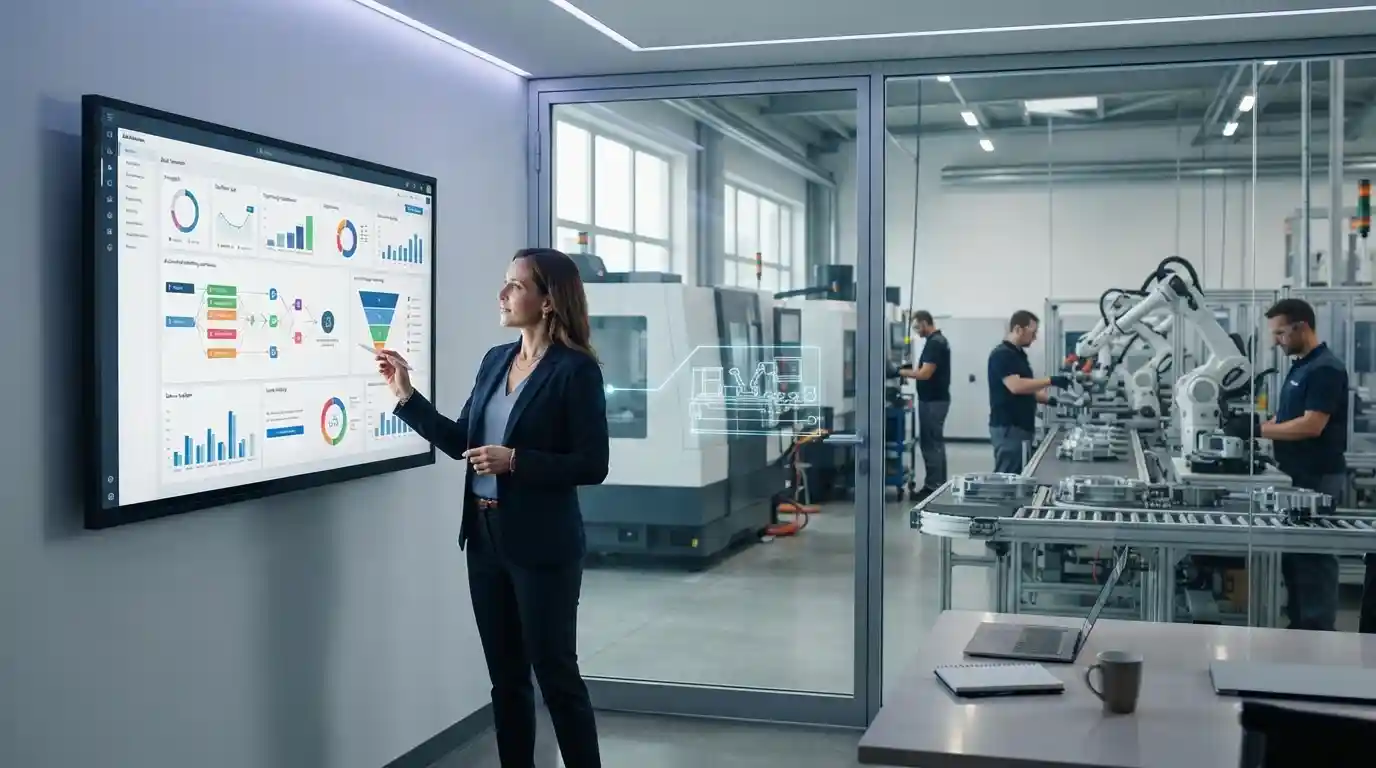
However, automation is not simply about sending more emails. The real value comes from connecting digital marketing strategy, lead capture, customer segmentation, follow-up, content delivery, and sales processes. When these pieces work together, manufacturers can spend less time on repetitive marketing tasks while giving prospects more relevant information throughout the buying journey.
What Is Marketing Automation for Manufacturing?
Marketing automation is the use of software and predefined workflows to handle repetitive marketing activities based on customer actions, preferences, or stages in the buying process.
For a manufacturing company, this can include automatically following up after a website inquiry, sending product information after a brochure download, notifying a sales representative when a high-value prospect returns to the website, segmenting contacts by industry, and maintaining communication with prospects who are not yet ready to buy.
The concept becomes especially useful when marketing teams need to manage a large number of prospects without treating every contact as a completely manual task.
Marketing automation can also work alongside broader digital business transformation initiatives. Instead of keeping customer data, campaigns, sales activity, and reporting in disconnected systems, companies can create a more coordinated marketing process.
Why Manufacturing Companies Need a Different Automation Strategy
Manufacturing marketing is different from many consumer-focused industries. A customer may not make a purchasing decision after seeing one advertisement or receiving one promotional email.
A manufacturing buyer may first search for a product, review specifications, compare suppliers, consult an engineer, discuss pricing with procurement, request samples, evaluate technical documentation, and finally contact the sales team.
That journey creates many opportunities for automation.
Instead of repeatedly asking sales employees to remember every follow-up, an automated system can help organize communication around the prospect’s actions. This approach can complement digital marketing strategies designed to attract and convert qualified business customers.
Does Marketing Automation Actually Work for Manufacturing?
Marketing automation can work extremely well for manufacturing companies when the underlying marketing process is already reasonably clear.
The important distinction is between automating a good process and automating a broken process.
If a company has unclear messaging, poor lead data, weak landing pages, slow sales follow-up, or an undefined target audience, automation will not automatically solve those problems. It may simply make the existing problems happen faster.
Manufacturers should therefore view automation as an operating system for marketing activities rather than a replacement for strategy.
7 Ways Marketing Automation Can Help Manufacturers
1. Capture Leads More Efficiently
Manufacturing websites can receive inquiries through contact forms, quote requests, product pages, downloadable resources, distributor applications, and other conversion points.
Automation can organize these contacts as soon as they enter the system. Instead of relying on manual spreadsheets or inbox searches, the business can automatically record the lead, identify its source, and trigger the appropriate next step.
This is particularly useful for businesses investing in data-driven digital marketing, because marketing activity becomes easier to connect with actual business outcomes.
2. Improve Lead Nurturing
Not every manufacturing prospect is ready to request a quote immediately.
Some buyers may still be researching technical requirements. Others may be comparing suppliers or waiting for an internal purchasing decision.
Marketing automation allows manufacturers to continue providing useful information during this period. Depending on the audience, automated communication could include product information, technical guides, application examples, maintenance information, industry insights, or answers to common purchasing questions.
This keeps the company visible without requiring a salesperson to manually contact every prospect at every stage.
3. Segment Different Types of Buyers
A manufacturer may serve distributors, retailers, engineers, procurement professionals, contractors, OEMs, wholesalers, and direct customers.
These audiences can have completely different needs.
Marketing automation can separate contacts into useful groups based on industry, product interest, location, company size, previous interactions, or purchasing stage.
Better segmentation makes it easier to deliver relevant information instead of sending identical messages to every contact.
4. Automate Follow-Up
Follow-up is one of the simplest and most practical applications of marketing automation.
For example, when someone requests product information, an automated workflow can acknowledge the request immediately. A later message can provide additional resources, while a sales notification can be triggered when the prospect demonstrates stronger buying intent.
This reduces the chance that valuable inquiries disappear because someone forgot to follow up.
5. Support Sales Teams
Marketing automation should not be viewed as a competitor to the sales department.
Its stronger role is to help sales representatives identify which prospects deserve attention and provide useful context before the conversation begins.
When marketing and sales data are connected, teams can better understand which pages prospects visited, what resources they requested, and what products appear to interest them.
This supports the broader goal of digital transformation in business services, where information is used to improve operational efficiency.
6. Make Trade Show Follow-Up Easier
Manufacturers often generate contacts through exhibitions, conferences, industry events, and networking activities.
The problem starts after the event.
Hundreds of contacts may need to be organized, categorized, and followed up with. Marketing automation can help create different follow-up paths depending on the contact’s interests and level of engagement.
For example, someone interested in a specific product line can receive information related to that product rather than a generic company newsletter.
7. Improve Marketing Measurement
Automation can make it easier to measure which marketing activities are generating meaningful engagement.
Manufacturers can monitor metrics such as lead volume, engagement, form submissions, qualified inquiries, sales opportunities, and conversions.
This makes marketing decisions more measurable and supports a more structured approach to digital marketing ROI analysis.
What Should Manufacturers Automate First?
One of the biggest mistakes is trying to automate everything at once.
A better approach is to start with a small number of workflows that solve obvious problems.
Start With Lead Response
Begin with the moment a new prospect submits a form or requests information.
The system can acknowledge the inquiry, record the contact, categorize the request, and notify the appropriate person.
Automate Basic Lead Nurturing
Next, create a simple sequence for prospects who are interested but not ready to purchase.
The content should be useful rather than promotional. Technical resources, product information, FAQs, case examples, and educational content can help buyers continue their research.
Automate Re-Engagement
Manufacturers often have older leads sitting in their databases.
Instead of allowing these contacts to remain inactive forever, a re-engagement workflow can identify appropriate prospects and invite them to explore new products, updated information, or relevant resources.
How Marketing Automation Fits Into a Manufacturing Marketing Funnel
A useful manufacturing funnel can be divided into several stages:
- Awareness: A potential buyer discovers the company through search, content, advertising, social media, industry resources, or referrals.
- Research: The buyer investigates products, capabilities, specifications, and possible suppliers.
- Evaluation: The prospect compares options and considers technical or commercial requirements.
- Inquiry: The prospect requests information, pricing, a sample, consultation, or quotation.
- Sales: A representative engages with the prospect and works toward a commercial opportunity.
- Customer: The buyer completes the purchase and enters the customer relationship stage.
Automation can support several of these stages without removing the human interaction that is often essential in manufacturing sales.
This funnel approach also fits with industry-specific marketing strategy, where customer journeys need to reflect the complexity of the market rather than relying on a generic promotional model.
Marketing Automation and Content Marketing
Automation becomes much more valuable when a manufacturer has useful content available for different stages of the buying journey.
For example, an early-stage visitor may benefit from an educational article. A prospect evaluating products may want a comparison or technical guide. A sales-ready contact may want pricing information or a consultation.
Without useful content, automation can quickly become a sequence of repetitive promotional messages.
With a strong content strategy, automation can deliver the right resource at the right stage.
Manufacturers can also connect these efforts with broader digital marketing strategies to create a more integrated acquisition system.
Common Marketing Automation Mistakes in Manufacturing
Automating Too Much Too Quickly
Launching dozens of workflows before understanding customer journeys can create confusion.
Start with the highest-value processes and expand gradually.
Using Generic Messages
Industrial buyers usually have specific problems and requirements. A generic message may not provide enough value to keep them engaged.
Ignoring Data Quality
Automation depends on reliable contact and company information. Duplicate, outdated, or incomplete records can produce poor segmentation and ineffective campaigns.
Separating Marketing From Sales
If marketing automation produces leads but sales does not trust or use the resulting information, the system will struggle to create business value.
Measuring Only Email Activity
Opens and clicks can provide useful engagement signals, but manufacturers should ultimately connect marketing activity with qualified inquiries, opportunities, and revenue.
How to Build a Manufacturing Marketing Automation Strategy
A practical implementation can follow these steps.
Step 1: Define Your Ideal Customer
Identify the industries, company types, decision-makers, geographic markets, and product applications that represent your strongest opportunities.
Step 2: Map the Buying Journey
Document what prospects need to know before contacting sales. Identify common questions, objections, technical concerns, and purchasing stages.
Step 3: Audit Your Existing Marketing
Review your website, landing pages, forms, email campaigns, content, advertising, CRM, and reporting systems.
This can reveal where leads are being lost or where manual work is consuming unnecessary time.
Step 4: Create Priority Workflows
Build a small number of workflows around the most important customer actions. Lead response, nurturing, sales alerts, and re-engagement are often logical starting points.
Step 5: Connect Marketing and Sales
Agree on what qualifies as a marketing-ready lead and what information sales needs before taking action.
Step 6: Measure Business Outcomes
Track the metrics that matter to the business rather than focusing exclusively on campaign activity.
For companies investing in broader digital transformation, this measurement layer can also support better decision-making across departments.
How Automation Supports Manufacturing Growth
The biggest advantage of marketing automation is not simply saving a few hours of administrative work.
The larger opportunity is creating a repeatable system that allows a manufacturing company to communicate with potential customers consistently while its team focuses on higher-value activities.
When a company combines automation with strong content, effective conversion paths, accurate data, and a clear sales process, marketing becomes easier to manage and scale.
This is especially important for businesses trying to improve their revenue streams through data-driven marketing.
Frequently Asked Questions
Does marketing automation work for small manufacturing companies?
Yes. Small manufacturers can benefit from automation because it can reduce repetitive administrative work and help small marketing or sales teams maintain consistent follow-up. The key is starting with simple workflows rather than building a complicated system immediately.
Is marketing automation only useful for email marketing?
No. Email is one common application, but automation can also support lead routing, segmentation, CRM updates, sales notifications, content delivery, re-engagement, reporting, and other repetitive marketing processes.
Can marketing automation replace manufacturing sales representatives?
No. Automation can support sales teams by organizing information and handling repetitive communication, but complex manufacturing purchases often require human conversations, technical expertise, negotiation, and relationship building.
What should a manufacturer automate first?
Start with processes that are repetitive, measurable, and directly connected to revenue opportunities. New-lead responses, basic nurturing, sales notifications, and re-engagement are practical starting points.
How long does it take to see results?
The timeline varies depending on the quality of the existing website, customer database, content, sales process, and automation setup. Simple workflows can begin producing operational benefits relatively quickly, while meaningful pipeline improvements generally require ongoing testing and optimization.
Final Verdict: Does Marketing Automation Work for Manufacturing?
Yes, marketing automation can work very effectively for manufacturing companies when it is built around the real industrial buying journey.
The strongest strategy is not to automate marketing simply because software makes it possible. Instead, manufacturers should identify repetitive processes, understand their buyers, create useful content, connect marketing with sales, and automate the interactions where technology can improve consistency and speed.
Used correctly, marketing automation can help manufacturers capture more opportunities, nurture prospects for longer buying cycles, improve follow-up, organize customer data, and create a more measurable marketing operation.
The goal is simple: use automation to make the marketing process more consistent while keeping human expertise where it matters most.