
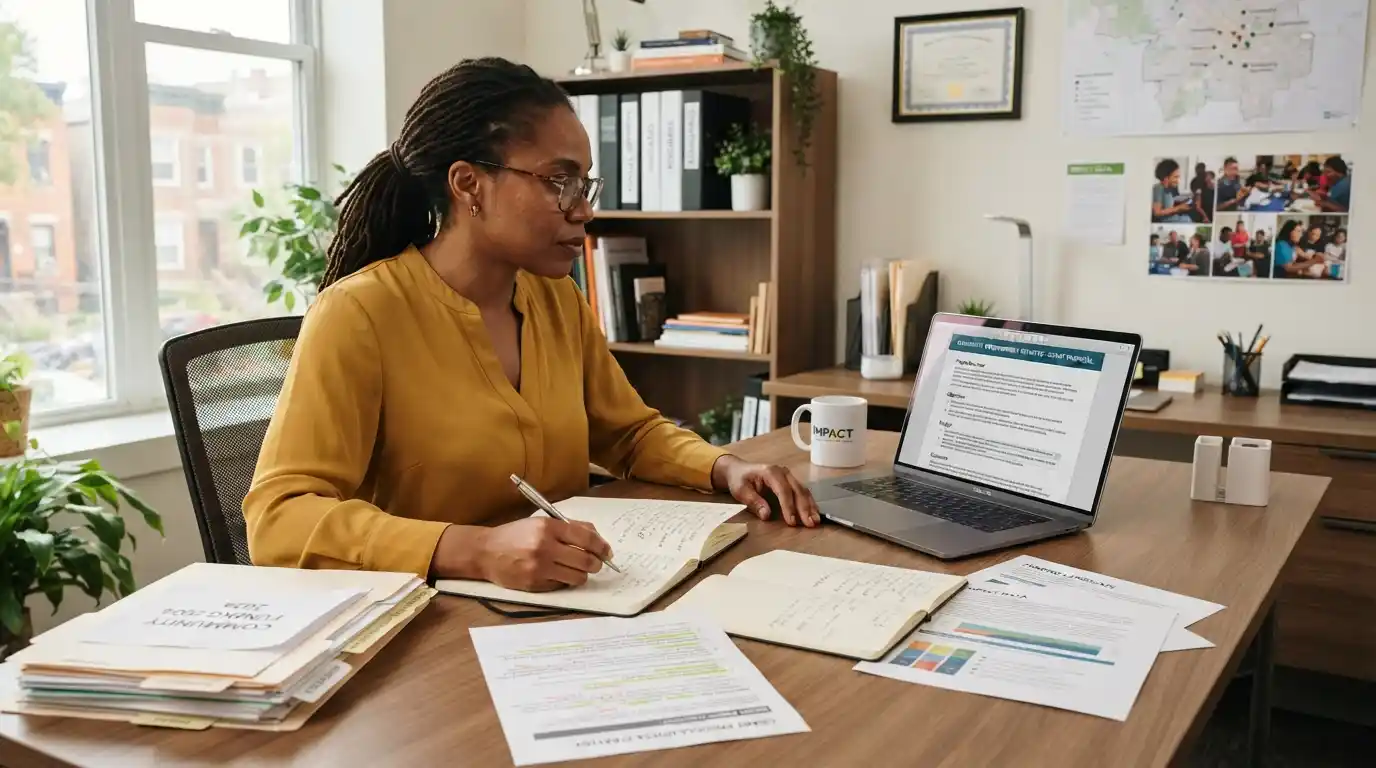
This guide explains what nonprofit grant writers do, which skills employers look for, how to find opportunities, what career growth can look like, and how to build a strong foundation for a successful grant writing career.
What Are Non Profit Grant Writing Jobs?
Nonprofit grant writing jobs involve preparing proposals and supporting documents that help organizations apply for grants from foundations, corporations, government programs, and other funding sources. A grant writer may research funding opportunities, study eligibility requirements, collect information from program teams, write proposals, organize supporting materials, and help track deadlines.
The role is broader than simply writing. Successful grant writers need to understand an organization’s mission, identify the problem a program is designed to address, explain the proposed solution clearly, and connect expected outcomes with the funder’s priorities.
Because nonprofit organizations operate across many industries, grant writing careers can also provide exposure to education, healthcare, community development, environmental programs, social services, arts, research, and economic development.
Why Grant Writing Matters to Nonprofit Organizations
Many nonprofit organizations depend on multiple funding sources to operate their programs. Grants can help support staffing, community services, educational initiatives, research, technology, facilities, and program expansion.
A well-written proposal makes it easier for a potential funder to understand what an organization is trying to accomplish and why financial support could make a measurable difference. Grant writers therefore play an important communication role between nonprofit organizations and funding institutions.
Grant writing also connects with broader organizational activities such as digital transformation in business services, strategic planning, communication, marketing, and operational development.
Common Non Profit Grant Writing Job Titles
Searching only for the exact phrase “grant writer” can limit the number of opportunities you discover. Organizations may use different titles for similar responsibilities.
- Grant Writer
- Grant Writing Specialist
- Grant Development Specialist
- Proposal Writer
- Development Writer
- Fundraising Writer
- Development Coordinator
- Grants Manager
- Institutional Giving Specialist
- Fund Development Manager
- Proposal Development Manager
Some positions combine grant writing with communications, fundraising, marketing, or program management. Others focus almost entirely on proposal development and reporting.
What Does a Nonprofit Grant Writer Do?
The daily responsibilities of a grant writer depend on the organization and position. However, several activities are common across the field.
Research Funding Opportunities
Grant writers research foundations, government programs, corporations, and other potential funders. They evaluate eligibility requirements, funding priorities, application deadlines, geographic restrictions, and program requirements.
Develop Grant Proposals
The core responsibility is usually developing persuasive proposals. This may include writing the organizational background, statement of need, project description, goals, objectives, implementation plan, evaluation strategy, and sustainability section.
Gather Information
Grant writers rarely work alone. They often communicate with executive leaders, program managers, finance teams, researchers, volunteers, and subject-matter specialists to collect accurate information for proposals.
Prepare Budgets and Supporting Materials
Depending on the position, a grant writer may collaborate with finance or program staff to prepare project budgets and supporting documents. Understanding basic financial information can therefore be useful for anyone pursuing this career.
Professionals interested in strengthening their financial knowledge may also explore resources such as the Celtic Finance Institute and the UNC Finance Society as examples of finance-focused educational and professional development topics.
Track Deadlines and Requirements
Grant applications often involve strict deadlines and detailed instructions. Missing a required document or submitting an application after the deadline can prevent an otherwise strong proposal from being considered.
Support Grant Reporting
Some grant writers also help organizations prepare reports explaining how funding was used and what results were achieved. Strong reporting can help organizations maintain relationships with funders and demonstrate accountability.
Skills Needed for Non Profit Grant Writing Jobs
A successful grant writer combines writing ability with research, organization, communication, and analytical thinking.
1. Strong Writing Skills
Grant proposals need to be clear, concise, specific, and persuasive. Writers must explain complex programs without making the proposal difficult to understand.
2. Research Skills
Grant writers need to quickly understand funders, program requirements, community needs, and relevant background information. Good research also helps writers identify opportunities that are genuinely aligned with an organization’s mission.
3. Attention to Detail
Grant applications can contain numerous requirements, word limits, attachments, budget details, and deadlines. Careful proofreading and checklist-based workflows can reduce avoidable mistakes.
4. Communication Skills
Grant writers regularly communicate with people who have different professional backgrounds. They need to ask effective questions and turn information from program staff into a coherent funding proposal.
5. Project Organization
Professionals may manage several proposals at different stages simultaneously. Strong organization helps them prioritize deadlines, track documents, and maintain consistent communication.
6. Basic Financial Understanding
A grant writer does not necessarily need to be an accountant, but understanding budgets, expenses, funding categories, and financial narratives can make proposal development much easier.
Do You Need a Degree to Become a Grant Writer?
There is no single educational route that guarantees a grant writing position. Employers may value degrees in English, communications, journalism, public administration, nonprofit management, business, social sciences, or related fields.
However, practical writing ability and evidence of strong work can be just as important. A candidate who can demonstrate excellent research, persuasive writing, careful editing, and an understanding of nonprofit missions may be competitive even without a highly specialized degree.
Continuing education can also strengthen your profile. For example, adult education and employment opportunities can provide useful context for professionals looking to develop new career skills.
Professional development courses, writing workshops, fundraising training, nonprofit management programs, and practical experience can all contribute to career growth.
How to Get Your First Grant Writing Job
Breaking into grant writing can feel difficult because many employers prefer candidates with experience. The good news is that experience can be developed through several practical routes.
Build a Grant Writing Portfolio
Create several writing samples that demonstrate your ability to identify a community problem, propose a solution, explain expected outcomes, and communicate a clear funding case.
Your portfolio does not need to contain confidential nonprofit documents. You can create sample proposals based on fictional organizations or publicly available program scenarios.
Volunteer With a Nonprofit
Volunteering can provide valuable exposure to nonprofit operations. Even if you initially help with communications, research, administration, or fundraising support, the experience can help you understand how nonprofit programs work.
Look for Entry-Level Development Roles
Grant writing is sometimes part of a broader development position. Roles involving fundraising, communications, donor relations, or development coordination can provide a pathway toward specialized grant writing work.
Career development is also relevant across other industries. For example, career development and professional training can illustrate how specialized skills can open new employment opportunities.
Consider Freelance Grant Writing
Freelancing can be another way to build experience. Small nonprofits may need help with individual proposals without having enough work to justify a full-time position.
Freelance work can help you develop a portfolio, learn different nonprofit sectors, and understand how organizations approach funding.
Where to Find Non Profit Grant Writing Jobs
Job seekers should search across multiple channels rather than depending on one job board. Nonprofit organizations may advertise positions through their own websites, professional networks, specialized employment platforms, and general career websites.
Use combinations of keywords such as “grant writer,” “nonprofit grant writer,” “development writer,” “proposal writer,” “grants specialist,” “fund development,” and “institutional giving.”
It is also useful to search for organizations whose missions interest you and then examine their career opportunities directly.
Grant Writing and Digital Skills
Modern nonprofit organizations increasingly use digital tools for fundraising, communications, donor engagement, research, reporting, and project management. Grant writers who understand digital workflows can therefore bring additional value to an organization.
Understanding online communication and audience behavior can be useful when developing proposals and explaining how an organization plans to reach its beneficiaries.
For professionals interested in broader business and marketing knowledge, resources covering digital marketing strategy for global business, digital marketing for small business, and advanced digital marketing and business transformation can provide useful complementary perspectives.
Grant writers may also benefit from understanding how organizations communicate their value online. Topics such as data-driven revenue strategies and enterprise IT and marketing integration demonstrate the broader connection between strategy, communication, technology, and organizational growth.
How Grant Writing Can Lead to Career Growth
Grant writing does not have to remain an entry-level writing position. With experience, professionals can move into more senior development and fundraising roles.
A possible career path might look like this:
- Grant Writing Assistant or Development Assistant
- Grant Writer
- Grant Specialist or Development Coordinator
- Senior Grant Writer
- Grants Manager
- Development Manager
- Director of Development or Institutional Giving
Some experienced professionals eventually become independent consultants and work with multiple nonprofit organizations.
Career growth can also be supported by developing transferable business skills. Understanding business return on investment, strategic communication, and organizational performance can make a professional more versatile.
How to Make Your Grant Writing Resume Stronger
A strong resume should focus on measurable skills and outcomes rather than simply listing writing responsibilities.
Where possible, describe the types of proposals you developed, the number of projects supported, the nonprofit sectors you understand, the size or complexity of projects, and any measurable results you can legitimately document.
Useful skills to highlight may include:
- Grant research
- Proposal development
- Fundraising communication
- Nonprofit research
- Program development
- Copywriting and editing
- Project management
- Budget coordination
- Deadline management
- Stakeholder communication
Professionals changing careers can also emphasize transferable skills from business, education, marketing, administration, journalism, or communications.
Grant Writing Challenges to Expect
Although nonprofit grant writing can be rewarding, the work also comes with challenges. Writers may face tight deadlines, detailed application requirements, multiple revisions, uncertain funding outcomes, and competing priorities.
Not every well-written proposal receives funding. A grant decision can depend on the funder’s priorities, available budget, competition, eligibility, program alignment, and other factors outside the writer’s control.
Successful professionals learn to handle rejection constructively, improve proposals based on feedback when available, and continue developing relationships with nonprofit teams and funding organizations.
How to Build a Long-Term Grant Writing Career
Long-term success comes from more than writing quickly. Strong grant writers develop expertise in particular nonprofit sectors, understand funding priorities, improve their research process, and learn how successful organizations measure outcomes.
Choosing a specialization can also be useful. For example, a writer might focus on education, healthcare, environmental programs, youth development, community development, arts organizations, housing, or social services.
It is equally important to keep learning. The broader professional environment continues to change, and organizations increasingly rely on technology, digital communication, data, and strategic planning. Articles about marketing strategy and the changing nature of work and side hustles illustrate why adaptable professional skills can be valuable across industries.
Is Nonprofit Grant Writing a Good Career?
For people who enjoy writing, research, organization, and mission-driven work, nonprofit grant writing can be a strong career option. The profession combines communication with practical problem-solving and gives writers the opportunity to support programs that serve communities.
The field can also provide flexibility. Professionals may work in-house for nonprofit organizations, join development teams, work remotely, pursue contract positions, or eventually build independent consulting practices.
The best candidates are usually those who can write clearly, understand an organization’s mission, research carefully, manage deadlines, and turn complex information into a convincing story supported by realistic goals.
Final Thoughts
Non profit grant writing jobs can provide a meaningful path for professionals who want to combine strong writing skills with nonprofit impact. The career offers opportunities at different experience levels, from entry-level development support to senior grants management and independent consulting.
Building a portfolio, gaining nonprofit experience, learning grant development fundamentals, improving research skills, and developing complementary business and digital skills can make it easier to compete for opportunities.
Whether you are changing careers, entering the workforce, or expanding an existing writing career, grant writing can become a valuable professional specialization when approached with patience, strong research habits, and a genuine understanding of the organizations and communities being served.