
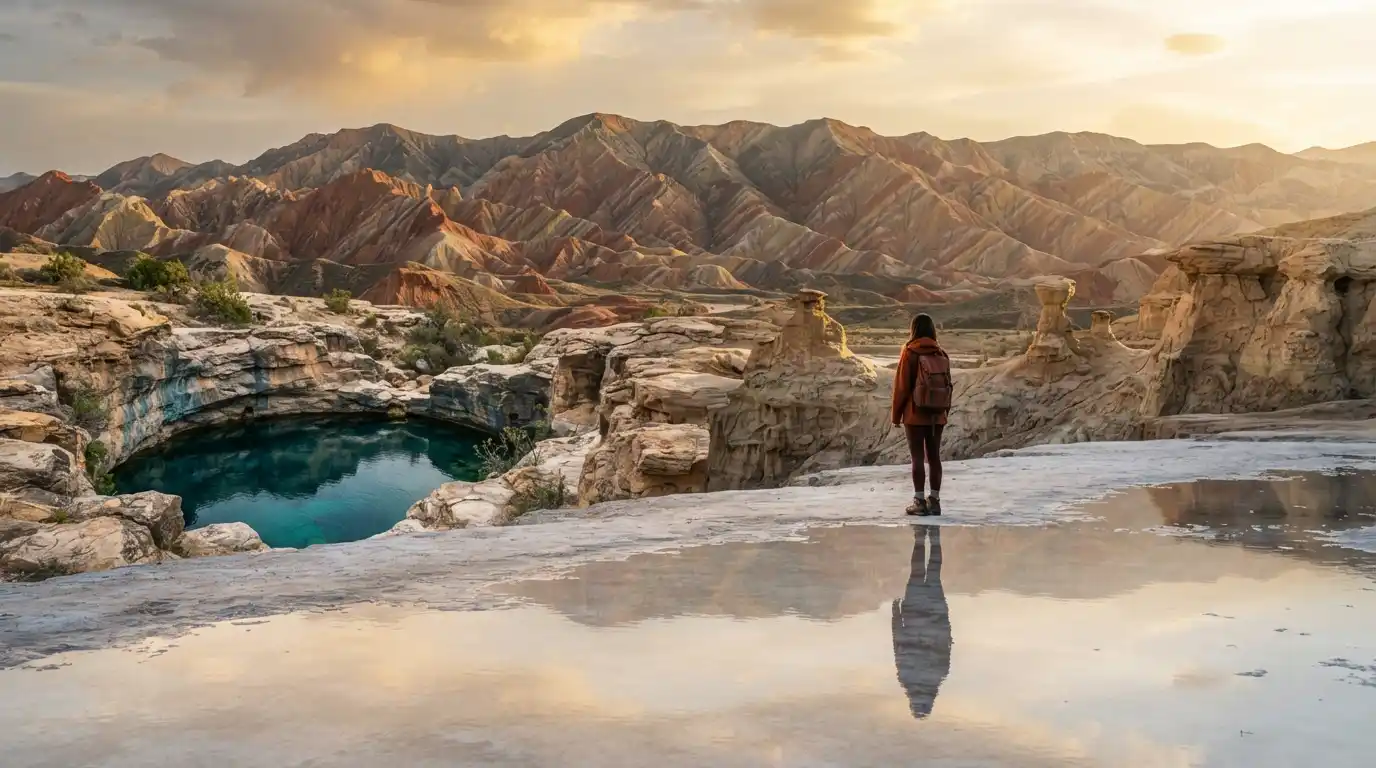
This guide explores 27 surreal places to visit before you die, covering extraordinary landscapes across Asia, Europe, North and South America, Africa, and the Pacific. These destinations are not simply scenic stops; many offer experiences that can become the centerpiece of an unforgettable journey.
If you’re building a travel bucket list, use these destinations as inspiration rather than a strict ranking. Each one offers a different combination of geology, wildlife, culture, adventure, and visual beauty.
1. Zhangye Danxia Landform, China
The Zhangye Danxia Landform in Gansu is famous for its dramatic layers of red, orange, yellow, and brown rock. The striped mountains create a landscape that can look almost digitally painted, especially when sunlight emphasizes the different geological layers.
The colorful formations are the result of long-term geological processes involving sedimentary rocks and mineral deposits. Viewing platforms around the geopark provide opportunities to see the formations from different angles, making this an especially rewarding destination for landscape photography.
2. The Swing at the End of the World, Ecuador
Near Baños, Ecuador, La Casa del Árbol became famous for its dramatic swing overlooking the surrounding mountain landscape. The setting combines a simple wooden treehouse, steep terrain, and expansive Andean views.
The experience is less about a complicated attraction and more about the sensation of being suspended above a vast natural landscape. Travelers visiting Ecuador can also combine Baños with other outdoor destinations for hiking, waterfalls, and volcanic scenery.
3. Great Blue Hole, Belize
Off the coast of Belize, the Great Blue Hole is one of the world’s most recognizable marine landscapes. From above, its deep blue circular shape contrasts sharply with the surrounding turquoise Caribbean waters.
The enormous underwater sinkhole attracts experienced divers interested in exploring its unusual geological formations and marine environment. It is also an impressive destination for travelers who simply want to experience one of the world’s most distinctive natural formations.
4. Tulip Fields, Netherlands
During tulip season, parts of the Dutch countryside transform into enormous bands of color. Rows of flowers stretch across flat agricultural landscapes, producing a geometric pattern that can appear almost unreal from above.
The area around Lisse and the wider bulb-growing region is particularly associated with spring flowers. Visitors should plan around the seasonal bloom because the most dramatic displays are naturally limited to a relatively short period.
5. Hang Son Doong Cave, Vietnam
Hang Son Doong in Vietnam’s Phong Nha-Ke Bang region is famous for its extraordinary scale. Inside the cave are enormous chambers, unusual rock formations, underground passages, and areas where vegetation can grow beneath openings in the cave system.
Exploring Son Doong is a serious adventure rather than a conventional sightseeing excursion. Its remote environment and demanding expedition requirements make preparation an important part of the experience.
6. Hitachi Seaside Park, Japan
Hitachi Seaside Park in Ibaraki is another destination that demonstrates how seasonal landscapes can become surreal. Different flowers dominate different periods of the year, creating expansive fields that can change dramatically with the seasons.
The park is also more than a flower destination. Walking areas, recreational attractions, gardens, and views toward the coast make it suitable for travelers who want a slower experience after exploring busy Japanese cities.
For travelers planning a broader Japanese itinerary, you can also explore our guide to unique places to visit in Japan.
7. Mendenhall Ice Caves, Alaska
The Mendenhall Glacier near Juneau provides a remarkable example of how ice can create temporary interiors that look completely different from ordinary caves. Blue tones, flowing meltwater, and translucent ice can produce an otherworldly atmosphere.
Glacier environments are dynamic, so conditions and accessibility can change. Anyone planning an ice-cave experience should check current conditions and use appropriate local guidance rather than assuming a previously photographed formation will still exist.
8. Mount Roraima, Venezuela, Brazil, and Guyana
Mount Roraima is a massive tabletop mountain rising above the surrounding landscape in the Guiana Highlands. Its flat summit, cliffs, unusual vegetation, and frequent clouds give it an appearance that has inspired countless adventure stories and speculative landscapes.
Reaching the summit requires a serious trekking commitment. The reward is an environment that feels dramatically different from the forests and valleys below.
9. Cappadocia, Turkey
Cappadocia is one of the world’s most recognizable surreal landscapes. Erosion carved the region’s soft volcanic rock into unusual formations commonly known as fairy chimneys, while centuries of human settlement added underground cities, cave dwellings, churches, and other structures.
Hot-air balloons floating above the valleys at sunrise have become an iconic part of the Cappadocia experience. Travelers who prefer staying on the ground can explore valleys, viewpoints, historic sites, and cave architecture.
10. Sea of Stars, Maldives
Some coastlines can appear to sparkle after dark because of bioluminescent marine organisms. The effect can make breaking waves look like scattered points of blue light, creating the famous “Sea of Stars” phenomenon associated with parts of the Maldives.
Because bioluminescence is a natural event rather than a guaranteed attraction, travelers should treat it as a possible experience rather than something that can always be scheduled for a specific night.
11. Victoria Falls, Zambia and Zimbabwe
Victoria Falls is one of Africa’s most spectacular natural landmarks. The Zambezi River drops dramatically into a deep gorge, producing immense volumes of spray and creating a powerful landscape that changes with river levels and seasonal conditions.
Visitors can experience the falls from viewpoints on either side of the border, while the surrounding region also offers opportunities for wildlife viewing and adventure activities.
12. Trolltunga, Norway
Trolltunga, or “Troll’s Tongue,” is a dramatic rock formation extending horizontally above the landscape in Norway. The viewpoint combines steep mountain terrain, distant water, and enormous open skies.
The hike is demanding and conditions can change quickly. Travelers should plan according to the season, daylight, weather, fitness level, and official local guidance.
If Norway is already on your travel list, our guide to scenic destinations can also inspire ideas for combining dramatic natural landscapes with a broader international itinerary.
13. Whitehaven Beach, Australia
Whitehaven Beach in the Whitsunday Islands is famous for its brilliant white silica sand and clear tropical water. The contrast between the pale beach and changing shades of blue creates a landscape that looks almost artificially designed.
Hill Inlet is particularly striking because tides move sand and water through the inlet, creating constantly changing patterns. Boat trips and other island experiences make the region accessible to different types of travelers.
14. Grand Canyon, USA
The Grand Canyon is one of the clearest examples of how geological time can create a landscape that feels almost impossible to comprehend. Vast layers of rock form cliffs, terraces, and deep canyon walls stretching across the Arizona landscape.
The canyon can be experienced from multiple viewpoints, trails, and river-based adventures. Sunrise and sunset can dramatically change the appearance of the rock layers, making repeat visits surprisingly different.
Travelers looking for more American destinations can also explore unique places to visit in North America and our guide to the best places to visit on the West Coast.
15. Marble Caves, Patagonia
On General Carrera Lake in Patagonia, water has gradually shaped marble formations along the shoreline. The resulting caves and tunnels feature swirling mineral patterns that contrast beautifully with the blue water.
Boat trips provide the most direct way to appreciate the formations. Conditions on the lake can influence access, so travelers should build flexibility into their plans.
16. Tunnel of Love, Ukraine
The Tunnel of Love near Kleven is a naturally formed-looking railway corridor surrounded by dense vegetation. Trees and plants arch over the tracks, creating a green passage that has become one of Ukraine’s most photographed unusual landscapes.
The location demonstrates how ordinary infrastructure can become visually extraordinary when nature gradually transforms its surroundings.
17. Salar de Uyuni, Bolivia
Salar de Uyuni is the world’s largest salt flat and one of the most visually distinctive landscapes on Earth. During dry periods, its vast white surface can extend toward the horizon with almost no obvious sense of scale.
When a thin layer of water covers the salt, the surface can reflect the sky and create the famous mirror effect. This combination of enormous scale and minimal visual boundaries makes Salar de Uyuni a favorite destination for landscape photographers.
18. Enchanted Well, Brazil
In Chapada Diamantina, Brazil, natural pools and underground formations create some remarkably atmospheric landscapes. The Enchanted Well, known locally as Poço Encantado, is particularly notable for its clear blue water and unusual underground setting.
Light entering the cavern can create striking visual effects under suitable conditions. The surrounding national park also offers waterfalls, mountains, caves, and hiking opportunities.
19. Antelope Canyon, Arizona
Antelope Canyon is famous for its narrow sandstone passages and flowing rock walls. Over time, water and erosion shaped the sandstone into smooth curves, creating dramatic patterns that change as light moves through the canyon.
The canyon’s photography appeal comes from its combination of texture, shadow, warm rock tones, and narrow openings. Access is managed through guided experiences, so advance planning is important.
Arizona also connects naturally with other American bucket-list destinations, including the mountain destinations around Denver and other landscapes across the western United States.
20. Fingal’s Cave, Scotland
Fingal’s Cave on the uninhabited island of Staffa is famous for its dramatic basalt columns. The geometric formations were created by ancient volcanic activity and form a striking natural structure around the sea cave.
The combination of hexagonal columns, ocean waves, and the cave’s echoing interior gives the site a distinctly atmospheric quality. Weather and sea conditions play an important role in access.
21. To Sua Ocean Trench, Samoa
To Sua Ocean Trench on Upolu Island is a deep natural swimming pool surrounded by lush tropical vegetation. A ladder leads visitors down into the water, creating a dramatic transition from the garden above to the enclosed blue pool below.
The attraction illustrates how volcanic island landscapes can produce hidden environments that feel completely separated from the surrounding coastline.
22. Arashiyama Bamboo Forest, Japan
Arashiyama’s bamboo groves near Kyoto create a completely different kind of surreal experience. Tall bamboo stalks rise closely together, forming a narrow green corridor where the landscape feels unusually quiet and enclosed.
The forest is part of a larger Arashiyama area containing temples, gardens, riverside scenery, and traditional attractions. Visiting earlier in the day can provide a calmer experience, although visitor conditions vary by season.
If you’re planning a first trip to Japan, our guide to places to visit in Tokyo for first-timers provides another starting point.
23. Waitomo Glowworm Caves, New Zealand
New Zealand’s Waitomo region is known for caves illuminated by glowworms. Inside the dark cave environment, thousands of tiny points of light can resemble a star-filled night sky.
The experience is especially distinctive because the “stars” are created by living organisms rather than the night sky. Guided cave tours allow visitors to experience the underground environment while learning about the local geology and ecology.
For more ideas, see our guides to places to visit in New Zealand and New Zealand travel destinations.
24. Haiku Stairs, Oahu, Hawaii
The Haiku Stairs are associated with a steep mountain route on Oahu that became famous for its dramatic views and thousands of steps. The staircase climbs through a lush mountainous environment and has long attracted attention from adventure travelers.
However, access and legal status have changed over time, so travelers should never assume that historic descriptions of the route mean it is currently open to the public. Always verify local access rules before planning a visit.
25. Volcanoes of Kamchatka, Russia
Kamchatka is known for an extraordinary concentration of volcanoes, glaciers, rivers, and remote wilderness. The peninsula’s combination of active volcanic landscapes and relatively undeveloped terrain gives it a distinctly otherworldly character.
Its remoteness is part of the attraction, but it also makes planning more complicated than a conventional city trip. Specialized tours and careful logistical preparation are often necessary.
26. Cenotes of the Yucatán Peninsula, Mexico
The Yucatán Peninsula is home to thousands of cenotes, natural sinkholes connected to underground water systems. Some are open to the sky, while others are partly or completely enclosed by limestone formations.
Clear freshwater, submerged rock formations, and shafts of sunlight can make these natural pools feel like hidden worlds. Different cenotes offer different swimming, snorkeling, and diving experiences.
For another Mexico-focused travel idea, explore our guide on places in Mexico to visit and consider how different regions can fit into a broader itinerary.
27. Kelimutu Crater Lakes, Indonesia
Kelimutu on Flores Island is famous for its three crater lakes, whose colors can change over time because of chemical and geological processes beneath the surface. The contrasting lakes create a striking landscape around the volcanic summit.
The best way to appreciate the scenery is to reach the viewpoints around sunrise, when changing light adds another layer of contrast to the crater landscape. Flores also offers opportunities to explore traditional villages, coastal areas, and other natural attractions.
How to Choose the Right Surreal Destination
With 27 dramatically different destinations, choosing where to go first depends on the kind of experience you want. Some places are suited to adventure travelers, while others are better for photography, nature, culture, or a relaxed escape.
For dramatic landscapes
Consider Zhangye Danxia, the Grand Canyon, Salar de Uyuni, Mount Roraima, or Cappadocia if your priority is scenery that looks unlike everyday surroundings.
For unusual water experiences
The Great Blue Hole, To Sua Ocean Trench, the Yucatán cenotes, Whitehaven Beach, and the Sea of Stars offer very different ways to experience remarkable water environments.
For adventurous travelers
Hang Son Doong, Trolltunga, Mount Roraima, Kamchatka, and selected glacier experiences involve more planning and physical preparation than conventional sightseeing.
For photographers
Zhangye Danxia, Antelope Canyon, Salar de Uyuni, Cappadocia, Whitehaven Beach, and the Marble Caves are particularly compelling because light, texture, color, and landscape scale can dramatically change the appearance of each location.
How to Plan a Bucket-List Trip
A surreal destination can look simple in a photograph while requiring considerable planning in real life. Before booking flights, check the season, accessibility, local transportation, permits, weather, physical requirements, and any restrictions that may apply.
Seasonality is especially important for destinations involving flowers, glaciers, waterfalls, bioluminescence, mountain trails, or weather-sensitive activities. The same destination can offer a completely different experience depending on when you arrive.
It is also worth building additional destinations into your itinerary rather than traveling thousands of miles for a single attraction. For example, a Japan trip can combine unusual natural scenery with major cities, while a North American road trip can connect several landscapes within one broader journey.
Travelers searching for additional destinations can browse our guides to places around the world, global travel destinations, and some of the world’s most interesting places.
Final Thoughts
The most surreal destinations remind us that the planet is far more varied than ordinary travel routines suggest. Rainbow-colored mountains, enormous caves, glowing water, volcanic islands, hidden pools, and ancient geological formations all demonstrate different ways that nature can create landscapes that feel almost imaginary.
You do not need to visit all 27 destinations to build an unforgettable travel life. Instead, choose places that match your interests, travel style, available time, and comfort level. Whether you want a demanding mountain adventure, an unusual underwater experience, a peaceful natural escape, or a landscape that seems made for photography, there is plenty of inspiration here for your next bucket-list journey.



