
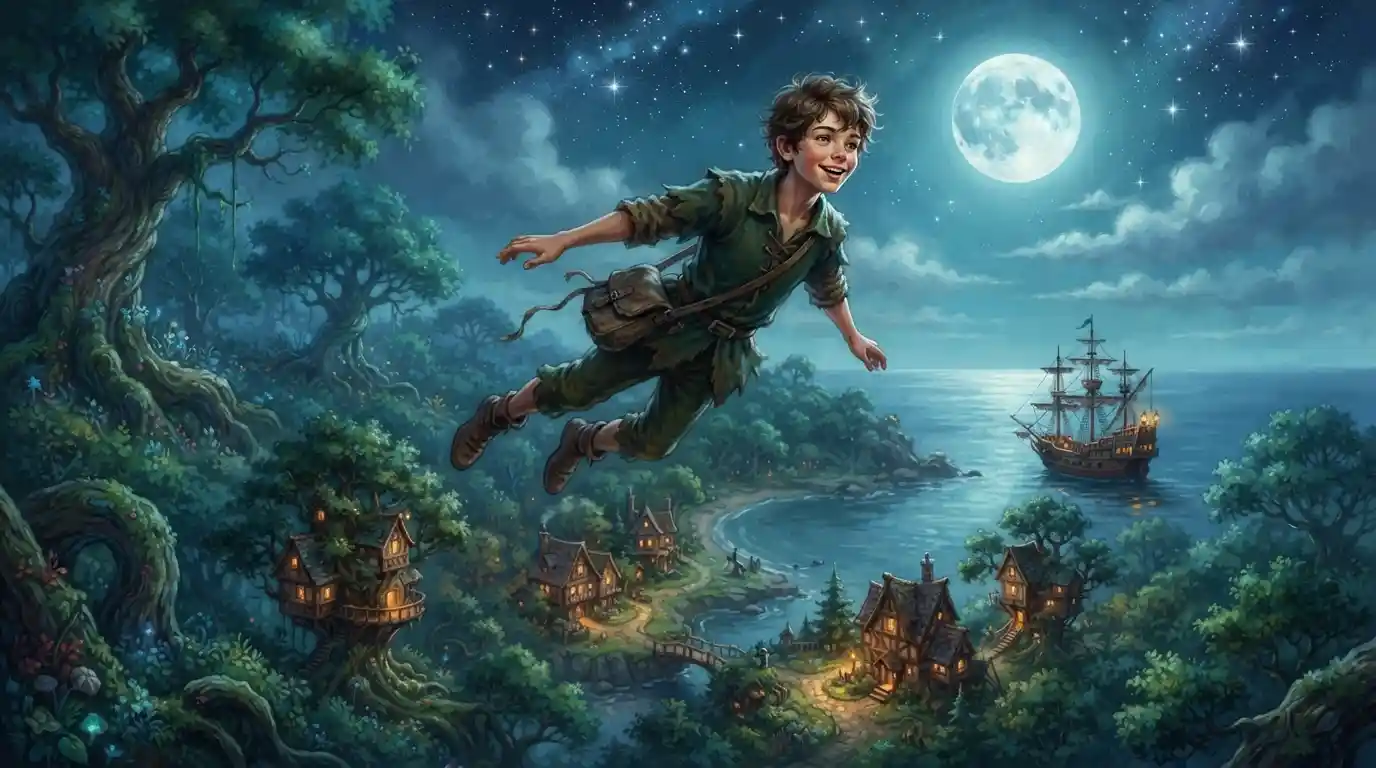
Since J.M. Barrie introduced Peter Pan to audiences in the early twentieth century, Neverland has become a cultural symbol of imagination and escape. The story has inspired stage productions, films, books, merchandise, adaptations, and generations of young readers who see something different in Peter’s adventures each time they return to them.
That lasting influence makes Peter Pan more than a traditional children’s adventure. It is a story about the excitement of childhood, the responsibilities of adulthood, the fear of change, and the importance of keeping imagination alive.
The Origins of Peter Pan
Peter Pan was created by Scottish author and playwright J.M. Barrie. The character first appeared in Barrie’s 1902 novel The Little White Bird before becoming the central figure in the 1904 stage play Peter Pan; or, The Boy Who Wouldn’t Grow Up. Barrie later developed the story into the novel Peter and Wendy, published in 1911.
From the beginning, Peter was presented as an unusual child. He could fly, lived in the fantastical world of Neverland, and had little interest in accepting the responsibilities associated with adulthood.
The story quickly established a combination that continues to make classic entertainment memorable: an imaginative setting, recognizable characters, emotional conflict, and a central idea that audiences can interpret in different ways.
That ability to remain relevant across different forms of entertainment is one reason classic characters continue to attract audiences. Readers interested in how entertainment culture evolves can also explore classic entertainment autographs and the ways memorable entertainment figures become part of popular culture.
What Makes Neverland So Fascinating?
Neverland is one of the most important elements of Peter Pan’s enduring appeal. It is not simply a fictional island filled with unusual creatures and dangerous adventures. It represents freedom from many of the rules that define ordinary life.
Children can imagine Neverland as a place where almost anything is possible. Flying through the night, meeting fairies, exploring unfamiliar territory, facing pirates, and discovering hidden places all become part of the adventure.
At the same time, Neverland is deliberately unpredictable. It contains danger as well as wonder. Captain Hook and his pirates create genuine tension, while the crocodile introduces an ever-present sense of time and mortality.
This mixture of fantasy and danger helps explain why the setting continues to work for both children and adults. Younger audiences can enjoy the adventure, while older readers can interpret Neverland as a metaphor for freedom, nostalgia, or the desire to escape responsibility.
Peter Pan: The Boy Who Refuses to Grow Up
Peter is fascinating precisely because he is not a simple hero. He is brave, adventurous, confident, and imaginative, but he can also be selfish, forgetful, impulsive, and emotionally detached.
His refusal to grow up initially sounds attractive. Who would not want unlimited adventures without homework, bills, schedules, or adult responsibilities? Yet Barrie’s story gradually reveals that permanent childhood has consequences.
Peter can experience excitement without fully understanding the emotional consequences of his actions. His inability to form lasting memories or relationships gives the character a more complicated dimension than the traditional image of a carefree flying boy might suggest.
This is one of the reasons Peter Pan remains interesting for adults. The character encourages readers to ask whether growing up necessarily means losing imagination, or whether maturity can coexist with curiosity and creativity.
Wendy Darling and the Meaning of Growing Up
Wendy provides an important contrast to Peter. She enjoys fantasy and adventure, but she also understands that childhood cannot continue forever.
Her relationship with Peter and her experiences in Neverland create a bridge between childhood imagination and adult responsibility. She can enjoy stories, pretend play, and adventure while still recognizing the importance of family and personal growth.
This makes Wendy particularly important to the story’s larger message. Growing up does not necessarily mean abandoning imagination. Instead, it can mean learning how to carry the best parts of childhood into a more mature stage of life.
The idea of preserving creativity as people mature is also visible throughout modern entertainment. For example, imaginative products and characters continue to attract younger audiences through franchises such as Calico Critters fashion playsets and Kuromi and Sanrio.
Captain Hook: More Than a Traditional Villain
Captain Hook is one of the most recognizable villains in children’s literature. His rivalry with Peter Pan creates much of the story’s tension, but Hook also represents something deeper.
Peter sees life as an endless adventure, while Hook is obsessed with order, reputation, rules, and the passage of time. His fear of the crocodile and its ticking clock reinforces the idea that adulthood is connected with the awareness that time is always moving forward.
Hook therefore becomes more than a character who simply wants to defeat Peter. He represents the anxiety associated with aging and the inability to escape time.
That combination of recognizable characters and memorable conflicts is one of the characteristics shared by enduring entertainment franchises. Readers interested in other examples of recognizable entertainment culture can explore the changing world of AMC Entertainment’s movie lineup and the continuing popularity of major entertainment brands.
The Lost Boys and the Appeal of Belonging
The Lost Boys add another important dimension to the story. They live in Neverland without the conventional structure of a traditional family home, creating their own community around adventure and friendship.
Their experiences highlight a universal desire for belonging. Children often enjoy stories in which groups of friends create their own worlds, establish their own rules, and experience adventures together.
This group dynamic is one reason family entertainment can remain powerful across generations. The audience is not simply watching an individual hero. It is watching a community of characters discover friendship, loyalty, conflict, and cooperation.
Modern entertainment continues to use this formula in different ways, from children’s franchises to live entertainment experiences. The wider world of Ninja entertainment is one example of how adventure and physical activity can be transformed into shared experiences for families and younger audiences.
Why Peter Pan Appeals to Children
For children, Peter Pan offers an immediate fantasy: the ability to fly, explore a magical world, avoid ordinary rules, and experience exciting adventures with friends.
The story gives children permission to imagine a world that operates differently from everyday life. That imaginative freedom is particularly powerful because childhood is naturally associated with exploration and curiosity.
The story also contains clear adventure elements. Pirates create danger, fairies introduce magic, and Neverland provides an environment where unexpected events can happen at almost any moment.
That combination makes Peter Pan particularly suitable for children who enjoy imaginative storytelling and fantasy-based entertainment. It also helps explain why stories centered on beloved characters remain valuable in the broader entertainment and fan-culture landscape.
Why Adults Still Connect With Peter Pan
The adult appeal of Peter Pan is more complicated. Adults may recognize the attraction of Neverland, but they can also see the limitations of Peter’s refusal to mature.
Responsibilities, relationships, careers, family commitments, and the passage of time are unavoidable parts of adult life. Peter’s permanent escape from those realities therefore becomes both attractive and unsettling.
For adults, the story can inspire reflection on questions such as:
- What parts of childhood should we preserve?
- Does growing up require abandoning imagination?
- Can freedom exist alongside responsibility?
- Why do people become nostalgic for childhood?
- What happens when someone refuses to accept change?
These questions give the story greater longevity than a simple children’s adventure. A child may see Peter as an exciting hero, while an adult may see him as a character struggling with the consequences of refusing to change.
Peter Pan and the Fear of Time
Time is one of the story’s most important underlying themes. Peter wants to remain outside the normal process of aging, while Captain Hook is constantly reminded that time cannot be stopped.
The ticking crocodile is particularly effective because it turns an abstract idea into a physical threat. The sound represents something that everyone eventually has to confront: time continues moving forward regardless of whether people are prepared for it.
This theme gives Peter Pan a surprisingly mature emotional layer. The story can be enjoyed as fantasy, but it can also be interpreted as a meditation on change, memory, aging, and mortality.
The Influence of Peter Pan on Modern Storytelling
Peter Pan helped establish storytelling patterns that remain common throughout fantasy and children’s entertainment. Magical worlds, young heroes, secret adventures, extraordinary companions, and journeys away from ordinary life continue to appear in books, movies, television, theater, and games.
The character has also become part of the broader language of popular culture. The phrase “Peter Pan” can be used to describe someone who seems determined to avoid adulthood, while the concept of an imagined world separated from ordinary reality has become a familiar storytelling device.
Modern entertainment continues to build on these traditions. Readers interested in the broader development of entertainment can explore Cedric the Entertainer’s cinematic career, live entertainment experiences, and the continuing role of entertainment culture in shaping audience interests.
From Stage Story to Global Cultural Icon
Peter Pan has appeared in numerous theatrical productions, films, books, adaptations, and merchandise lines. Each generation has found new ways to interpret the characters while maintaining the central ideas of Neverland and the boy who refuses to grow up.
This adaptability is one of the strongest indicators of a successful fictional character. A story does not have to remain unchanged to remain recognizable. Instead, its core ideas can be reinterpreted for different audiences and different forms of media.
The same principle can be seen throughout popular entertainment, where established characters and stories are repeatedly introduced to new generations. From major film releases to collectible memorabilia, entertainment franchises continue to transform stories into cultural experiences.
For readers interested in entertainment collectibles, sports autographs and memorabilia provide another example of how famous cultural figures can maintain relevance long after their original moment has passed.
Peter Pan and Imagination in the Digital Age
Today’s audiences have more entertainment choices than ever. Streaming services, social media, video games, mobile applications, and digital platforms compete for attention throughout the day.
Despite that constant digital stimulation, traditional storytelling remains valuable because imagination does not depend entirely on technology. A strong story can still encourage readers to create mental images, invent possibilities, and explore ideas beyond their immediate surroundings.
That is one reason classic stories continue to find audiences alongside modern forms of entertainment. Even as digital experiences become more sophisticated, the fundamental appeal of entering another world remains unchanged.
Modern entertainment spaces increasingly combine physical and digital experiences. Readers interested in this broader trend can also explore basement entertainment center ideas and how people create personalized spaces for movies, games, and family activities.
What Peter Pan Can Teach Modern Readers
Peter Pan’s most valuable lesson may not be that people should avoid growing up. Instead, the story suggests that maturity and imagination do not have to be opposites.
Growing older brings responsibilities, but it can also bring perspective. Adults can continue to appreciate creativity, storytelling, curiosity, humor, and adventure without pretending that adulthood does not exist.
Peter’s greatest weakness is not that he enjoys childhood. It is that he refuses to accept change. Wendy’s journey offers a different possibility: growing up while preserving the ability to remember, imagine, and appreciate the experiences that shaped her.
That balance remains meaningful today. In a world where work, technology, and daily responsibilities can consume attention, taking time for creativity and meaningful entertainment can provide an important counterbalance.
Peter Pan’s Place in Family Entertainment
Few fictional characters demonstrate as clearly how a story can connect different generations. Parents may remember Peter Pan from their own childhoods and later introduce the character to their children.
That shared experience gives classic stories a unique advantage. They become part of family conversations and traditions rather than existing solely as individual entertainment products.
Family-oriented entertainment continues to evolve, but the ingredients that make Peter Pan successful remain familiar: memorable characters, adventure, humor, imagination, emotional stakes, and a world that feels larger than everyday life.
For readers exploring other forms of family-friendly entertainment, Universal Studios Orlando demonstrates how fictional worlds can be transformed into immersive real-world experiences.
Frequently Asked Questions About Peter Pan
When was Peter Pan created?
Peter Pan first appeared in J.M. Barrie’s 1902 novel The Little White Bird. The character later became the central figure of the 1904 stage play Peter Pan; or, The Boy Who Wouldn’t Grow Up.
What does Peter Pan represent?
Peter Pan represents eternal youth, freedom, imagination, and resistance to adulthood. At a deeper level, the character can also represent the emotional costs of refusing to accept change.
Why is Neverland important?
Neverland represents a world where ordinary rules can be suspended. It allows children to explore freedom and imagination while giving adults an opportunity to reflect on nostalgia, responsibility, and the passage of time.
Who is Captain Hook?
Captain Hook is Peter Pan’s principal antagonist. He represents order, adulthood, fear of time, and the consequences of being unable to escape the realities of aging.
Why does Peter Pan remain popular?
Peter Pan remains popular because the story combines adventure with universal themes. Children can enjoy the fantasy, while adults can find deeper ideas about childhood, responsibility, memory, change, and time.
Why Peter Pan Still Matters
Peter Pan has survived for generations because the story speaks to something deeply human. Almost everyone understands the appeal of childhood freedom, the excitement of imagination, and the desire to escape responsibility for a while.
Yet the story also reminds readers that growing up is unavoidable. The goal is not necessarily to remain a child forever, but to carry curiosity, creativity, and a sense of wonder into adulthood.
That balance explains why Peter Pan continues to inspire books, theater, movies, merchandise, family entertainment, and new interpretations. The story may have begun in the early twentieth century, but its central questions remain remarkably current.
Neverland may be fictional, but the desire to visit it is real. For every generation, Peter Pan offers another invitation to imagine, explore, and remember that growing older does not have to mean forgetting how to dream.
Conclusion
Peter Pan remains a timeless adventure because it combines fantasy with a deeper reflection on childhood, adulthood, imagination, and the passage of time. Its characters and themes continue to resonate because every generation can discover something different in Neverland. While we cannot remain children forever, Peter Pan reminds us that imagination, curiosity, and wonder can remain part of who we are at every age.