
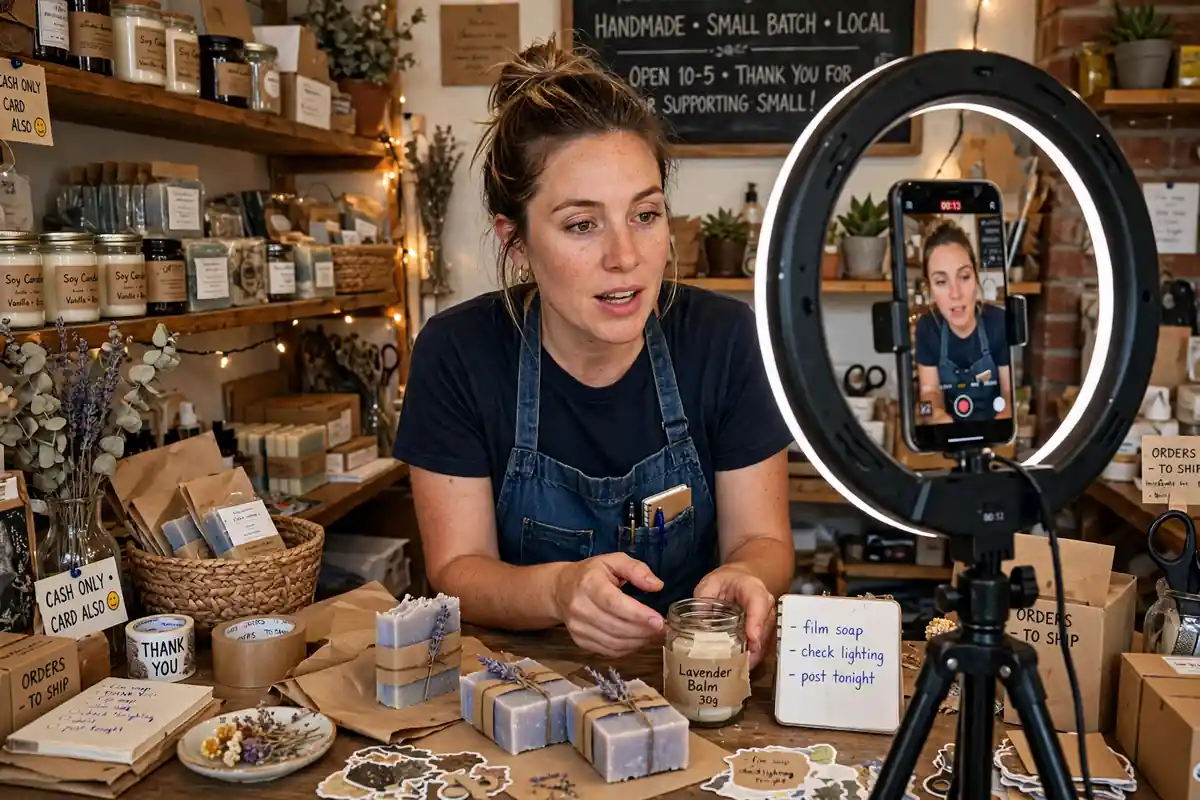
Big brands post daily with full creative teams. You have a business to run and maybe an hour a week. The good news is that social media marketing small budget strategies do not require matching their volume; they require choosing the right platform, posting content your customers genuinely value, and spending small amounts of money only where it clearly pays. This guide lays out a realistic starting plan for owners who need social media to produce customers, not just likes.
Start With One Platform, Not Five
The most common beginner mistake is opening accounts everywhere and feeding none of them. Pick the single platform where your customers already spend time. Local services and restaurants usually find them on Facebook and Instagram. Business-to-business services do better on LinkedIn. Younger consumer audiences live on TikTok and Instagram. Trades and home services earn surprising returns from Facebook community groups and Nextdoor-style local networks.
One platform, posted to consistently, beats five abandoned profiles in every way: the algorithm learns your audience, you learn what content works, and customers see a living business. This focused start is a recurring theme in any sensible digital marketing strategy for small business, because limited resources punish scattered effort.
What to Post When You Have No Content Team
Your workday is already full of content; you just have to capture it. Photograph jobs before, during, and after. Film thirty-second answers to questions customers ask weekly. Introduce team members, celebrate customer wins with permission, share honest behind-the-scenes moments, and explain how to choose a provider in your industry, including when the answer is not you.
Repurpose ruthlessly. One job-site video becomes a post, a story, an email snippet, and a website testimonial. The lean operations profiled in digital marketing and small business excellence treat content as a byproduct of doing good work and documenting it, which is exactly how a one-person marketing department survives.
A Realistic Weekly Rhythm
Aim for three posts a week: one educational, one proof or story, and one offer or invitation. Batch the work into one or two sessions, use your platform’s scheduler, and spend ten minutes a day replying to comments and messages. That daily engagement matters more than production polish, because conversations are where followers turn into customers.
Consistency over months is what compounds. Wildly successful small accounts usually are not viral; they are simply present, helpful, and recognizable week after week. Many owners running lean operations, including the ventures in our side hustle ideas collection, built their first real customer base on exactly this rhythm before spending anything on ads.
Spending Your Social Media Marketing Small Budget Wisely
When you do spend, spend behind proof. Boost or advertise the posts that already performed well organically, targeted tightly to your service area and customer profile. Small daily budgets tested against one clear goal, such as messages, calls, or email signups, teach you quickly what works. Spending to promote weak content to a broad audience is the fastest way to conclude that social media does not work.
Treat early ad spend as tuition with a cap you set in advance, inside the same discipline used for launch costs in our guide to startup costs. Track every inquiry’s source by simply asking new customers how they found you, then compare against the returns framework in our ROI of digital marketing guide. When a post or small campaign reliably produces customers below your target cost, that is where the next dollars go.
Free Reach: Groups, Partnerships, and Customers
Some of the best small-budget reach is borrowed. Participate helpfully in local Facebook groups without spamming, and answer questions as the resident expert. Partner with complementary businesses to feature each other: the florist and the wedding venue, the gym and the meal-prep service. Feature real customers, with permission, and tag them; their networks see authentic proof no ad can buy.
Encourage user content with a simple branded hashtag and by resharing customer photos. Distributed teams and solo operators alike use these tactics, as described in our guide to mastering digital marketing in the remote economy, because community reach scales without scaling payroll.
Measuring What Matters on a Budget
Ignore follower counts as a goal. Watch reach among local accounts, profile visits, link clicks, messages, calls, and, above all, attributed customers and revenue. A three-hundred-follower account that books five jobs a month beats a ten-thousand-follower account that entertains strangers in other states.
Review monthly, kill what consistently flops, and double down on the two or three content types your audience rewards. Growing firms systematize this review early; it is one of the habits separating the operators in digital marketing strategies for high-growth firms from everyone else. If you sell products, connect social content to your store’s best sellers, the way an ecommerce business in the USA aligns posts with the items that actually move.
When to Expand Beyond One Platform
Expand only when the first platform runs on a sustainable rhythm and produces measurable business. Then clone what works: your best content usually adapts to a second platform with minor changes. Many businesses find that a simple website, an email list, and one strong social channel outperform a sprawling presence for years.
Think of social as one leg of a stable stool, alongside search visibility and an owned audience. The journey usually starts with the fundamentals in our guide to how to become an entrepreneur, and matures into the multi-market thinking in our global digital marketing strategy overview. Protect the budget that funds it by keeping the books clean, as our guide to small business cash flow insists, and your social media marketing small budget plan becomes a growth asset instead of a guilt item on your to-do list.
Content Ideas That Work in Almost Any Industry
When the idea well runs dry, return to these proven categories. Answer one common question on camera every week; customers search and scroll with problems in mind, and the business that answers becomes the business they trust. Show transformations: the yard, the kitchen, the haircut, the repaired engine, before and after. Introduce the humans: a thirty-second clip of a team member saying what they love about the work outperforms most polished graphics, because people buy from people.
Add seasonal and local hooks. Comment helpfully on community events, school schedules, weather, and local sports, always tying back to how they affect your customers. Share mistakes and lessons occasionally; a post about what you would do differently earns unusual trust. And once a month, ask a direct question and genuinely discuss the answers. Every reply trains the algorithm to show your next post to that person, which quietly builds a loyal local audience around your business.
The Mistakes That Waste Small Budgets
The first is promoting everything to everyone. Untargeted boosting burns money reaching people outside your service area who can never buy. The second is judging by likes: a funny meme can earn hundreds of reactions and zero customers, while a plain post about a real job earns three comments and two bookings. The third is disappearing. Accounts that post daily for two weeks and then vanish for two months train both the algorithm and the audience to forget them.
Finally, avoid buying followers or joining engagement pods. Inflated numbers poison your targeting data, make real performance impossible to read, and can violate platform rules. Slow, honest growth from your actual community is not the consolation prize; for a local business it is the entire point. Keep the audience real and every dollar and hour you spend later works harder.
Treat your first ninety days as research you get paid for in knowledge. Note which posts earned saves and shares, which questions repeat in comments, and which offers made the phone ring. By the end of the quarter you will know your audience better than competitors who spent ten times more guessing. That knowledge directs everything you do next, from the services you promote to the stories you tell, and it costs almost nothing beyond consistency.
Start small, stay consistent, and let real results, not vanity metrics, decide where your next hour and dollar go.
Frequently Asked Questions
How much should a small business spend on social media ads?
Start with an amount you can afford to learn with, often a few dollars a day behind your best-performing posts, tightly targeted. Increase only when a campaign reliably produces customers at a cost that leaves profit.
How often should I post?
Three quality posts a week is a strong, sustainable target for most small businesses. Consistency over months matters far more than daily posting that collapses after a few weeks.
Do I need to be on TikTok?
Only if your customers are there and you can sustain short video. For many local and B2B businesses, Facebook, Instagram, or LinkedIn deliver better returns for the same effort.
Should I hire someone or do it myself?
Start yourself to learn what your audience responds to. Once the channel produces revenue and your time becomes the bottleneck, hire help for execution while keeping your voice and customer knowledge in the content.