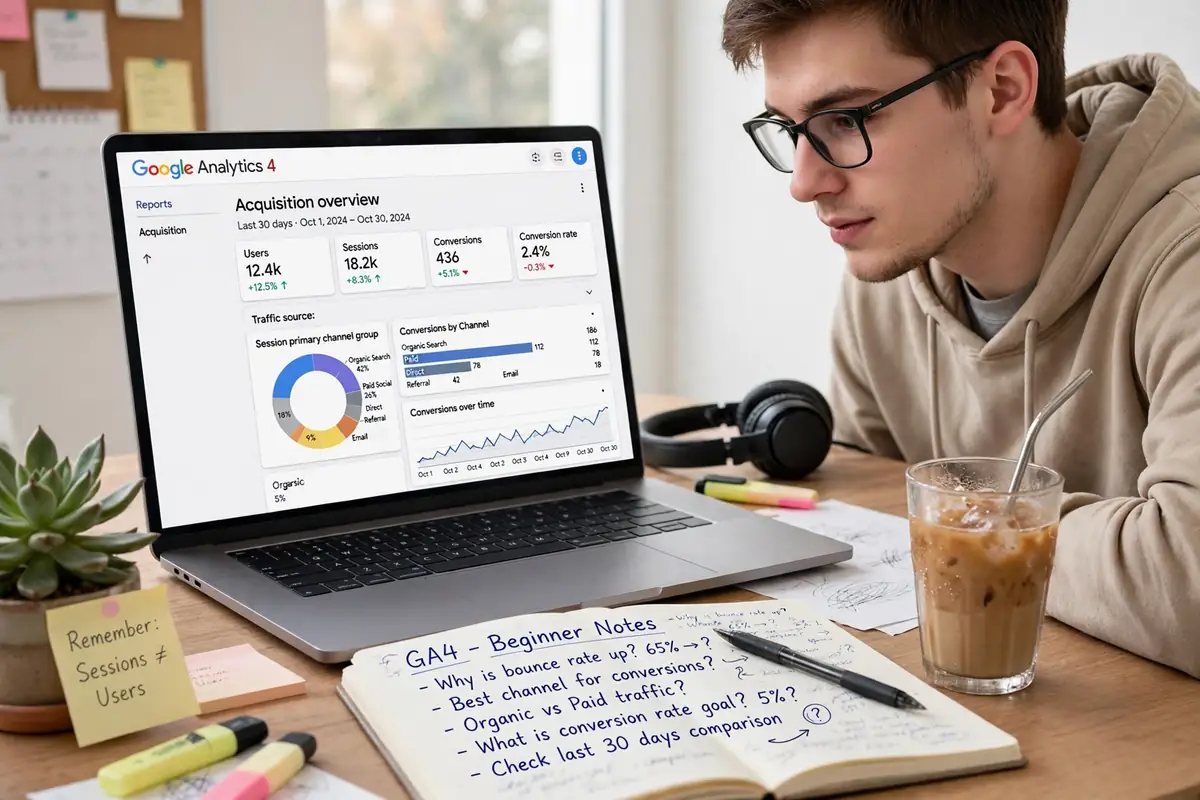

Traffic is only half the battle. If a thousand people visit your website and only five buy, your problem is not traffic; it is conversion. Your conversion rate is the percentage of visitors who take the action you want, whether that is buying, booking, or signing up. Learning how to improve conversion rate with simple, honest fixes is often the fastest way to grow revenue without spending another dollar on ads.
This guide walks through the fixes that matter most, from headline clarity and page speed to trust signals and checkout friction, in the order a busy owner should tackle them.
First, Know Your Conversion Rate Numbers
You cannot improve what you do not measure. Find your current conversion rate for your most important action: total conversions divided by total visitors, multiplied by 100. Then break it down by page and traffic source. The product page shared by most of your ads may convert very differently from your homepage.
This baseline work is basic data-driven digital marketing, and it takes under an hour. Every fix below should be judged against these numbers, not against opinions or guesses.
Fix 1: Make Your Headline Say What You Do
Visitors decide in seconds whether a page is for them. Your headline should state, in plain words, what you offer, who it is for, and the main benefit. Clever slogans fail this test constantly. “Fresh-roasted coffee delivered weekly, roasted the day it ships” converts; “Awaken your senses” does not.
Test your headline by reading it to someone outside your business. If they cannot repeat what you sell, rewrite it. Clarity is the cheapest conversion fix there is, and it anchors every serious digital marketing strategy for a small business.
Fix 2: Speed Up Your Pages
Slow pages leak buyers at every step. Compress large images, remove plugins and scripts you no longer use, and choose decent hosting. Then test your key pages on a phone over a normal connection, not office Wi-Fi. If you feel impatient, so do your customers.
Speed work is unglamorous but compounding: every second saved lifts conversions across all your traffic, forever. Businesses deep into digital transformation of their business services usually start here, because it improves every campaign at once.
Fix 3: One Page, One Goal
Pages that ask visitors to buy, subscribe, download, and follow all at once usually achieve none of it. Give each key page a single primary action, make that action visually dominant, and let everything else quietly support it. Secondary options can exist, but they should never compete in size, color, or placement.
This focus is the same principle behind high-performing landing pages and the playbooks used by high-growth advertising firms: remove choices that do not serve the goal, and the right choice gets easier.
Fix 4: Make Your Call to Action Impossible to Miss
Your main button should stand out in a contrasting color, use action words that describe the outcome, and appear early, often, and at natural decision points. “Get My Free Quote” outperforms “Submit” because it reminds the visitor what they gain. On mobile, keep the button reachable by thumb and consider a sticky button on long product pages.
Also, reduce the risk around the button: a short line beneath it, such as “Free shipping over $50 · 30-day returns,” answers the hesitation happening at that exact moment.
Fix 5: Add Trust Signals Where Doubt Happens
Strangers do not trust you yet, and that is fine; your job is to earn trust at the moment of doubt. Place reviews and testimonials near prices and buy buttons. Show real photos of your team, store, or work where relevant. Display guarantees, secure checkout notes, and clear contact information.
Even small signals help: a phone number in the header, a real address, and recently dated reviews all say “a real business stands behind this.” Trust-building of this kind is a recurring theme in small business excellence through digital marketing, because it lifts every metric downstream.
Fix 6: Answer Objections Right on the Page
Every product or service has three or four predictable objections: price worries, fit or compatibility questions, delivery timing, and “what if it does not work for me?” Answer them on the page, in plain sight, with an FAQ section and honest detail in your descriptions.
Think of your page as your best salesperson on their best day. If a question comes up in emails and calls every week, it belongs on the page. Sites that sell products benefit doubly, since clear pages also reduce returns; the same discipline shows up in any careful step-by-step guide to starting an ecommerce business.
Fix 7: Simplify Forms and Checkout
Every field you add costs conversions. Ask only for what you need to complete the transaction or deliver the service. Offer guest checkout, show all costs early including shipping and taxes, and support the payment methods your customers expect.
Progress indicators on multi-step checkouts reduce abandonment because people can see the finish line. And when someone does abandon, a polite reminder email or text can recover a meaningful share of those sales; this kind of follow-up is where marketing automation proves its value for product businesses and service firms alike.
Fix 8: Match the Page to the Promise
When an ad promises “same-week roof repair in Denver,” the landing page must say exactly that, immediately. Message mismatch is a silent conversion killer: visitors feel misled and leave before reading anything. Review every major traffic source and confirm the page it lands on keeps the promise that earned the click.
Fix 9: Test One Change at a Time
Guessing which fix will work is a waste of your traffic. Run simple A/B tests: half your visitors see the current page, half see one change. Test big things first: headline, main image, offer, and CTA. Small businesses often find their biggest win in an unexpected place, which is why analysts who study the value of digital advertising assets insist on measured experiments over opinions.
Give each test enough visitors to trust the result, keep the winner, and move to the next idea. A simple testing log, with dates and outcomes, becomes one of the most valuable documents in your business.
Fix 10: Watch Real People Use Your Site
Numbers tell you where visitors struggle; watching tells you why. Ask a friend who has never seen your site to complete a purchase or booking while you stay silent. Note every hesitation and confusion. Session-recording tools can show the same patterns at scale, including rage clicks on elements that look clickable but are not.
Five watched sessions will usually reveal your top three conversion problems more clearly than a month of reports. Fix those first. This humble, practical habit separates improving businesses from stagnant ones across every market, including those examined in digital marketing ROI studies for Toronto and other competitive cities.
Special Notes for Service Businesses
Service companies convert visitors into calls, bookings, and quote requests rather than cart checkouts, so their fixes have a slightly different flavor. Make your phone number prominent and tappable on mobile. Put a short quote form on every service page, not just the contact page, and ask only for name, contact detail, and a one-line description of the job. Response speed is itself a conversion feature: state plainly how fast you reply, then actually beat that promise.
Proof matters even more when the product is you. Photos of finished work, named reviews from real neighborhoods, and clear licensing or insurance details all answer the visitor’s silent question: “Can I trust these people in my home or with my problem?” Pages that answer it win the call; pages that hide behind stock photos lose it. This local trust equation appears in market after market, from the global picture of digital marketing strategy down to a single plumber’s service page.
Finally, make booking the path of least resistance. Online scheduling, clear service areas, and honest “what happens next” steps remove the friction that sends ready buyers to the next company on the results page.
Frequently Asked Questions
What is a good website conversion rate?
It depends on your industry, offer, and traffic source, so be careful with universal benchmarks. A rate that improves steadily quarter over quarter is a healthy rate. Judge yourself against your own baseline first.
Which fix should I do first?
Start with clarity and speed: a headline that says what you do, and pages that load quickly on phones. Then remove friction from your main form or checkout. These three changes help almost every site.
How long does it take to see results?
Some fixes, like a clearer headline or a simplified checkout, can lift conversions within days. Testing takes longer because you need enough visitors to trust the numbers. Expect a meaningful picture within one to two months of steady work, a timeline familiar to anyone mastering digital marketing in the remote economy.
The Bottom Line
Improving your conversion rate is mostly about removing friction and doubt: say clearly what you offer, load fast, ask for one action, prove you can be trusted, answer objections, and simplify the path to yes. Then test, measure, and repeat. Do this consistently and the traffic you already have becomes far more valuable, which is the closest thing to free growth a business can find.