
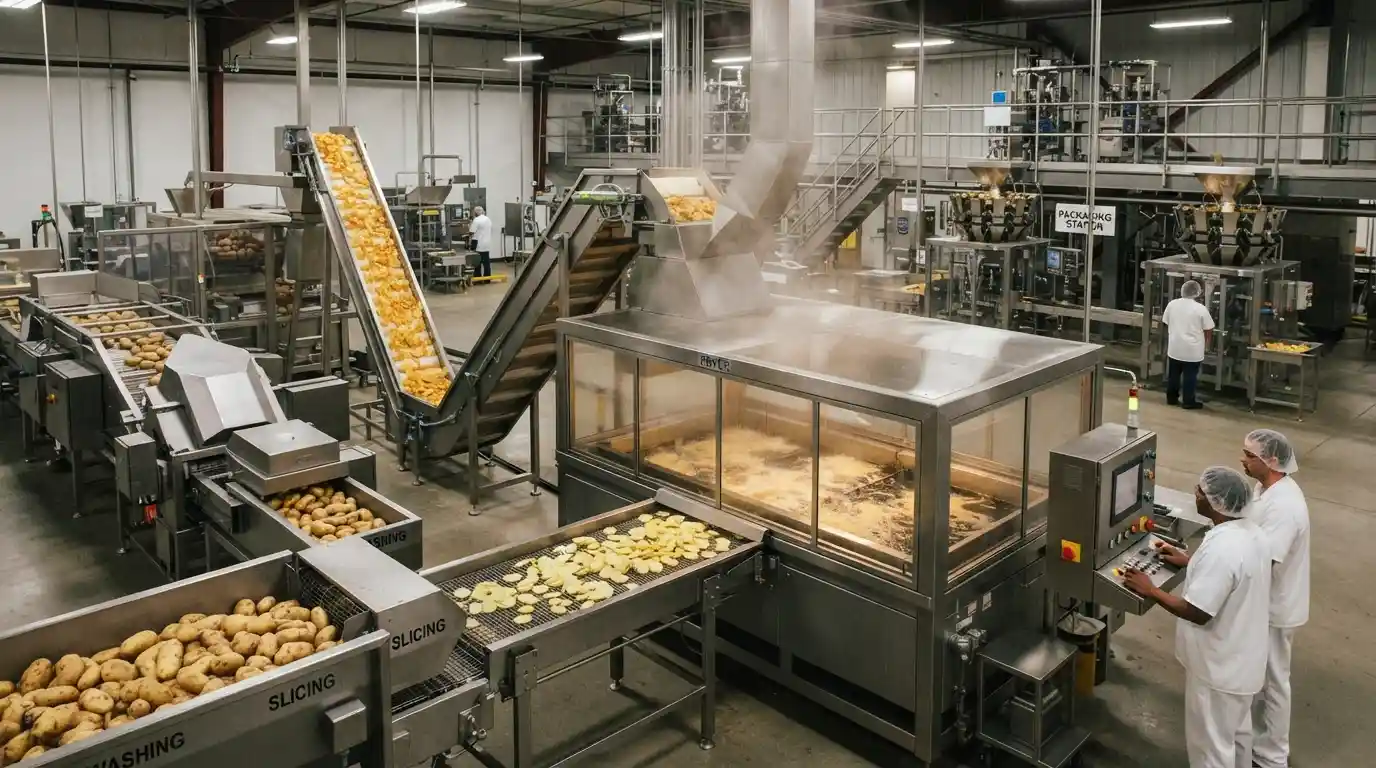
The biggest lesson is that the price of a potato chips machine should never be considered in isolation. Production capacity, automation, frying technology, potato preparation, oil management, seasoning, packaging, utilities, installation, factory requirements, maintenance, and labor can all change the total investment.
If you are researching food manufacturing opportunities, it also helps to understand the wider production environment. Articles about food ingredients and production quality, changing food trends, and commercial food products can provide useful context when thinking about what consumers actually buy.
Why the Price of a Potato Chips Machine Can Be Misleading
The first quotation I would now question is the one that simply says “potato chips machine” followed by a single price. A commercial production system is usually a collection of machines working together rather than one standalone unit.
A typical production workflow can include washing, peeling, slicing, blanching, drying or dewatering, frying, oil removal, seasoning, cooling, conveying, weighing, packaging, and inspection. The more stages that are automated and integrated, the more the overall project can cost.
Two machines can therefore have similar advertised capacities while having very different specifications. One may require workers to move products manually between stages, while another may use conveyors, automatic controls, oil filtration, temperature management, and integrated packaging.
What I Would Check Before Looking at the Price
Before comparing suppliers, I would define the production target. A buyer should know approximately how much finished product is expected per hour and how many hours the factory will operate each day.
Capacity affects almost everything else. A small operation serving local retailers has very different equipment requirements from a manufacturer supplying supermarkets, distributors, restaurants, or export markets.
For a new business, starting with the largest possible machine can create unnecessary financial pressure. A smaller line can provide a more manageable entry point if demand has not yet been proven. On the other hand, buying equipment that is too small can create bottlenecks when orders increase.
Small, Medium, and Large Production Systems
Potato chips production equipment generally falls into different capacity and automation categories. The exact capacity of each machine depends on its design, raw material conditions, product specifications, and operating method.
Small-Scale Production
Small-scale systems are generally designed for startups, local snack producers, restaurants, specialty food businesses, and regional brands. They may rely more heavily on manual labor and batch processing.
The attraction is a lower initial equipment requirement. The trade-off is that labor involvement can be higher and production may be less consistent than with an automated continuous line.
Medium-Scale Production
A medium-scale system can make sense when a business has established local demand and needs greater consistency. Automated conveyors, improved frying systems, seasoning equipment, and semi-automatic or automatic packaging can become important at this stage.
The objective is not simply to produce more chips. It is to produce them consistently while controlling labor, waste, energy consumption, oil usage, and packaging costs.
Large-Scale Production
Large factories require much more than a high-capacity fryer. They may need automated material handling, continuous frying, sophisticated oil management, seasoning systems, quality inspection, high-speed packaging, utilities, storage, drainage, ventilation, and production controls.
At this scale, the equipment quotation is only one part of the investment decision.
The Main Equipment in a Potato Chips Production Line
Understanding what you are actually buying makes machine quotations much easier to compare.
1. Potato Washing System
Washing equipment removes soil and other unwanted material from incoming potatoes. The design and capacity should match the intended production rate.
2. Peeling Equipment
Peeling can be performed using different approaches depending on the production scale and machine configuration. The objective is to achieve consistent preparation while minimizing unnecessary potato loss.
3. Slicing Machine
Slicing is one of the most important quality-control stages. Consistent thickness helps produce more uniform frying results. Poor slicing consistency can lead to a mixture of undercooked and overcooked pieces.
4. Blanching and Preparation
Depending on the production process, blanching and related preparation stages can help manage starch and improve consistency before frying.
5. Dewatering System
Removing excess surface moisture before frying is another important part of the process. The exact system depends on the line design and production requirements.
6. Frying System
The fryer is often one of the most important components in the entire production line. Temperature control, oil circulation, filtration, heating method, throughput, and cleaning requirements can all affect both equipment cost and ongoing operating expenses.
A cheap fryer that provides inconsistent temperature control can create quality problems that cost much more than the initial equipment saving.
7. Oil Management
Oil is a recurring production expense, so filtration and oil-management capabilities deserve careful attention. The goal is to maintain product quality while controlling unnecessary oil consumption and waste.
8. Seasoning Equipment
Seasoning systems distribute flavors across the finished chips. Businesses producing several flavors should also consider how quickly and easily the system can be cleaned and changed between products.
9. Cooling and Conveying
After frying and seasoning, chips need to reach an appropriate condition before packaging. Conveyors can connect production stages and reduce unnecessary manual handling.
10. Packaging Machine
Packaging is not simply the final step. It directly affects product presentation, protection, shelf life, labor requirements, and production speed.
Depending on the business model, packaging equipment may include weighing systems, bag forming, filling, sealing, coding, inspection, and optional gas flushing.
Automation Can Change the Investment Dramatically
Automation is one of the biggest reasons two potato chips production lines with similar advertised capacities can have very different prices.
A semi-automatic system may require workers to feed materials, transfer products, monitor processes, perform quality checks, and package finished goods. A more automated line can connect several stages and reduce manual intervention.
Automation therefore needs to be evaluated as a long-term operating decision rather than simply as an expensive feature.
A higher upfront equipment cost may make sense if it significantly reduces repetitive labor and improves production consistency. However, automation that is unnecessary for a small operation can increase complexity without providing a meaningful commercial benefit.
The Factory Costs People Often Forget
One of the easiest mistakes is to budget only for the machine itself.
A commercial potato chips operation can also require:
- Factory or production space
- Electrical infrastructure
- Water supply
- Drainage
- Heating or fuel infrastructure
- Ventilation and exhaust systems
- Storage areas
- Packaging storage
- Finished-product storage
- Installation and commissioning
- Transportation and logistics
- Maintenance equipment and spare parts
- Quality-control facilities
- Waste-management systems
These costs can turn an apparently affordable machine purchase into a much larger project.
Installation and Transportation Matter Too
When comparing suppliers, I would always ask whether the quotation covers transportation, installation, commissioning, operator training, and testing.
A machine can have an attractive factory price but become considerably more expensive after freight, customs-related expenses, local transportation, installation, and additional components are included.
The same principle applies to imported equipment. Before placing an order, the buyer should understand exactly where the machine will be delivered and what services are included after arrival.
Energy Consumption Is Part of the Real Cost
Equipment cost is a capital expense, but electricity, gas, water, oil, labor, packaging, and maintenance become recurring expenses.
Frying can be particularly important because heating requirements can have a substantial effect on operating costs. When evaluating different machines, ask suppliers for realistic utility requirements at the intended production capacity rather than looking only at the purchase price.
A machine that costs less initially but consumes considerably more energy can produce a different financial result over several years.
Labor Should Be Included in the Calculation
Labor requirements depend heavily on automation. A small batch line may require several people to move and monitor products, while an integrated automated line can reduce the amount of manual handling.
That does not mean an automated line eliminates labor. Operators are still needed for monitoring, quality control, sanitation, maintenance, packaging supervision, inventory handling, and other production responsibilities.
The useful calculation is therefore not simply “machine price versus labor.” It is the total cost of ownership over the expected operating period.
Packaging Can Become a Major Expense
Packaging is sometimes treated as an afterthought, but it can strongly influence the economics of a snack business.
Retail packaging needs to protect the product from moisture, contamination, crushing, and other quality problems. At the same time, the package needs to communicate the brand effectively on a retail shelf or online marketplace.
If you are developing a consumer food brand, understanding wider small-business marketing strategies can be useful because production is only one part of the commercial equation.
Don’t Compare Machines Using Capacity Alone
Capacity is important, but the definition of capacity needs to be clear.
Ask whether the supplier’s quoted number refers to raw potato input, sliced potato input, fryer throughput, or finished chips output. These measurements are not interchangeable.
A supplier should also explain the operating conditions under which the advertised capacity is achieved. Product specifications, potato characteristics, moisture content, slice thickness, frying conditions, downtime, and packaging speed can all affect actual output.
Questions I Would Ask Every Machine Supplier
Before comparing quotations, I would create a standard checklist and send the same questions to every supplier.
- What is the finished-product capacity per hour?
- How is the quoted capacity measured?
- What equipment is included in the quotation?
- Which components are optional?
- What are the total electrical requirements?
- What heating or fuel source does the fryer require?
- How much factory space is required?
- How many operators are recommended?
- What packaging equipment is included?
- Is oil filtration included?
- What material are the food-contact components made from?
- What spare parts are included?
- How long is the warranty?
- Is installation included?
- Is operator training included?
- What after-sales support is available?
- What is the expected production lead time?
- What maintenance schedule is recommended?
Local Versus Imported Equipment
There is no universal answer when choosing between locally manufactured and imported machinery. The right choice depends on budget, technical requirements, availability of parts, production scale, and after-sales support.
Local equipment can sometimes provide easier access to technicians and spare parts. Imported systems may offer different levels of automation or specialized processing technology.
The important point is to compare complete specifications rather than comparing countries of origin or headline prices.
The Cost of Maintenance Should Be Part of the Decision
A production line is a working asset, not a one-time purchase that can be ignored after installation.
Belts, bearings, heating components, electrical controls, pumps, cutting components, seals, sensors, and other parts can eventually require inspection or replacement. Downtime can also become expensive when production is dependent on a single critical component.
Ask suppliers about commonly replaced parts and their availability before purchasing. A slightly more expensive machine may be easier to maintain if critical components are readily available.
How to Think About the True Cost
The true cost of a potato chips manufacturing machine is better understood as a complete project rather than a machine invoice.
A practical calculation should consider:
- Equipment purchase price
- Transportation
- Installation
- Factory preparation
- Electrical and utility infrastructure
- Packaging equipment
- Initial raw materials
- Packaging materials
- Labor
- Energy
- Maintenance
- Spare parts
- Quality control
- Marketing and distribution
- Working capital
This broader calculation provides a much more realistic picture of what it takes to move from buying equipment to actually selling potato chips.
Production Is Only Half the Business
A modern food manufacturing business also needs customers, distribution, branding, and visibility. Producing excellent chips does not automatically create demand.
Businesses planning to sell directly online may benefit from understanding digital marketing strategy, while companies building a broader commercial operation can explore digital business transformation and data-driven revenue strategies.
Marketing expenses should therefore be considered alongside manufacturing costs rather than treated as something to worry about after the factory is operational.
What I Would Do Before Buying
If I were starting the process again, I would begin with the market rather than the machine.
First, I would estimate realistic sales volume. Then I would determine the required production capacity. After that, I would create a product specification, decide on packaging formats, calculate utility requirements, and request comparable quotations from multiple suppliers.
I would also calculate the expected cost per kilogram or per package under realistic operating conditions. That figure is much more useful than simply knowing the purchase price of the production line.
For businesses evaluating broader commercial opportunities, resources covering digital transformation in business services, digital marketing ROI, and business valuation considerations can also help put the investment into a larger business-planning context.
Final Takeaway
The biggest lesson is simple: the price printed on a potato chips manufacturing machine quotation is not necessarily the amount you will need to spend to build a functioning production business.
Capacity, automation, frying technology, oil management, packaging, utilities, factory preparation, installation, labor, maintenance, and working capital all influence the final economics.
Instead of asking only, “How much does a potato chips machine cost?” ask, “How much will it cost to produce my target quantity of saleable chips consistently?”
That question changes the entire buying process. It encourages you to compare complete production systems, understand recurring expenses, identify hidden costs, and choose equipment that matches actual demand rather than simply selecting the cheapest quotation.
Frequently Asked Questions
How much does a potato chips manufacturing machine cost?
There is no single price because equipment varies significantly by production capacity, automation, frying system, packaging configuration, materials, and customization. A small semi-automatic setup can cost far less than a fully integrated industrial production line.
What is the most expensive part of a potato chips production line?
The frying system and integrated processing equipment can represent a significant portion of the investment, particularly in larger continuous-production systems. Packaging and automation can also substantially increase the project cost.
Is a fully automatic potato chips machine worth the investment?
It depends on production volume, labor costs, available capital, and expected demand. Automation can reduce manual handling and improve consistency, but it also increases the initial investment and technical complexity.
What should I ask a potato chips machine supplier?
Ask about finished capacity, included equipment, utility consumption, factory-space requirements, labor requirements, installation, warranty, spare parts, maintenance, training, packaging integration, and after-sales support.
Should a new business buy a large potato chips production line?
Not necessarily. Capacity should be based on realistic demand, available working capital, distribution plans, raw-material supply, and future expansion. Buying more capacity than the market can support can create unnecessary financial pressure.



