
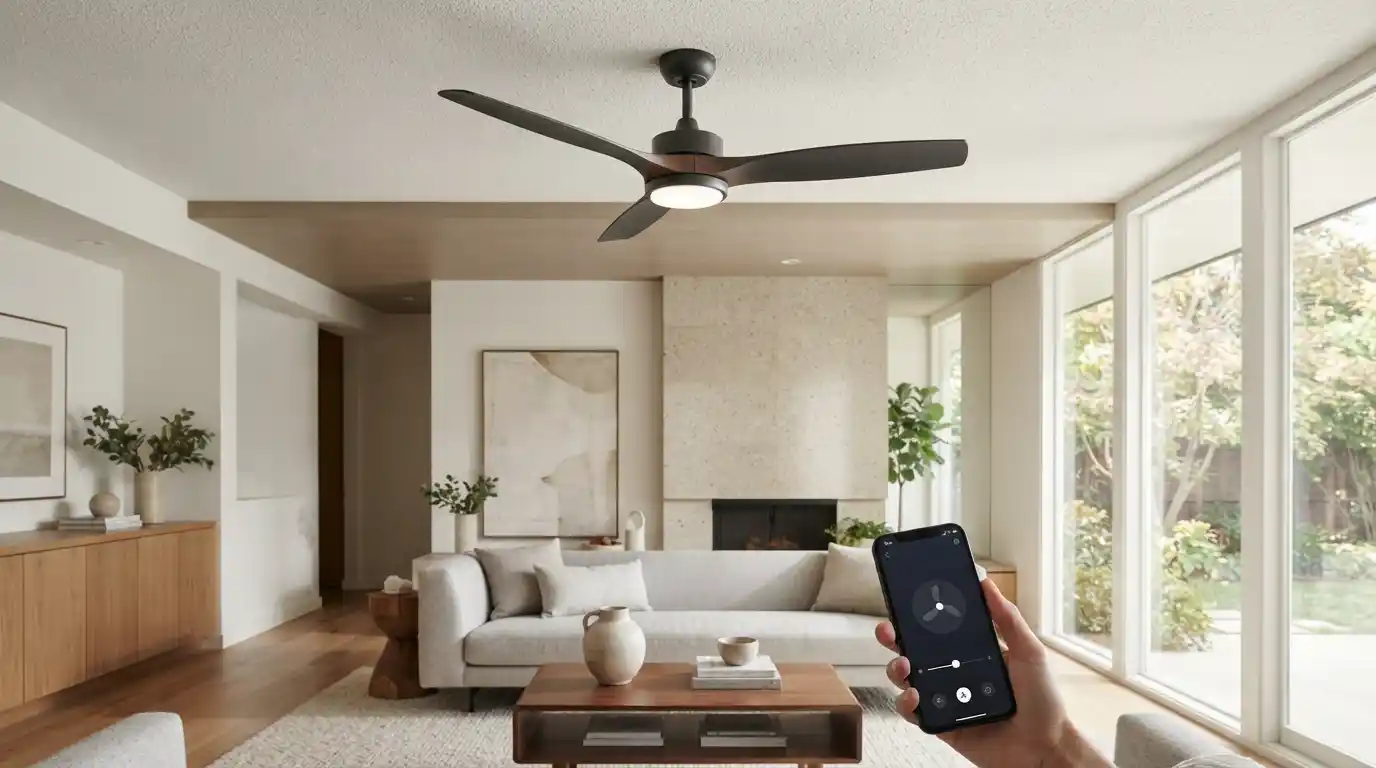
R&R technology represents this broader shift toward responsive automation in smart ceiling fans. Instead of treating a fan as a basic mechanical cooling appliance, modern systems combine efficient motors, sensors, connectivity, controls, and intelligent automation to create a more adaptable indoor environment.
This evolution fits naturally into the wider smart-home movement. From innovative smart home devices to connected entertainment systems and automated household technology, consumers increasingly expect their homes to be more efficient, convenient, and responsive.
What Is R&R Technology in Smart Ceiling Fans?
In the context of this article, R&R technology describes the responsive and regulatory automation concepts used to make smart ceiling fans more adaptive. The basic idea is simple: instead of running at one fixed speed regardless of conditions, a connected fan can use available environmental information and user settings to determine how it should operate.
This can include automated speed adjustments, scheduled operation, remote controls, sensor-based responses, lighting integration, and compatibility with broader smart-home systems.
The result is a ceiling fan that behaves less like a standalone appliance and more like one component of a connected home environment.
How Smart Ceiling Fans Have Evolved
Traditional ceiling fans are highly effective at moving air, but their controls are generally limited. A user selects a speed, turns the fan on or off, and manually changes the setting when conditions change.
Smart ceiling fans introduce another layer of control. Depending on the product and ecosystem, users may be able to operate a fan through an application, remote control, wall controller, scheduling system, or voice assistant.
This transition reflects the same larger technological movement visible across transportation and household technology. For example, electric vehicles and connected transportation demonstrate how conventional systems can evolve when software and intelligent controls become part of the user experience.
In the home, that same philosophy can be applied to lighting, climate management, entertainment, security, and ventilation.
Key Features of Modern Smart Ceiling Fans
1. Connected Controls
One of the most noticeable differences between conventional and smart ceiling fans is the ability to control the appliance digitally.
Depending on the model, users may be able to adjust fan speed, turn the unit on or off, create schedules, or integrate the fan with other connected-home routines. This is particularly useful when the fan is installed in a bedroom, home office, living room, or other frequently used space.
Connected control also fits into the broader development of AI-powered personal technology, where users increasingly expect devices to respond intelligently rather than simply wait for manual commands.
2. More Responsive Airflow
A smart fan can provide more flexible airflow management than a conventional fixed-speed appliance. Users can select different operating levels depending on the time of day, room activity, or desired comfort.
Some advanced systems can also incorporate environmental information when supported by their hardware and software. This makes the fan more adaptable to changing indoor conditions.
The goal is not simply to make the fan spin faster. It is to make airflow more purposeful.
3. Energy-Conscious Operation
Energy efficiency is one of the strongest reasons homeowners consider upgrading household appliances. Smart controls can help users avoid unnecessary operation by allowing schedules, remote shutoff, and more deliberate speed management.
Efficient motor technology can further improve the overall performance of a ceiling fan. Rather than focusing only on maximum airflow, modern designs increasingly balance airflow, operating noise, power consumption, and comfort.
This broader emphasis on intelligent efficiency can also be seen in digital transformation across modern services, where automation is increasingly used to reduce unnecessary processes and improve resource management.
4. Smart Lighting Integration
Many contemporary ceiling fans combine airflow with integrated lighting. This allows one fixture to serve multiple purposes while reducing the need for separate ceiling-mounted devices.
Depending on the model, integrated lights may provide different brightness levels or color temperatures. A brighter setting can support focused activities, while a softer setting may work better during evening relaxation.
This combination of lighting and airflow makes the ceiling fan a more important part of interior design rather than merely a functional cooling device.
Why Design Matters Alongside Technology
Technology alone does not determine whether a smart ceiling fan works well in a home. Physical design remains equally important.
Modern fans are increasingly designed around aerodynamic blade shapes, compact motor housings, integrated lighting, contemporary finishes, and quieter operation. These features help the appliance fit naturally into modern interiors.
For homeowners interested in creating a coordinated living environment, this connects with broader home decor and functional living-space ideas.
A well-designed smart ceiling fan should therefore accomplish two goals: provide effective air movement and complement the room visually.
Smart Ceiling Fans and the Connected Home
The real potential of R&R-style automation becomes more apparent when a ceiling fan is considered as part of a larger connected ecosystem.
Instead of operating independently, a smart fan can potentially participate in household routines alongside other connected devices. A homeowner might create schedules for different rooms, coordinate lighting with fan operation, or control several devices from a central smart-home platform.
This interconnected approach resembles the broader technology integration strategies used in larger digital environments. BizHorizone’s discussion of enterprise IT marketing integration, for example, highlights the importance of connecting separate digital components into a more coordinated system.
At home, the same underlying principle can be much simpler: make individual devices work together instead of forcing people to manage every appliance separately.
The Role of Automation in Everyday Comfort
Automation becomes especially valuable when it removes repetitive tasks.
Consider a bedroom fan. Without automation, a user may need to adjust the speed before sleeping, reduce airflow during the night, or turn the fan off in the morning. With scheduling and smart controls, some of these actions can happen automatically.
The same concept can apply to a home office. A fan can be scheduled around working hours, controlled remotely, or adjusted when the room is occupied.
Automation does not necessarily mean that the appliance should make every decision independently. Instead, the best smart-home systems give users a combination of automation and manual control.
Smart Ceiling Fans Compared With Traditional Fans
| Feature | Traditional Ceiling Fan | Smart Ceiling Fan |
|---|---|---|
| Basic speed control | Usually available | Available with digital control options |
| Remote operation | Depends on model | Common feature |
| Scheduling | Limited or unavailable | Often supported |
| Smart-home integration | Rare | Designed for connected ecosystems |
| Automated responses | Limited | Possible with compatible sensors and software |
| Integrated lighting | Available on some models | Common in many modern designs |
The important distinction is not simply that one fan is newer than another. Smart models introduce an additional layer of control and connectivity that can change how the appliance fits into daily routines.
How Smart Technology Is Changing Household Appliances
The development of intelligent ceiling fans is part of a much larger movement in consumer technology.
Household devices are increasingly connected, programmable, and software-assisted. The same trend can be seen in home audio, where modern equipment combines traditional hardware with advanced connectivity. For example, modern noise-canceling headphones demonstrate how sensors, processing, and software can transform a familiar consumer product.
Likewise, advanced home audio technology shows how hardware design and digital control increasingly work together.
Smart ceiling fans follow the same trajectory. The mechanical function remains important, but digital intelligence adds flexibility to the experience.
What Homeowners Should Consider Before Buying
Motor Efficiency
Look beyond the word “smart.” The underlying motor remains one of the most important components of a ceiling fan. A connected fan with poor mechanical performance is unlikely to provide a satisfying upgrade.
Noise Levels
Noise matters particularly in bedrooms, nurseries, offices, and relaxation areas. A quieter fan can improve comfort even when the smart features are not being actively used.
Control Compatibility
Before purchasing, check which control methods the fan supports. Consider whether you prefer an application, remote, wall control, voice commands, or integration with an existing smart-home system.
Installation Requirements
Smart features may introduce additional setup requirements. Wi-Fi connectivity, companion applications, compatible controllers, and electrical considerations should all be reviewed before installation.
Homeowners who are already building connected environments should think about compatibility in the same way they would when adding any other smart device.
Smart Ceiling Fans and Sustainable Home Design
Connected cooling technology can also contribute to a broader conversation about sustainable living.
Efficient airflow can improve perceived comfort without relying entirely on air conditioning. When a fan and cooling system are used strategically, homeowners may be able to manage indoor comfort more efficiently.
This fits into the wider movement toward technology-assisted sustainability, where automation helps households make better use of energy and resources.
The idea extends beyond individual appliances. industrial technology focused on efficiency and innovation demonstrates the same broader principle: technology becomes more valuable when it improves how resources are used.
Beyond Ceiling Fans: The Future of Intelligent Homes
The next stage of smart-home development is likely to involve greater coordination between individual devices.
Fans, lighting, thermostats, security systems, entertainment equipment, and other appliances can increasingly become parts of a unified digital environment.
Technology companies are already exploring increasingly sophisticated approaches to automation and connected systems. Articles covering next-generation technology innovation and technology-driven business innovation reflect how quickly intelligent systems are expanding into different areas.
Even emerging technology developments such as advanced technology and AI-driven innovation demonstrate the accelerating convergence between physical systems, software, automation, and data.
For homeowners, that future does not necessarily require complicated equipment. The most useful innovations may be the ones that quietly make everyday activities easier.
Is R&R Technology Worth Considering?
For homeowners who want more control over indoor comfort, smart ceiling fans can be a practical upgrade. Their value comes from the combination of mechanical airflow, efficient operation, connectivity, scheduling, and automation.
However, the smartest choice is not automatically the model with the longest feature list. Buyers should consider room size, airflow requirements, motor quality, noise, installation, connectivity, maintenance, and compatibility with their existing home technology.
A smart fan should solve a real household problem rather than add complexity for its own sake.
Frequently Asked Questions
What does R&R technology mean for smart ceiling fans?
In this context, R&R technology refers to responsive and regulatory automation concepts that allow smart ceiling fans to combine traditional airflow with connected controls, scheduling, and adaptive operation.
Are smart ceiling fans better than traditional ceiling fans?
They can be a better choice for homeowners who value automation, remote control, scheduling, and smart-home integration. Traditional fans may remain preferable for people who want simple operation and fewer connected features.
Can a smart ceiling fan save energy?
A smart fan can support more energy-conscious operation through efficient motors, scheduling, speed management, and reduced unnecessary runtime. Actual energy savings depend on the specific fan, usage pattern, room conditions, and overall cooling strategy.
Do smart ceiling fans require Wi-Fi?
Not every smart fan requires Wi-Fi for basic operation. However, advanced features such as app-based control, remote access, cloud-connected routines, or certain smart-home integrations may require a network connection.
Can smart ceiling fans work with air conditioning?
Yes. Fans and air conditioning systems can complement each other by improving air circulation and perceived comfort. The appropriate combination depends on room conditions, climate, equipment, and how the systems are operated.
Are smart ceiling fans difficult to install?
The physical installation can be similar to that of conventional ceiling fans, but smart models may require additional configuration for connectivity and controls. Electrical work should be handled according to the manufacturer’s requirements and applicable safety standards.
Conclusion
R&R technology illustrates how a familiar household appliance can evolve when mechanical engineering meets digital automation. Smart ceiling fans can combine efficient airflow, connected controls, scheduling, integrated lighting, and intelligent-home functionality in a single fixture.
The larger lesson is that smart-home innovation does not always need to be dramatic. Sometimes the most useful technology is simply a better version of something people already use every day.
As connected living continues to develop, smart ceiling fans are positioned to become more than cooling appliances. They can become practical components of comfortable, efficient, and increasingly responsive homes.