
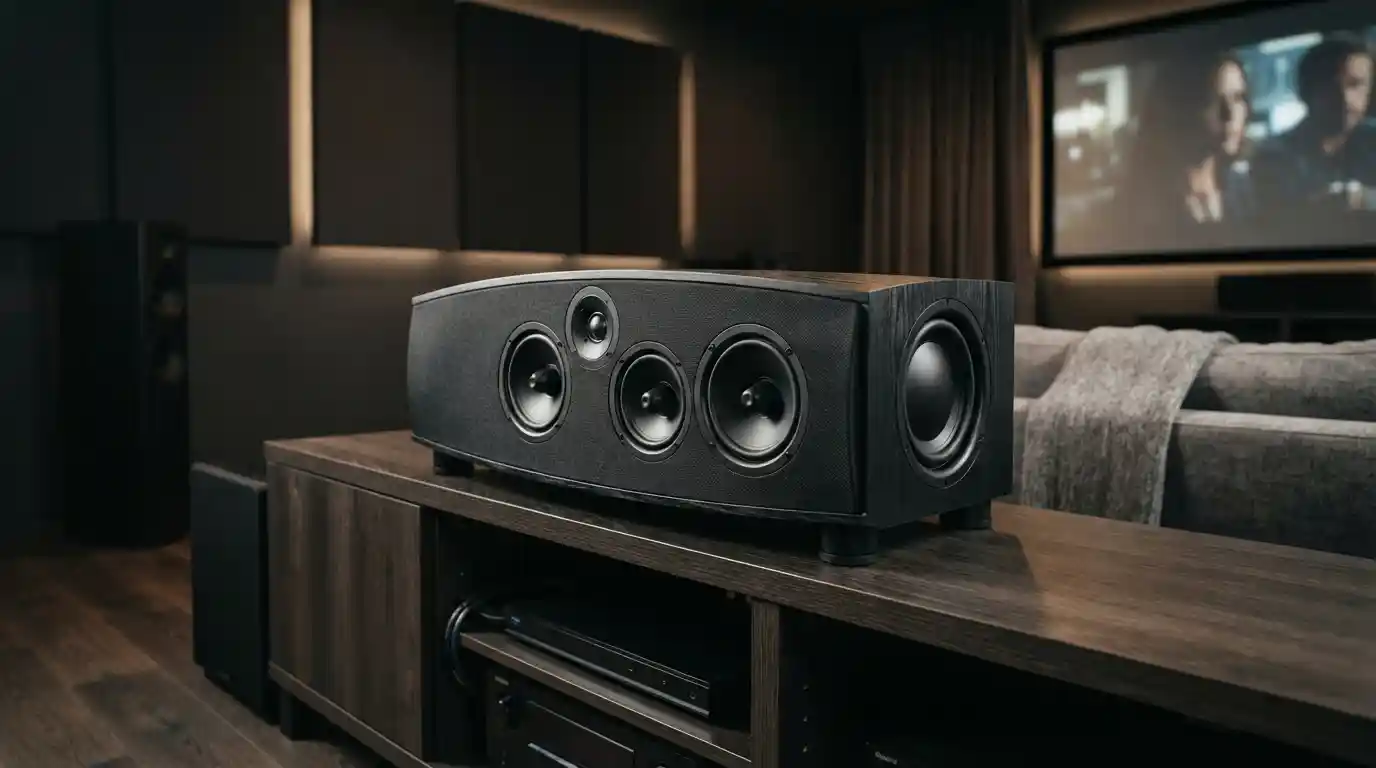
Although it belongs to an earlier generation of home-audio equipment, its design illustrates why larger center-channel and L/C/R speakers continue to attract home-theater enthusiasts. The combination of dedicated drivers, substantial cabinet volume, and powered low-frequency output was intended to deliver a fuller presentation than many compact center speakers.
If you are comparing older audio equipment with today’s noise-canceling headphones, modern smart home devices, or other entertainment technology, the CLR 2300 provides a useful example of a traditional speaker-first approach to home entertainment.
What Is the Definitive Technology CLR 2300?
The Definitive Technology C/L/R 2300 is a three-way, four-driver audio/video loudspeaker system associated with the brand’s earlier home-theater lineup. Archived specifications identify a frequency response of approximately 22 Hz to 30 kHz, an 8-ohm impedance, and recommended amplifier power ranging from 20 to 250 watts.
Its driver arrangement includes a 1-inch aluminum-dome tweeter, two 4.5-inch midbass drivers, and an 8-inch long-throw sub-bass driver. The speaker also incorporates a 150-watt subwoofer amplifier, making its design considerably more substantial than a basic passive center-channel speaker.
That configuration is particularly relevant for people building traditional home-theater systems where dialogue clarity, front-stage presence, and low-frequency impact all need to work together.
Key CLR 2300 Specifications
The technical design is one of the most interesting aspects of this older speaker. Its published specifications include:
- Speaker type: Three-way, four-driver loudspeaker system
- Frequency response: Approximately 22 Hz–30 kHz
- Impedance: 8 ohms
- Recommended amplifier power: 20–250 watts
- Sub-bass driver: 8-inch long-throw driver
- Midbass drivers: Two 4.5-inch drivers
- Tweeter: 1-inch pure aluminum dome
- Integrated subwoofer amplification: 150 watts
- Approximate dimensions: 5.75 × 19.5 × 12 inches
These specifications help explain the speaker’s intended role. It was not designed simply to reproduce dialogue from a television. Instead, the configuration was intended to provide a more complete front-stage experience with meaningful low-frequency support.
Three-Way Design and Why It Matters
A three-way speaker divides the audio spectrum among specialized driver sections rather than asking a single driver to handle a broad range of frequencies.
In the CLR 2300, the tweeter handles higher frequencies, the pair of midbass drivers focuses on the middle portion of the spectrum, and the larger low-frequency driver contributes deeper bass. This arrangement can provide a more controlled way of handling different parts of a soundtrack.
For movie playback, this can be especially useful because soundtracks contain dialogue, music, effects, environmental sounds, and deep cinematic effects simultaneously. A properly integrated speaker system can make those elements easier to distinguish.
How the Integrated Bass System Changes the Experience
One of the most notable characteristics of the CLR 2300 is its integrated powered subwoofer section. Instead of depending entirely on an external subwoofer for every low-frequency demand, the speaker incorporates dedicated amplification for its low-end system.
This approach can be attractive in a home-theater setup where the front speaker needs more authority without relying exclusively on small satellite speakers. It also illustrates the difference between traditional full-featured loudspeaker designs and today’s increasingly compact entertainment products.
For readers interested in broader home technology, the same design philosophy can be seen in the evolution from conventional entertainment hardware toward connected smart-home equipment and integrated systems.
CLR 2300 for Movies and TV
A speaker with this type of configuration can make sense in a dedicated home-theater environment. Movie playback benefits from a strong center and front soundstage because dialogue and many important on-screen sounds are anchored around the front of the room.
The CLR 2300’s wider cabinet and dedicated drivers were designed for a more substantial presentation than compact television speakers. When correctly positioned and matched with suitable equipment, a traditional speaker of this type can help create a more immersive listening environment.
That is especially relevant for people who have moved beyond basic television audio and are exploring a complete home audio upgrade rather than simply adding another small speaker.
Music Listening With the CLR 2300
Although home theater is an obvious application, a capable full-range speaker can also be useful for music. The combination of a dedicated tweeter, midbass drivers, and powered low-frequency section gives the system a broader hardware foundation than many compact entertainment speakers.
Music with strong bass lines can benefit from a speaker capable of producing substantial low-frequency energy, while vocals and instruments depend heavily on clean midrange reproduction.
For listeners who also use personal audio products, comparing the presentation of a room-filling speaker with headphone-based listening can highlight the fundamental difference between near-field and room-based sound.
Placement Is Important
Even a technically capable speaker can perform poorly if it is positioned incorrectly. The CLR 2300 has a relatively wide cabinet, so owners should consider available shelf, cabinet, or dedicated-stand space before installing it.
The front of the speaker should have a reasonably unobstructed path into the listening area. Avoid placing it where furniture or other equipment substantially blocks the drivers.
Room acoustics also matter. Hard floors, bare walls, large windows, and reflective surfaces can influence perceived brightness and clarity. Soft furnishings, rugs, curtains, and appropriately positioned furniture can affect how sound behaves throughout the room.
Home layout is equally important when creating an entertainment area. Readers working on a broader room upgrade may also find ideas in this guide to stylish and functional living spaces and the article covering basement entertainment center ideas.
Choosing an Amplifier or Receiver
Matching a speaker with suitable amplification is an important part of any home-theater installation. The published CLR 2300 specifications list an 8-ohm impedance and recommended amplifier power of 20 to 250 watts.
That does not mean every receiver should automatically be operated at the maximum figure. Instead, the receiver or amplifier should be selected according to the complete speaker system, room size, listening distance, and manufacturer’s guidance.
Correct speaker connections also matter. Proper polarity and secure connections help maintain consistent performance across the front soundstage. If multiple speakers are used, maintaining consistent wiring polarity is an important basic setup step.
CLR 2300 vs. Modern Center Speakers
The biggest difference between the CLR 2300 and many modern center-channel speakers is the design philosophy. Current models can be considerably more compact, while some premium designs continue to use multiple drivers and integrated bass technologies.
For example, current Definitive Technology center-channel products include models such as the CLR 2300 discussed here as a reference point for older designs, while today’s market emphasizes compact cabinets, modern driver materials, and flexible home-theater integration.
Someone considering an older speaker should therefore evaluate condition rather than assuming that an older model will automatically outperform a newer one. Driver condition, amplifier operation, cabinet integrity, replacement-part availability, and overall system compatibility can all affect the practical value of used equipment.
What to Check When Buying a Used CLR 2300
Because the CLR 2300 is an older model, condition should be a major consideration if you find one on the used market.
Inspect the Drivers
Look for visible damage, deterioration, unusual movement, or signs that a driver has been replaced incorrectly. The tweeter and midbass drivers should receive particular attention.
Test the Powered Section
The integrated powered low-frequency system is an important part of the speaker’s design. Confirm that the powered section operates normally and does not produce abnormal noise, distortion, or intermittent behavior.
Check the Cabinet
Inspect the cabinet for cracks, water damage, major dents, loose panels, or evidence of improper modification. Cosmetic wear may be acceptable on used equipment, but structural damage can be more significant.
Confirm Connections
Check the terminals and power connections before purchasing. Damaged connectors can turn an otherwise functional speaker into a more complicated restoration project.
Is the CLR 2300 Still Relevant?
The answer depends on what you want from a home-audio system. The CLR 2300 is not a current-generation product, but its three-way architecture and integrated powered low-frequency section make it an interesting option for enthusiasts who appreciate substantial traditional speaker designs.
It can also be useful as a reference point when comparing how home entertainment hardware has evolved. Modern consumers can choose between conventional speakers, soundbars, wireless systems, headphones, connected devices, and increasingly integrated entertainment ecosystems.
That broader evolution is also visible in areas such as smart household technology, AI-powered personal technology, and other connected devices that increasingly influence how people use their homes.
Building a Complete Home Entertainment Space
A speaker should not be considered in isolation. The listening room, television or display, receiver, source devices, acoustic environment, seating position, and other speakers all contribute to the final experience.
If you are designing a dedicated entertainment room, consider the room’s dimensions before choosing equipment. A large speaker may be unnecessary in a very small room, while a compact speaker may struggle to provide the desired scale in a large space.
Storage and furniture placement also deserve attention. A well-planned entertainment area can integrate audio equipment without allowing cables, speakers, and electronics to dominate the room. For broader home improvement inspiration, the site’s home decor guide offers useful context for balancing technology with everyday living areas.
Final Thoughts on the Definitive Technology CLR 2300
The Definitive Technology CLR 2300 represents a traditional approach to serious home audio: multiple dedicated drivers, a relatively substantial enclosure, and integrated powered bass in a single speaker system.
Its published specifications show why it remains an interesting piece of older home-theater equipment. The combination of an 8-inch low-frequency driver, dual 4.5-inch midbass drivers, aluminum-dome tweeter, and integrated 150-watt subwoofer amplifier gives it a distinctly different design from many compact modern speakers.
For anyone considering one today, the most important factors are condition, compatibility, placement, and the requirements of the rest of the audio system. Rather than focusing only on age or specifications, evaluate how the speaker fits your room and your complete entertainment setup.
The CLR 2300 is therefore best understood not simply as an older speaker, but as an example of a particular era of home-theater engineering—one that prioritized substantial cabinet design and dedicated low-frequency hardware while still aiming to deliver a complete front-stage audio experience.
Frequently Asked Questions
What type of speaker is the Definitive Technology CLR 2300?
The CLR 2300 is a three-way, four-driver audio/video loudspeaker system designed for home entertainment and home-theater applications.
Does the CLR 2300 have a powered subwoofer?
Yes. Its design includes an integrated powered low-frequency section with a 150-watt subwoofer amplifier.
What is the impedance of the CLR 2300?
The published specification lists an 8-ohm impedance.
What amplifier power is recommended?
The published specifications identify a recommended amplifier range of approximately 20 to 250 watts.
Is the CLR 2300 suitable for a home theater?
Its multi-driver configuration and low-frequency capability make it well suited to traditional home-theater applications when properly matched with the rest of the system.
Should I buy a used CLR 2300?
A used example should be evaluated individually. Check the drivers, powered section, cabinet, terminals, and overall operating condition before purchasing.



