
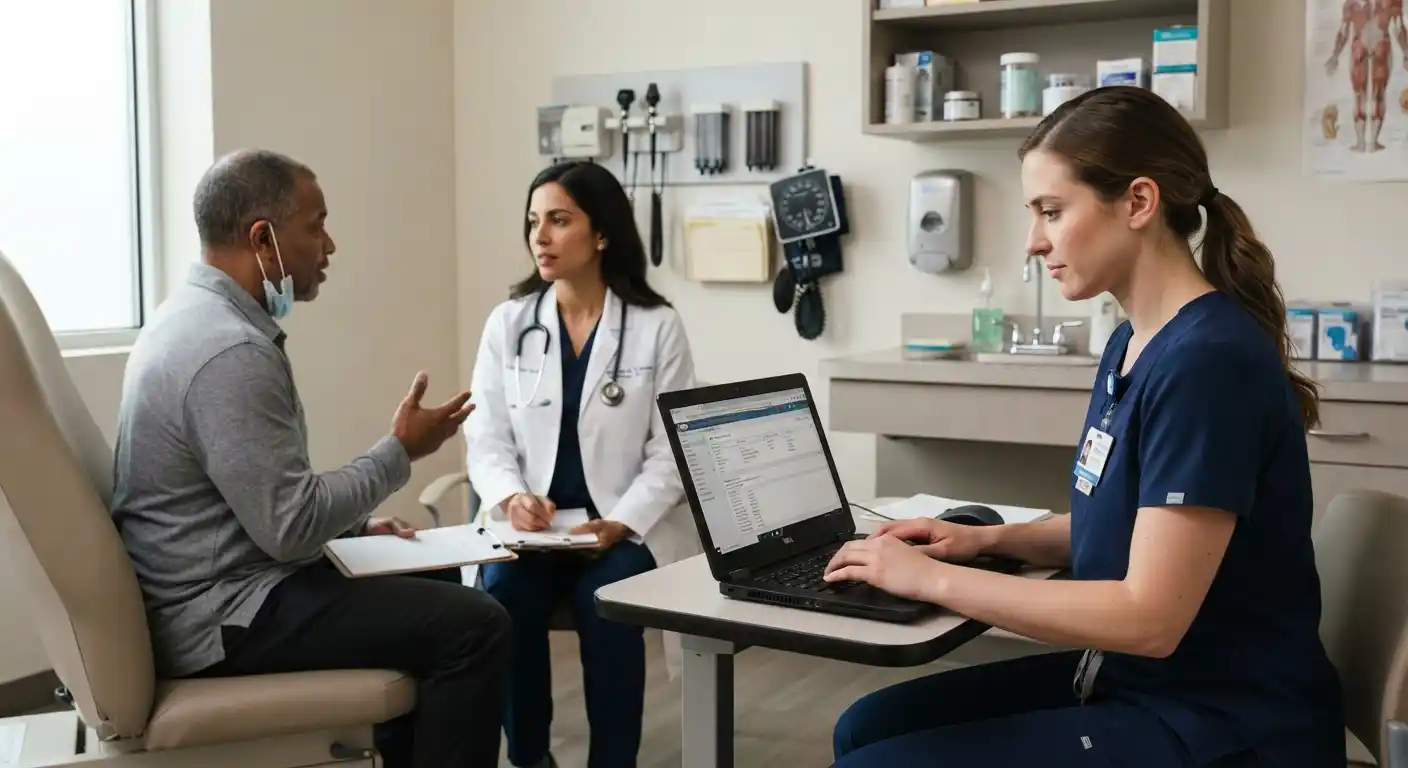
Medical scribes work closely with physicians and other healthcare professionals by documenting patient encounters, organizing clinical information, and learning how medical care is delivered in real-world settings. Because scribes are exposed to patient-provider interactions, medical terminology, diagnostic reasoning, and clinical workflows, the experience can be valuable for aspiring healthcare professionals.
However, simply listing “medical scribe” on an application does not automatically make the experience meaningful clinical exposure. What matters is what you actually did, how closely you observed patient care, what you learned, and how the experience influenced your understanding of healthcare.
This guide explains how medical scribing is generally viewed, what makes it valuable, its limitations, and how to describe the experience effectively on a professional or academic application.
What Does a Medical Scribe Do?
A medical scribe supports healthcare providers by documenting patient encounters and helping maintain accurate clinical records. Depending on the workplace, a scribe may work in an emergency department, outpatient clinic, specialty practice, or other healthcare environment.
Typical responsibilities can include recording information during patient visits, documenting histories and examinations, entering information into an electronic health record system, organizing clinical notes, and following the provider’s workflow.
Although scribes generally do not diagnose or treat patients independently, they can gain substantial exposure to the clinical decision-making process.
Common Medical Scribe Responsibilities
- Documenting patient-provider conversations
- Recording medical histories and examination findings
- Entering information into electronic health records
- Learning medical terminology and abbreviations
- Following physicians through patient encounters
- Observing diagnostic and treatment decisions
- Organizing clinical documentation
- Maintaining confidentiality and professional standards
The combination of documentation and direct observation is what makes medical scribing particularly interesting for students considering healthcare careers.
Is Medical Scribe Considered Clinical Experience?
Medical scribing can be considered clinical experience, particularly when the role involves direct exposure to patient care and close observation of healthcare providers. However, there is no universal rule that every institution will classify every scribing position in exactly the same way.
The distinction often depends on the responsibilities involved and the type of healthcare environment in which you work.
For example, a scribe who sits alongside a physician during patient encounters and observes examinations, medical histories, diagnoses, and treatment discussions may have a stronger case for describing the position as clinical exposure than someone whose role is primarily administrative.
That is why the actual duties and learning opportunities matter more than the job title alone.
Why Medical Scribing Can Be Valuable Clinical Exposure
Medical scribing provides something that many classroom experiences cannot: exposure to the everyday realities of patient care.
A student may spend hours studying anatomy, physiology, pharmacology, and medical terminology, but observing healthcare professionals interact with actual patients can provide an entirely different perspective.
1. You Observe Real Patient Encounters
One of the biggest advantages of scribing is the opportunity to observe patient-provider interactions.
You may see how clinicians communicate with patients, gather information, respond to concerns, explain diagnoses, and discuss treatment options. These experiences can help students understand that healthcare involves much more than memorizing medical facts.
Strong communication is particularly important because patients may be anxious, confused, frustrated, or unfamiliar with medical terminology.
2. You Learn How Clinical Decisions Are Made
Scribes often observe the reasoning that takes place during patient encounters. A physician may consider symptoms, medical history, physical findings, laboratory results, imaging, and other information before deciding what should happen next.
Watching this process repeatedly can help aspiring healthcare professionals develop a better understanding of clinical reasoning.
3. You Become Comfortable With Medical Terminology
Medical terminology can initially feel overwhelming. Scribing exposes you to terminology repeatedly and in context.
Instead of learning terms only from textbooks, you may encounter them while documenting real clinical conversations. Over time, this can improve your familiarity with common diagnoses, procedures, medications, body systems, and clinical abbreviations.
4. You Learn About Healthcare Teamwork
Modern healthcare depends on collaboration. Physicians, nurses, medical assistants, technicians, pharmacists, therapists, administrators, and other professionals often work together to support patients.
A medical scribe may have an opportunity to observe how these different roles interact within a healthcare setting.
Medical Scribe vs. Other Types of Clinical Experience
It is important to understand that clinical experience exists on a spectrum. Not every healthcare-related position provides the same type or level of patient contact.
A medical scribe may have extensive exposure to physicians and patient encounters without personally performing hands-on patient care. Other positions may involve much more direct responsibility for patients.
| Experience Type | Patient Exposure | Hands-On Care | Typical Learning Opportunity |
|---|---|---|---|
| Medical Scribe | Often high | Usually limited | Clinical documentation, observation, workflow, medical decision-making |
| Medical Assistant | High | Moderate to high | Patient preparation, clinical procedures, office workflow |
| Patient Care Technician | High | High | Direct patient support and basic clinical care |
| EMT | High | High | Emergency response and patient assessment |
| Clinical Volunteer | Varies | Usually limited | Healthcare environment and patient interaction |
This comparison does not mean one position is automatically better than another. Instead, it shows why applicants should accurately explain what they actually experienced.
Does Scribing Count as Patient Care Experience?
This is a slightly different question from whether scribing counts as clinical experience.
Clinical experience and direct patient care experience are not always the same thing.
A scribe may spend significant time around patients and healthcare providers but generally does not provide hands-on care. For programs that specifically require direct patient care hours, a medical scribe position may not satisfy that requirement.
Applicants should therefore distinguish between:
- Clinical exposure
- Patient interaction
- Direct patient care
- Healthcare employment
- Shadowing
- Volunteer experience
These categories can overlap, but they are not interchangeable.
Can Medical Scribing Help With Medical School Applications?
Yes. Medical scribing can strengthen an application when the experience demonstrates meaningful exposure to healthcare and helps explain why you want to pursue medicine.
Admissions committees are generally interested in more than the number of hours you accumulated. They also want to understand whether you developed a realistic perspective on the profession.
A strong scribing experience may help you demonstrate:
- Understanding of patient-provider relationships
- Exposure to clinical environments
- Familiarity with healthcare workflows
- Professional communication
- Attention to detail
- Commitment to healthcare
- Reflection on patient care
- Understanding of the responsibilities of healthcare professionals
Your ability to explain what you learned can ultimately make the experience more meaningful than simply reporting a large number of hours.
How Many Hours of Medical Scribing Are Enough?
There is no single number of scribing hours that guarantees an applicant will be viewed favorably.
Quality, consistency, responsibilities, patient exposure, and reflection can all matter. Someone who spends several months regularly working alongside clinicians may gain a deeper understanding of healthcare than someone who completes a short period of exposure without meaningful engagement.
Rather than focusing exclusively on reaching an arbitrary number, think about whether your experience has helped you answer important questions about healthcare.
Questions to Ask Yourself
- What did I learn from observing patient care?
- How did clinicians communicate with different patients?
- What surprised me about healthcare?
- What challenges did I observe?
- How did the experience influence my career goals?
- What did I learn about teamwork?
- Did the experience confirm that I want to work in healthcare?
What Makes Medical Scribing Stronger Clinical Experience?
Not all scribing jobs provide identical exposure. If you want the experience to contribute meaningfully to your healthcare journey, look for opportunities where you can learn from genuine clinical interactions.
Direct Observation
A role that allows you to observe providers during patient encounters can provide greater clinical exposure than a position where you primarily work away from patients.
Consistent Clinical Environment
Repeated exposure can help you understand how healthcare works over time. You may see different patient conditions, communication styles, workflows, and treatment approaches.
Professional Interaction
Working around physicians and other healthcare professionals can teach you about professionalism, communication, responsibility, and teamwork.
Reflection
The most valuable experiences often become clearer when you reflect on them. Consider keeping private notes about general lessons you learn while avoiding any patient-identifying information.
Limitations of Medical Scribe Experience
While scribing can be valuable, it is important not to overstate what the role involves.
A medical scribe generally does not independently diagnose patients, prescribe medications, perform procedures, or make treatment decisions. Your primary responsibility is usually documentation and support.
This distinction matters when applying to programs that specifically ask for direct patient care.
Instead of claiming that scribing gave you hands-on patient care when it did not, describe the experience accurately. Explain how you observed clinical decision-making, patient communication, healthcare teamwork, and the realities of medical practice.
Can Medical Scribing Replace Shadowing?
Sometimes a scribing position can provide some of the observational benefits associated with shadowing, but the two experiences are not necessarily identical.
Shadowing typically focuses on observing a healthcare professional without performing a substantial job function. Scribing, on the other hand, involves an active responsibility within the clinical workflow.
Because you are working while observing, scribing may provide a different perspective on healthcare operations.
For some applicants, combining scribing with dedicated physician shadowing, volunteering, or other healthcare experiences can provide a broader understanding of the profession.
How to Describe Medical Scribing on an Application
When documenting your experience, avoid relying on generic statements such as “I learned about medicine.”
Instead, explain what you actually observed, what responsibilities you performed, and what those experiences taught you.
Weak Description
“Worked as a medical scribe and gained clinical experience.”
Stronger Description
“Documented patient encounters while working alongside physicians, gaining exposure to clinical reasoning, patient communication, medical documentation, and the workflow involved in evaluating and managing patients.”
The second description provides context without exaggerating the responsibilities of the position.
Skills You Can Develop as a Medical Scribe
Medical scribing can help develop several transferable professional skills.
- Attention to detail: Clinical documentation requires accuracy.
- Listening: Scribes must carefully follow conversations and clinical information.
- Medical terminology: Repeated exposure improves familiarity with healthcare language.
- Time management: Clinical environments can move quickly.
- Professionalism: Healthcare requires confidentiality and appropriate conduct.
- Technology skills: Scribes commonly work with electronic health record systems.
- Communication: Working with healthcare professionals requires clear communication.
These skills can be useful whether you ultimately pursue medicine, nursing, physician assistant studies, healthcare administration, or another healthcare profession.
Medical Scribing for Pre-Med Students
For pre-med students, scribing can be particularly useful because it provides an inside look at the profession they are considering.
Medicine can look very different from the outside. Students may imagine physicians spending most of their time diagnosing complex conditions, but real clinical work also involves documentation, communication, coordination, administrative requirements, and difficult conversations.
Observing these realities before medical school can help students make more informed career decisions.
Students interested in broader healthcare education can also explore resources related to adult education and employment, particularly when considering alternative healthcare or professional pathways.
How Clinical Experience Fits Into a Broader Healthcare Journey
Clinical exposure is only one part of developing a strong healthcare background. Students can also benefit from academic preparation, volunteering, research, leadership, community involvement, and experiences that develop communication skills.
Understanding the broader healthcare environment can be especially useful because patient outcomes often depend on many professionals and systems working together.
Healthcare-related topics across different areas can provide additional context, including discussions of home health services, comprehensive healthcare services, and community healthcare environments.
These perspectives can help aspiring healthcare professionals appreciate that patient care extends beyond a physician’s office.
What Should You Do If a Program Does Not Count Scribing as Clinical Hours?
Do not assume that one program’s classification applies everywhere.
If a school or professional program has specific experience requirements, review its current admissions guidance and determine exactly how it defines clinical, patient-contact, or direct-care experience.
If your scribing experience does not satisfy a particular requirement, you may need to obtain another type of experience that clearly meets the definition.
This is one reason it can be helpful to build a diverse healthcare experience portfolio instead of relying entirely on one position.
How to Combine Scribing With Other Healthcare Experiences
A well-rounded experience portfolio can demonstrate different dimensions of healthcare.
- Scribing: Clinical observation and documentation
- Shadowing: Focused observation of healthcare professionals
- Volunteering: Service and exposure to healthcare environments
- Direct patient care: Hands-on patient interaction when appropriate
- Research: Scientific investigation and analytical thinking
- Community service: Understanding community needs and health disparities
This combination can help you understand both the science and human side of healthcare.
Medical Scribe Experience and Professional Development
Scribing can also contribute to professional development beyond the admissions process.
Working in a clinical setting can teach you how healthcare organizations operate, how professionals communicate under pressure, and why accurate information matters.
These lessons may become valuable later when you encounter clinical rotations, professional training, or healthcare employment.
Students exploring healthcare careers can also benefit from learning about different healthcare environments, including mental health services and healthcare communication and mental health care settings.
Common Mistakes to Avoid When Listing Scribing Experience
1. Exaggerating Your Responsibilities
Never describe yourself as performing duties that were outside your actual role.
2. Focusing Only on Hours
Hours demonstrate commitment, but they do not fully communicate what you learned.
3. Ignoring Patient Interaction
If you observed meaningful patient-provider communication, explain what you learned from those encounters without revealing confidential information.
4. Treating Documentation as Unimportant
Accurate documentation is an important part of modern healthcare. Scribing can help students understand why clinical records matter.
5. Using Generic Application Language
Specific reflection is usually more informative than broad claims about “gaining medical experience.”
Is Medical Scribe Considered Clinical Experience for PA School?
Medical scribing may be viewed as healthcare or clinical experience by some PA programs, but applicants should pay close attention to each program’s definition of patient care experience.
Some programs distinguish between general healthcare experience and hands-on patient care experience. Because admission requirements differ, a scribe should not automatically assume that every hour will satisfy a direct patient care requirement.
If PA school is your goal, use your scribing position as one component of your overall experience strategy and consider obtaining additional patient-contact experience when required.
Is Medical Scribe Considered Clinical Experience for Nursing School?
Scribing can expose nursing applicants to healthcare environments and patient-provider interactions, but nursing programs may have their own requirements for clinical prerequisites, healthcare employment, or patient-care experience.
The value of scribing therefore depends on what the specific nursing program asks applicants to demonstrate.
Students should separate the educational value of an experience from whether it technically fulfills a particular admissions requirement.
Is Medical Scribe a Good Job for Someone Interested in Healthcare?
For many students, medical scribing can be an excellent entry point into a healthcare environment.
It allows you to observe clinical practice while developing professional skills and becoming familiar with medical terminology and documentation.
It can also help answer a very important question: Do I actually enjoy being around patients and healthcare professionals?
That insight can be valuable before making a major educational and financial commitment to a healthcare career.
Final Thoughts: Does Medical Scribe Count as Clinical Experience?
Medical scribing can be considered clinical experience, especially when the role involves meaningful exposure to patient encounters and direct observation of healthcare professionals. However, it should not automatically be treated as equivalent to hands-on patient care.
The most important factors are the responsibilities you performed, the clinical exposure you received, the environment in which you worked, and how you can thoughtfully explain what you learned.
For aspiring healthcare professionals, scribing can provide a valuable window into clinical practice. It can strengthen your understanding of medical workflows, patient communication, documentation, teamwork, and clinical decision-making.
At the same time, students should understand the distinction between clinical exposure and direct patient care. If a particular school requires hands-on patient-care hours, additional experience may be necessary.
Ultimately, the strongest healthcare experience is one that gives you genuine insight into the profession and helps you become a more informed, capable, and compassionate future healthcare professional.