
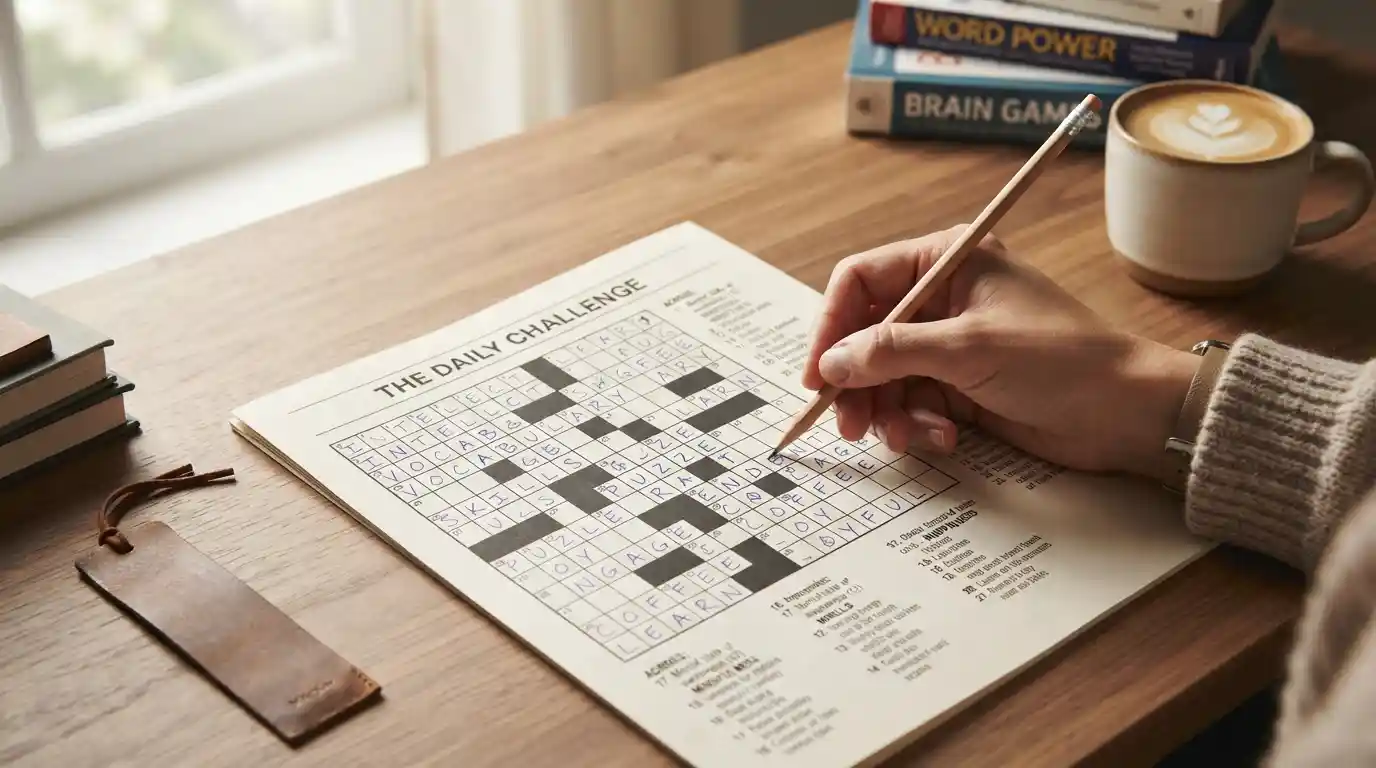
The appeal also comes from variety. Some puzzles focus on general knowledge, while others revolve around entertainment, fashion, history, language, or pop culture. For example, solving a fashion designer crossword clue requires a different type of recognition than working through a wordplay-based puzzle.
This guide explores how crossword challenges can support everyday mental engagement, improve vocabulary habits, make learning more enjoyable, and give people practical strategies for becoming more confident solvers.
Why Entertain Crossword Challenges Remain Popular
Crosswords have a simple format, but the mental process behind them can be surprisingly rich. A clue presents a problem, the grid provides constraints, and every correct answer supplies information that can help solve another clue.
That interconnected structure is one reason crosswords remain engaging. You are not simply recalling information. You are constantly testing possibilities, eliminating incorrect answers, checking letter patterns, and adjusting your thinking as new information appears.
Entertainment-themed puzzles make the experience even more approachable because clues can draw from movies, music, television, celebrities, fashion, and popular culture. Readers interested in entertainment trivia can also explore topics such as AMC Entertainment and movie culture to broaden the cultural knowledge that may prove useful in recognition-based puzzles.
How Crossword Puzzles Exercise Different Thinking Skills
A crossword session can require several forms of thinking at once. You may need to remember a word, interpret a clue, compare synonyms, recognize a cultural reference, and determine whether the answer fits the available spaces.
Memory and Recall
Crosswords frequently ask you to retrieve information that you may have encountered weeks, months, or years earlier. A name, phrase, historical reference, abbreviation, or unusual word can suddenly become useful.
The more puzzles you solve, the more familiar you may become with recurring clue patterns and vocabulary. Instead of memorizing lists mechanically, you encounter words in meaningful contexts and repeatedly retrieve them while solving.
Vocabulary Development
One of the most obvious benefits of word puzzles is exposure to language. A difficult clue can introduce an unfamiliar synonym, technical term, literary reference, or cultural expression.
Crosswords can therefore turn curiosity into a learning habit. If a word is unfamiliar, looking up its meaning and then encountering it again in another puzzle can make the information easier to remember.
Other word-based topics on BizHorizone can provide additional opportunities to think about language and clues, including the guide to the legally crossword clue.
Pattern Recognition
Crossword solving is also about recognizing patterns. Once several letters are placed into a word, possible answers become narrower. A solver learns to use those partial patterns instead of treating every clue as an isolated question.
This becomes especially valuable with short answers. A three-, four-, or five-letter entry can have many possible solutions at first, but crossing letters quickly reduce the possibilities.
Entertainment Clues Make Puzzles More Engaging
Entertainment is a natural source of crossword material because it covers an enormous range of recognizable names, titles, characters, performers, and cultural references.
A clue may refer to an actor, musician, movie studio, television program, fashion designer, or entertainment personality. The challenge is often less about memorizing obscure facts and more about recognizing the category suggested by the clue.
For readers who enjoy celebrity and entertainment history, subjects such as classic entertainment autographs can provide useful cultural context for recognition-based questions.
Music-related clues can work in a similar way. Exploring subjects such as the Top Dawg Entertainment music and culture gives puzzle enthusiasts another area of entertainment vocabulary to explore.
Entertainment knowledge can also overlap with television and film. Articles about Cedric the Entertainer’s cinematic work illustrate how names from popular culture can become useful reference points for trivia and crossword clues.
Crosswords Can Turn Learning Into Play
One reason puzzles work well as casual learning activities is that they provide an immediate objective. Instead of studying a vocabulary list, the solver has a reason to search for a particular answer.
This approach can be useful for people who prefer interactive learning. Students, adults, and lifelong learners can all use word puzzles as a supplemental activity alongside reading and other educational habits.
People interested in continuing education can explore related subjects such as adult education and employment opportunities. The broader goal is similar: developing knowledge while keeping the learning process active.
Crosswords can also introduce learners to unfamiliar subjects. A clue about fashion, for example, may encourage someone to investigate a designer or style movement. Fashion-related reading such as exclusive fashion and timeless style trends can expand that background knowledge.
Using Crosswords for Relaxation and Focus
Crossword solving can also provide a focused break from constant digital interruptions. Sitting down with a puzzle gives you one defined task: interpret the clues and complete the grid.
That focused activity can be enjoyable after work, during a quiet morning, or as part of a screen-free routine. The goal does not have to be speed. For many people, the satisfaction comes from gradually solving a difficult section.
Mental wellness is a broad subject, and crossword puzzles should not be presented as a replacement for professional care. However, enjoyable hobbies can form part of a balanced lifestyle. Readers interested in broader mental-health content can explore teen mental health and supportive practices or the discussion of mental health and creative expression.
The important distinction is that a crossword is primarily a recreational and cognitive activity. Its value comes from engagement, curiosity, and the enjoyment of solving something challenging.
How to Get Better at Entertain Crossword Puzzles
You do not need to solve the hardest puzzle immediately. Consistency and a sensible strategy are usually more useful than trying to complete every grid as quickly as possible.
Start With the Easiest Clues
Scan the entire puzzle before committing to difficult clues. Look for answers that you immediately recognize. Filling these entries gives you crossing letters that can unlock more challenging sections.
Use Crossing Letters
Never treat a difficult clue as completely independent. The surrounding answers are valuable sources of information. If you know three of five letters, reconsider the clue with those letters in place.
Think About the Clue Category
Ask what type of answer the clue appears to require. Is it a person’s name, place, verb, adjective, abbreviation, title, or object? Identifying the category can eliminate many incorrect possibilities.
Watch for Wordplay
Some clues are intentionally indirect. A phrase may have a second meaning, while another clue may rely on a pun or familiar expression. If a straightforward answer does not fit, step back and consider whether the clue is using wordplay.
Learn From Unfamiliar Answers
When you need to reveal an answer or check a solution, do not simply move on. Take a moment to understand why the answer works. This turns a missed clue into useful knowledge for future puzzles.
Fashion, Pop Culture and Crossword Vocabulary
Crossword knowledge grows naturally when you explore different cultural subjects. Fashion is particularly useful because designers, garments, materials, events, and style terms can all become clues.
The article covering latest saree blouse designs and fashion trends is one example of how clothing terminology can expand a reader’s cultural vocabulary.
Fashion-related entertainment knowledge can also connect with major events. Learning about subjects such as Paris Fashion Week and changing fashion trends gives readers more context for clues involving designers, colors, collections, and runway culture.
Even playful fashion topics can broaden recognition skills. The Calico Critters fashion playset, for instance, shows how clothing and styling can appear across different forms of popular culture and entertainment.
Crossword Challenges and Digital Entertainment
Traditional printed puzzles are no longer the only way to enjoy crosswords. Digital platforms can make puzzles accessible on computers, tablets, and smartphones, allowing users to solve them whenever they have a few spare minutes.
Digital crossword experiences may include features such as hints, timers, saved progress, daily puzzles, and interactive grids. These features can make the experience more convenient while giving solvers different ways to approach the challenge.
The wider entertainment industry is also increasingly connected to digital experiences. Readers interested in online entertainment trends can explore topics such as online gaming events and interactive entertainment.
The key is to choose a format that matches your preferences. Some people enjoy the tactile experience of pen and paper, while others prefer the convenience of digital solving.
Making Crossword Solving a Regular Habit
A sustainable puzzle routine does not need to take a large amount of time. A short daily session can be enough to maintain interest and gradually expose you to new vocabulary and clue styles.
You might solve a few clues with your morning coffee, complete a puzzle during a break, or work through a larger grid during the weekend. The best routine is one that remains enjoyable rather than becoming another obligation.
It can also help to vary the subjects you explore. One puzzle may emphasize entertainment, another may focus on general knowledge, and another may introduce specialized vocabulary.
For people interested in how digital experiences are designed around users, the discussion of mental-health website design and user-focused digital experiences offers another example of how interactive content can be structured to encourage engagement.
Turn Every Difficult Clue Into a Learning Opportunity
The most rewarding crossword sessions are not necessarily the ones where every answer is known immediately. A difficult clue creates an opportunity to reason, experiment, and learn.
When you encounter an unfamiliar name, word, or cultural reference, record it mentally or keep a small list of interesting discoveries. Over time, those small pieces of knowledge accumulate and make future puzzles easier.
This is especially useful for entertainment-themed puzzles. A performer you discover today could become an easy answer months later. A fashion designer learned from one clue could help solve another. A phrase encountered in a previous puzzle may suddenly unlock an entire section of a new grid.
Why Entertain Crossword Challenges Are Worth Exploring
Entertain crossword challenges combine recreation with active thinking. They can encourage vocabulary exploration, strengthen familiarity with cultural references, provide a focused activity, and create a satisfying sense of progress as the grid comes together.
The experience can also be social. Friends and family members can work on the same puzzle, compare solutions, or challenge each other to complete clues. For entertainment fans, themed puzzles offer another way to engage with familiar interests.
Ultimately, the greatest advantage of crossword solving is its accessibility. You do not need specialized equipment or a complicated setup. All you need is a puzzle, some curiosity, and a willingness to think through the clues.
Final Thoughts
Entertain crossword challenges offer a simple way to make wordplay, cultural knowledge, and problem-solving part of everyday leisure. From vocabulary and recognition to pattern matching and logical deduction, each puzzle provides a compact mental challenge that can be enjoyed at your own pace.
Start with manageable puzzles, use crossing letters intelligently, pay attention to clue categories, and treat unfamiliar answers as opportunities to learn. As your vocabulary and cultural knowledge grow, difficult clues can become increasingly approachable.
Whether you prefer traditional grids or digital puzzle platforms, crossword challenges can turn a few spare minutes into an engaging experience that combines fun, curiosity, language, and skill-building.



