
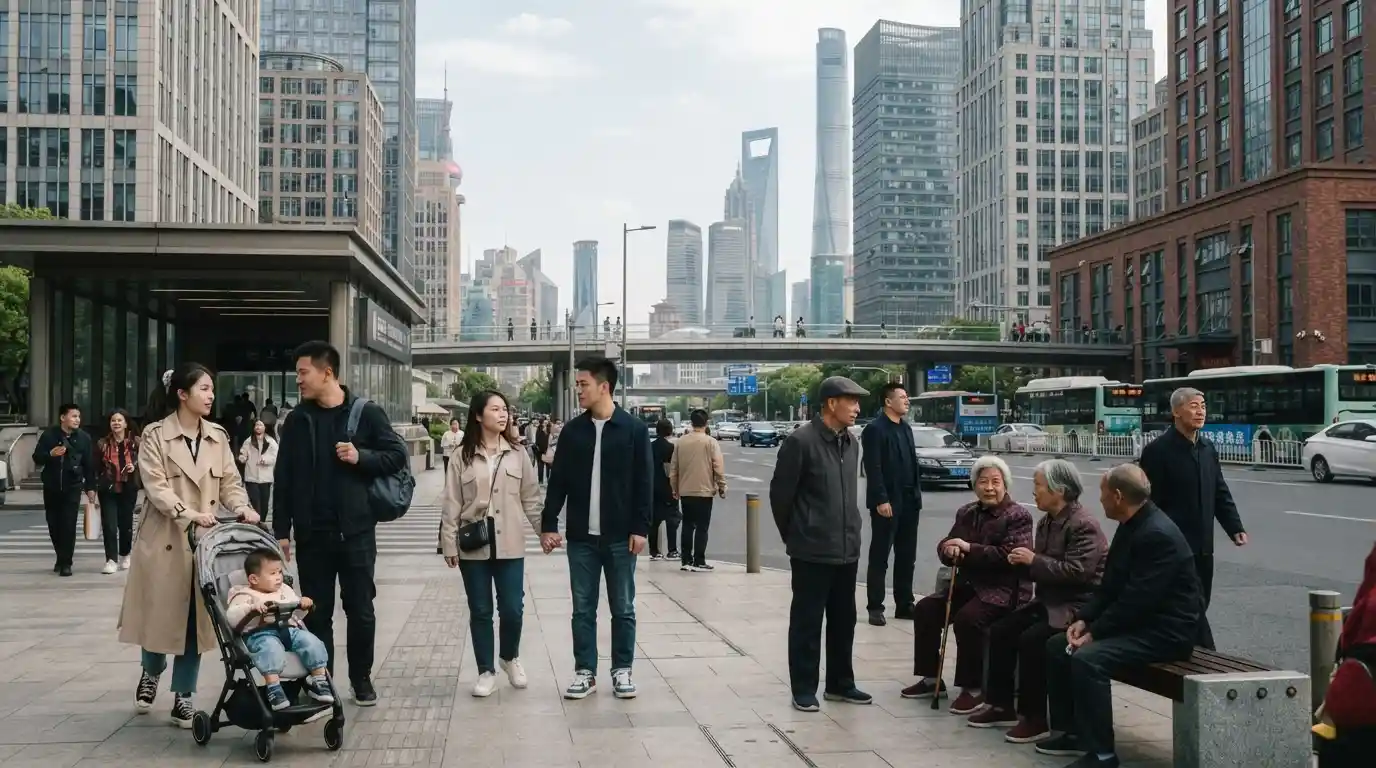
The change is more than a single annual statistic. Population size, fertility, aging, urbanization, employment, healthcare, housing, education, and consumer demand are closely connected. As China adjusts to a smaller and older population, demographic change is becoming increasingly important to the country’s economic and social outlook.
This shift also fits into a broader global discussion about how societies respond to changing population structures. From technology adoption and transportation to financial services and urban development, demographic trends can influence many areas of everyday life and long-term planning.
China’s Population Fell by 3.39 Million in 2025
China’s population stood at approximately 1.40489 billion at the end of 2025. That represented a decline of 3.39 million compared with the end of 2024.
The decline occurred because the number of deaths exceeded the number of births during the year. China recorded approximately 7.92 million births and 11.31 million deaths, producing a negative natural growth rate.
Although China remains one of the world’s most populous countries, the direction of population change has become an important issue. A sustained decline can gradually alter the size of the working-age population, household formation, consumer markets, education demand, and healthcare requirements.
For businesses and policymakers, the important question is therefore not simply how many people live in China today. It is how the age structure and distribution of that population may change over the next decade.
Births Fell to 7.92 Million
One of the clearest indicators of China’s demographic transition is the decline in annual births. In 2025, the country recorded 7.92 million births, while the crude birth rate was 5.63 births per 1,000 people.
A lower number of births eventually affects the size of future school-age and working-age populations. The effects do not happen immediately, but they accumulate over time. Fewer children today can mean fewer students in the future, followed by a smaller number of new workers several years later.
That makes fertility trends relevant to industries far beyond childcare. Education providers, consumer businesses, housing developers, healthcare organizations, technology companies, and financial institutions may all need to adjust to changing household structures.
China’s demographic shift also occurs alongside rapid technological change. For example, the growth of electric mobility and changing urban transportation patterns can be viewed alongside broader demographic and urban trends. Businesses interested in this transformation can also explore how EVs are shaping the future of urban commutes.
Deaths Outnumbered Births by a Wide Margin
China recorded approximately 11.31 million deaths in 2025. Compared with 7.92 million births, this created a natural decrease of roughly 3.39 million people.
This difference is important because population change is influenced by both fertility and mortality. Even if fertility were to stabilize, an aging population can continue to produce substantial numbers of deaths as larger older generations move through the age structure.
The issue therefore cannot be understood only as a decline in the birth rate. China is simultaneously experiencing population aging, changing household patterns, and continuing urbanization.
Healthcare demand is particularly relevant in an aging society. The country’s changing demographic profile can increase the importance of healthcare services, long-term care, wellness products, and technologies designed to support older adults. Broader healthcare-related topics are also explored in this guide to comprehensive healthcare services and this overview of healthcare solutions.
China Is Getting Older
Population decline and population aging are closely connected, but they are not the same thing. A country can have a very large population while simultaneously becoming older on average.
China’s 2025 figures demonstrate this changing age structure. People aged 60 and above accounted for approximately 23% of the population, while those aged 65 and above represented about 15.9%.
An aging population can affect labor supply, retirement systems, healthcare spending, household consumption, and demand for different types of products and services.
It can also create opportunities for businesses developing technologies that improve productivity. Automation, artificial intelligence, smart-home systems, and digital services can potentially help organizations serve customers and operate efficiently in an environment where the working-age population is under demographic pressure.
Readers interested in this technology transition can explore the changing role of AI-powered personal assistants and innovative smart-home devices.
The Working-Age Population Remains Large
Population decline does not mean that China suddenly lacks a large workforce. The country still has hundreds of millions of people within traditional working-age groups.
However, the long-term demographic direction matters. When fewer young people enter the population, the workforce can eventually become smaller as older generations retire.
This creates pressure to improve productivity rather than relying entirely on an expanding labor pool. Companies may increasingly focus on automation, employee productivity, digital transformation, and technology-enabled business models.
China’s broader digital economy provides useful context for this transition. Businesses examining how technology can improve operations may find value in digital transformation in business services, enterprise IT and marketing integration strategies, and advanced digital marketing and business transformation.
Urbanization Continues Despite Population Decline
Another important part of China’s demographic story is urbanization. A shrinking national population does not automatically mean that every city or region experiences the same trend.
People can continue moving from rural areas to cities even while the overall national population decreases. This can concentrate economic activity and consumer demand in major urban centers.
Urbanization can also change the way people use transportation, housing, retail, technology, and public services. This makes population distribution just as important as the national population total.
For businesses, understanding these shifts can help explain why some urban markets may continue to expand or modernize even during a period of national demographic decline.
What Does Population Decline Mean for Housing?
Housing is another sector that can be influenced by demographic change. Fewer households forming in some regions can eventually reduce demand for certain types of residential property, while continued urbanization can sustain demand in strategically important cities.
The effect is therefore unlikely to be identical across the entire country. Local population trends, employment opportunities, migration, household size, infrastructure, and economic conditions can all influence housing demand.
Technology is also changing how people research property and manage real estate decisions. Digital tools designed for property investors are becoming increasingly relevant, as illustrated by real estate tools designed to support property investment.
Education Could Face Long-Term Changes
A sustained decline in births can eventually reshape the education system. Fewer children can mean lower enrollment in primary schools and, later, changes in demand for secondary and higher education.
However, demographic decline does not necessarily mean education becomes less important. Instead, educational priorities can change. With a smaller younger population, improving educational quality, skills, and productivity may become even more significant.
Technology-enabled learning can also play a role in this transition. Digital education models may allow institutions to provide specialized learning opportunities more efficiently while supporting lifelong education for adults.
These trends can be considered alongside broader discussions about adult education and employment opportunities and the role of modern learning opportunities.
Consumer Markets May Become More Age-Specific
Population aging can change what consumers need and how companies market products. A younger population typically generates strong demand for products associated with children, education, first homes, and early-career lifestyles. An older population can increase demand for healthcare, wellness, financial planning, convenience services, and products designed around accessibility.
This does not mean younger consumers disappear. Instead, the relative size and economic importance of different age groups changes.
Businesses operating in China may therefore need more detailed customer segmentation. Rather than treating the population as one enormous consumer market, companies can increasingly develop products around age, location, household structure, income, and lifestyle.
Digital marketing can become especially useful in this environment. Businesses can explore broader approaches through global digital marketing strategy and digital marketing strategies for business growth.
Technology Could Help Offset Demographic Pressure
One of the major economic questions surrounding China’s demographic transition is whether productivity growth can compensate for a smaller labor force.
Automation, artificial intelligence, robotics, smart manufacturing, and digital services could allow businesses to produce more with fewer workers. The effectiveness of these technologies will depend on investment, skills, infrastructure, and how quickly organizations adapt.
China’s technology landscape is already developing rapidly. Topics such as artificial intelligence, smart devices, and advanced digital systems are increasingly connected to broader questions about productivity.
For example, businesses can examine technology-driven business innovation and changing mobility and consumer-service models as examples of how markets can adapt to changing consumer expectations.
China’s Demographic Shift Is a Long-Term Story
The 3.39 million population decline recorded in 2025 should be viewed as part of a longer demographic transition rather than an isolated annual event.
The combination of fewer births, more deaths, and a growing share of older residents can gradually reshape China’s economic structure. At the same time, continued urbanization, technological development, and productivity improvements may influence how strongly demographic pressures affect individual industries.
The key issue is therefore not simply whether China’s population is increasing or decreasing. The more important questions involve who makes up the population, where people live, how households are changing, how long people remain economically active, and how businesses respond to those changes.
What China’s Population Decline Could Mean for the Future
China’s demographic outlook could have consequences across multiple areas of society and the economy.
- Labor: A smaller younger population may eventually place greater emphasis on productivity and workforce participation.
- Healthcare: An aging population can increase demand for medical, wellness, and long-term care services.
- Education: Falling child populations may change enrollment patterns while increasing the importance of educational quality and skills.
- Housing: Demand may increasingly depend on regional population movements and household formation.
- Technology: Automation and digital tools may become increasingly important for productivity.
- Consumer markets: Companies may need to adapt products and marketing to an older and more diverse customer base.
- Urban development: Continued movement toward cities can concentrate economic activity despite national population decline.
Conclusion
China’s population decline of 3.39 million in 2025 marks another important stage in the country’s demographic transition. With 7.92 million births and 11.31 million deaths, the population recorded a negative natural growth rate for the year.
The consequences will not be limited to population statistics. Aging, fertility, urbanization, employment, housing, healthcare, education, technology, and consumer behavior are all connected to demographic change.
China’s future demographic story will therefore depend not only on birth and death rates, but also on how effectively households, businesses, cities, and institutions adapt to a changing population structure. For companies in particular, understanding these changes can help identify where demand is shifting and where technology and productivity improvements may become increasingly important.



