
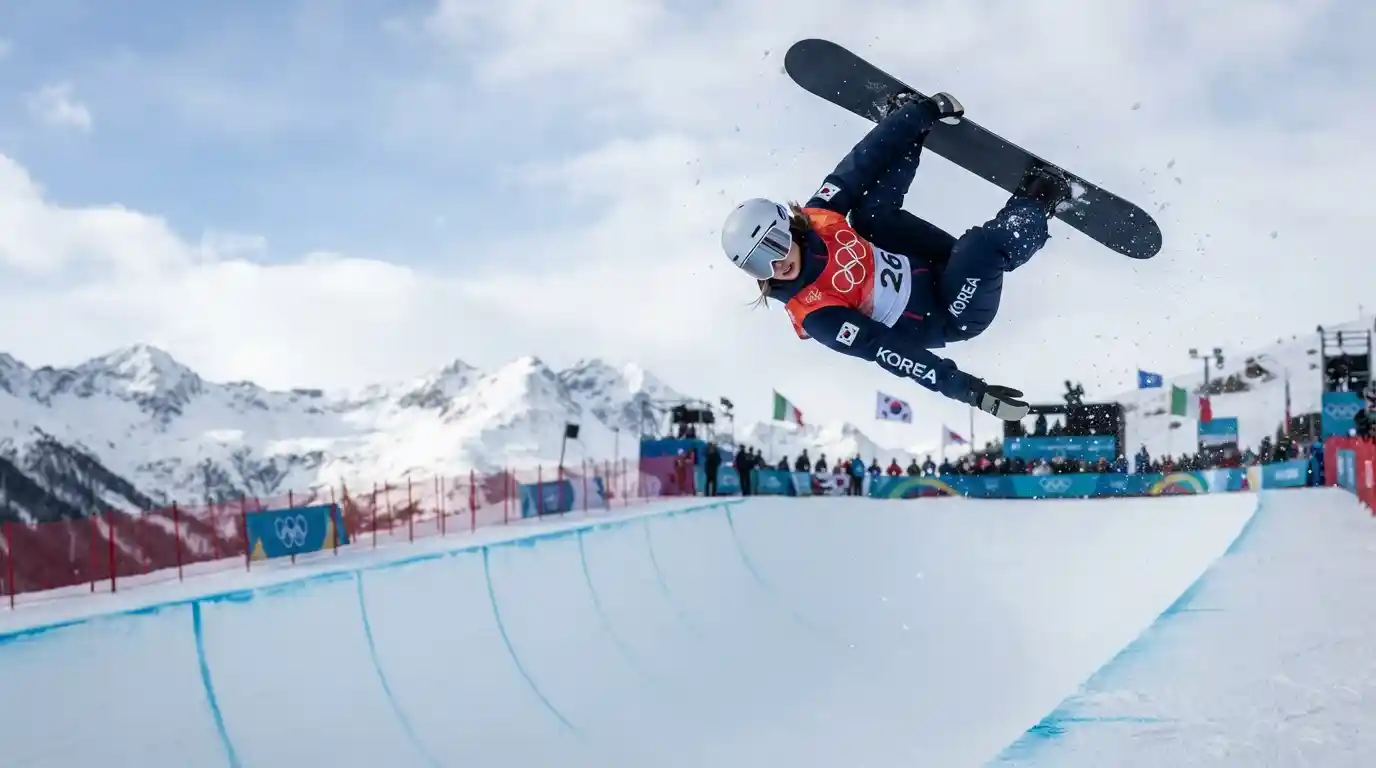
The women’s snowboard halfpipe final at the 2026 Winter Olympics delivered one of the most memorable moments of the Milano Cortina Games. South Korea’s Choi Ga-on overcame an early crash and produced a remarkable final run to win Olympic gold, defeating American snowboarding star Chloe Kim and ending her bid for a historic third consecutive Olympic halfpipe title.
2026 Women’s Snowboard Halfpipe Final Results
The Olympic final featured 12 riders competing for three medals. Each snowboarder had three runs, with the best score determining the final ranking. Choi’s winning performance came on her third attempt, after falls on her first two runs had made her medal hopes uncertain.
| Position | Athlete | Country | Best Score |
|---|---|---|---|
| Gold | Choi Ga-on | South Korea | 90.25 |
| Silver | Chloe Kim | United States | 88.00 |
| Bronze | Mitsuki Ono | Japan | 85.00 |
| 4th | Sara Shimizu | Japan | 84.00 |
| 5th | Rise Kudo | Japan | 81.75 |
| 6th | Cai Xuetong | China | 80.75 |
| 7th | Wu Shaotong | China | 78.00 |
| 8th | Bea Kim | United States | 77.00 |
| 9th | Sena Tomita | Japan | 68.25 |
| 10th | Queralt Castellet | Spain | 33.50 |
| 11th | Elizabeth Hosking | Canada | 27.50 |
| 12th | Maddie Mastro | United States | 5.50 |
The final standings reflected the difficulty of the halfpipe, where amplitude, rotation, execution, landing control, and the overall composition of a run can determine the difference between a medal and a lower finish.
Choi Ga-on’s Incredible Comeback After an Early Crash
Choi’s route to Olympic gold was far from straightforward. During her opening run, the young South Korean snowboarder suffered a heavy fall that required medical attention. Her second attempt also ended in a fall, leaving her with one final opportunity to produce a competitive score.
Instead of allowing the difficult start to define her competition, Choi returned for her third run with the pressure firmly on her shoulders. She delivered a technically demanding sequence of tricks, maintaining flow through the halfpipe and combining rotations with controlled grabs and a strong finish.
The judges awarded her 90.25 points, moving her above Kim’s leading score of 88.00. With several riders still to compete, Choi had to wait for the remaining runs before her gold medal was confirmed.
Her victory demonstrated the importance of composure, adaptability, and execution in elite snowboarding. A single fall can change a competition, but a successful final attempt can also transform an athlete’s Olympic story.
Chloe Kim Wins Silver After a Historic Olympic Career
Chloe Kim entered the Milano Cortina 2026 final as the two-time defending Olympic women’s halfpipe champion. She had won gold at PyeongChang 2018 and Beijing 2022, and another victory would have made her the first snowboarder to win three consecutive Olympic titles in the same event.
Kim established an early benchmark with a strong opening run worth 88.00 points. Her performance placed immediate pressure on the rest of the field and remained the score to beat until Choi’s decisive third attempt.
In her final run, Kim had a chance to reclaim the lead but could not complete the landing she needed. She finished with silver, adding another Olympic medal to an already remarkable career.
Although the result ended her pursuit of a three-peat, Kim remained one of the defining athletes in women’s snowboarding. Her consistency, technical ability, and influence on younger competitors have helped raise the profile of halfpipe snowboarding around the world.
Why Choi Ga-on’s Olympic Gold Is Historic
Choi’s victory was significant for several reasons. At 17, she became the first South Korean woman to win an Olympic snowboarding gold medal. Her performance also made her the youngest snowboarder to win an Olympic gold medal, adding another milestone to an already memorable final.
The achievement highlighted the growing international depth of women’s snowboarding. Athletes from South Korea, the United States, Japan, China, Canada, Spain, and other countries competed in a final where small differences in execution could have major consequences.
For South Korea, the result expanded the country’s presence in a winter sport traditionally associated with established snowboarding powers. For young athletes, Choi’s comeback illustrated how preparation and confidence can help competitors respond to setbacks on the biggest stage.
Readers interested in Choi’s background can also explore our related profile, Who Is Choi Ga-on, the Snowboarder Who Beat Chloe Kim at the 2026 Winter Olympics?
Understanding the Women’s Snowboard Halfpipe Competition
Snowboard halfpipe takes place on a specially constructed, U-shaped snow course with steep walls on both sides. Riders move from one wall to the other, launching into the air to perform spins, flips, grabs, and other aerial maneuvers.
Judges evaluate several aspects of each run, including the difficulty and variety of tricks, amplitude, execution, progression, and overall composition. Clean landings are essential because a fall can interrupt a sequence and reduce a rider’s final score.
Unlike a race decided by finishing time, halfpipe snowboarding rewards a combination of technical difficulty and controlled performance. Riders must balance risk with consistency, particularly when the final run provides their last opportunity to improve their standing.
The physical demands are substantial. Athletes need strength, balance, aerial awareness, precise timing, and the ability to recover mentally after mistakes. These qualities are relevant across competitive sports, including those covered in our guides to athletic performance and training and the role of sports facilities in athlete development.
Livigno Snow Park: The Setting for the Historic Final
The women’s halfpipe final took place at Livigno Snow Park in Livigno, an Alpine resort town in northern Italy. Its mountain setting provided the backdrop for a competition shaped by difficult tricks, changing momentum, and a dramatic final run.
Winter sports events depend on more than the athletes alone. Course preparation, snow conditions, safety teams, event scheduling, and venue operations all contribute to the competition environment. The importance of planning and coordination is also relevant to broader discussions of event setup and sports event operations.
For travelers inspired by the atmosphere of an Alpine competition, winter destination planning can offer another way to explore mountain landscapes and seasonal activities. BizHorizone also features guides to European winter destinations, winter destinations in the northeastern United States, and places to experience New England in winter.
What the Result Means for Women’s Snowboarding
The final represented both continuity and change. Kim’s silver medal reinforced her standing among the sport’s leading athletes, while Choi’s gold signaled the arrival of a new Olympic champion. Ono’s bronze further demonstrated the strength of Japan’s women’s halfpipe program.
Choi’s performance also showed that a competition can remain open until the final run. Early scores create pressure, but they do not guarantee the outcome when athletes still have opportunities to respond. That uncertainty is one of the reasons halfpipe snowboarding remains compelling to watch.
The result may encourage more young athletes to pursue the sport, particularly in countries seeking greater representation in Olympic snowboarding. Continued coaching, access to suitable training facilities, and opportunities to compete internationally will be important to developing the next generation.
Readers following other sports and athletic destinations can explore sports facilities and recreational competition, women’s athletic performance, and sports tournaments and competitive development.
Winter Travel Inspiration for Sports Fans
Major winter sporting events often inspire fans to explore snowy destinations and mountain communities. Travelers planning a winter getaway can compare different regions based on scenery, outdoor recreation, accessibility, and seasonal activities.
- Vermont destinations for a family winter trip
- Winter destinations across New York State
- Places to visit in Milwaukee during winter
- Winter destinations near Illinois
- Albania’s winter travel possibilities
- Places to visit near Tokyo in winter
- Tokyo in the winter season
- Colorado destinations for a seasonal getaway
- Banff’s mountain scenery in summer
- Travel ideas across the eastern United States
These destinations differ in climate, activities, and travel conditions. Visitors should check local weather, transport arrangements, and seasonal opening information before making plans, especially when traveling to mountainous areas.
Frequently Asked Questions
Who won the women’s snowboard halfpipe at the 2026 Winter Olympics?
Choi Ga-on of South Korea won the gold medal with a best score of 90.25 points.
What medal did Chloe Kim win in the 2026 Olympic halfpipe final?
Chloe Kim won silver with a best score of 88.00 points, finishing behind Choi Ga-on.
Who won bronze in women’s snowboard halfpipe?
Mitsuki Ono of Japan won bronze with 85.00 points.
Where was the 2026 women’s snowboard halfpipe final held?
The final took place at Livigno Snow Park in Livigno, Italy, on February 12, 2026.
Why was Choi Ga-on’s victory historic?
Choi became the first South Korean woman to win an Olympic snowboarding gold medal and, at 17, the youngest snowboarder to win an Olympic gold medal.
Did Chloe Kim win three consecutive Olympic halfpipe titles?
No. After winning gold in 2018 and 2022, Kim finished second in 2026, ending her bid for three consecutive Olympic titles in the event.
Final Thoughts
The 2026 Winter Olympics women’s snowboard halfpipe final will be remembered for Choi Ga-on’s resilience and the precision of her decisive third run. Recovering from two falls, she produced a score of 90.25 to defeat Chloe Kim by 2.25 points and claim a historic gold medal for South Korea.
Kim’s silver and Mitsuki Ono’s bronze completed a podium that reflected the global strength of women’s snowboarding. More than a change in medal positions, the final offered a compelling reminder that elite sport rewards preparation, adaptability, and the ability to perform when the pressure is greatest.



