
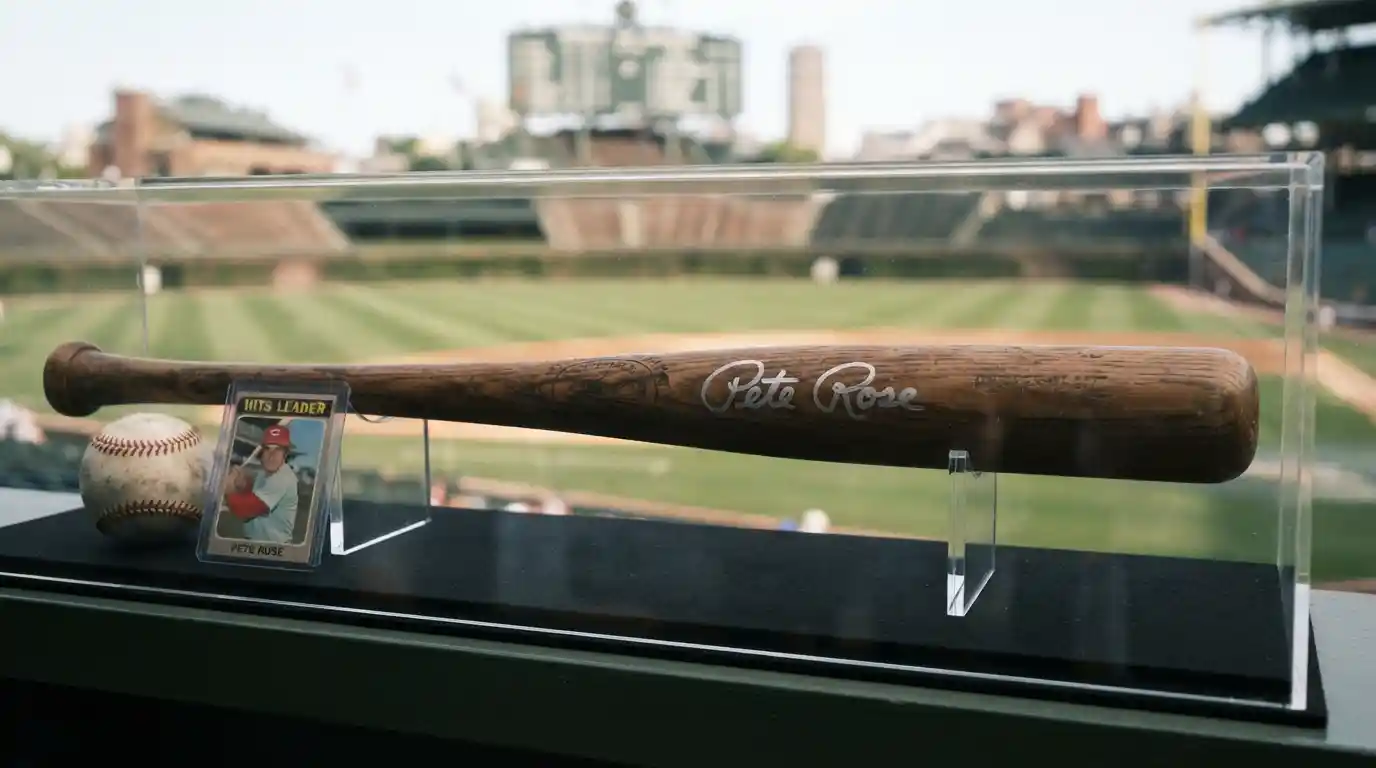
But buying signed sports memorabilia requires more than finding a signature on a bat. Collectors should consider authentication, provenance, inscriptions, bat model, condition, display quality, and the item’s relationship to Rose’s playing career.
This guide explains what makes a Pete Rose signed bat interesting, what to examine before buying one, how authentication affects confidence, and how to preserve and display the piece once it becomes part of your collection.
Why a Pete Rose Autographed Bat Matters to Baseball Collectors
Pete Rose remains one of baseball’s most recognizable figures because of the extraordinary volume of his career achievements. He finished his Major League career with 4,256 hits and became closely associated with the nickname “Charlie Hustle.”
His career also connects several important chapters of baseball history. Rose played for the Cincinnati Reds during the organization’s dominant 1970s period, later played for the Philadelphia Phillies and Montreal Expos, and returned to Cincinnati near the end of his playing career.
That history gives collectors several ways to approach signed memorabilia. Some buyers are primarily interested in Rose as the all-time MLB hits leader, while others prefer items connected to the Reds and the history of major sporting achievements.
What Makes a Pete Rose Signed Bat Collectible?
Not every signed bat carries the same appeal. Several characteristics can make one example more interesting than another.
1. The Signature
The autograph itself is obviously central to the piece. Collectors should examine its placement, clarity, ink type, consistency, and overall condition.
A bold signature that remains easy to see can make a bat substantially more attractive as a display piece. Signatures that are heavily faded, damaged, or located in an awkward position may be less visually appealing.
2. Authentication
Authentication is one of the most important considerations when purchasing signed sports memorabilia. A reputable third-party authentication service can provide additional confidence that the autograph was examined against known examples.
Collectors should carefully inspect the authentication documentation or certification information rather than assuming that every certificate carries the same level of credibility.
3. Provenance
Provenance refers to the documented history of an item. An autograph accompanied by credible information about when, where, or how it was obtained can be more compelling than an unsigned-history claim with no supporting documentation.
For particularly significant memorabilia, provenance can become an important part of the item’s story.
4. Bat Model and Era
The type of bat can add another layer of interest. A collector may prefer a vintage professional-model bat, a Louisville Slugger example, a commemorative bat, or a bat featuring a meaningful inscription.
The era represented by the bat can also matter. A piece associated with Rose’s Cincinnati Reds years may appeal to collectors interested specifically in the Big Red Machine period.
Pete Rose and the Baseball History Behind the Bat
Understanding Rose’s career helps explain why his autograph continues to attract memorabilia collectors.
Rose debuted with the Cincinnati Reds in 1963 and became one of the defining players of his generation. His relentless approach at the plate, durability, and ability to play multiple positions helped make him a distinctive figure in professional baseball.
He was part of the Reds teams that won consecutive World Series championships in 1975 and 1976. He later won another championship with the Philadelphia Phillies in 1980.
His most famous statistical milestone came in 1985, when he passed Ty Cobb to become Major League Baseball’s career hits leader. That 4,256-hit record remains central to the story surrounding many Rose collectibles.
Baseball memorabilia collectors often gravitate toward artifacts that connect directly to major achievements. The same principle can be seen across the broader world of autographed entertainment and collectible memorabilia.
Different Types of Pete Rose Autographed Bats
There is no single standard format for a Rose signed bat. Collectors may encounter several different categories.
Professional-Model Bats
Professional-model bats can be especially interesting because they resemble equipment associated with a player’s professional career. However, a professional-model bat should not automatically be described as game-used.
Collectors should distinguish carefully between a bat manufactured as a professional model and one with documented game use.
Commemorative Bats
Commemorative bats may celebrate a career milestone, team history, or statistical achievement. These can be attractive display pieces because the design often complements the autograph.
Inscribed Bats
An inscription can make an autograph more distinctive. Numbers, nicknames, achievements, or career references may give the piece additional historical context.
However, collectors should verify the inscription just as carefully as the signature itself and understand exactly what the wording represents.
Game-Used and Game-Associated Bats
A documented game-used bat is a different category from a standard signed bat. If an item is marketed as game-used, collectors should look for strong documentation supporting that claim.
Game use can significantly change the historical significance of memorabilia, but it should never be assumed simply because a bat looks old or heavily worn.
How to Authenticate a Pete Rose Autographed Bat
Authentication should be treated as a core part of the purchasing process rather than an optional extra.
Check the Authentication Company
Start by identifying who authenticated the signature. Established authentication services generally maintain databases, certification systems, or documentation that can help buyers evaluate an item.
Match Certification Details
If a certificate or certification number is supplied, verify that the details correspond to the actual item. Look for discrepancies involving the player, item description, certification number, or photographs.
Study the Signature
Compare the autograph with established examples from the same general period when possible. Signature styles can evolve over time, so collectors should avoid relying on one example alone.
Review the Seller’s Description Carefully
Words such as “game-used,” “game-issued,” “professional model,” “signed,” and “commemorative” can describe very different things. Read the listing carefully and identify exactly what is being claimed.
What Should You Look for Before Buying?
Before purchasing a Pete Rose autographed bat, create a simple checklist.
- Authentication: Is the autograph supported by credible authentication?
- Provenance: Is there a documented history behind the item?
- Bat type: Is it a commemorative, professional-model, or potentially game-used bat?
- Condition: Are there cracks, scratches, fading, or finish loss?
- Signature condition: Is the autograph bold and easy to read?
- Inscriptions: Does the inscription appear authentic and historically meaningful?
- Documentation: Are certificates, letters, or supporting records included?
- Seller reputation: Does the seller have a credible track record?
Taking a few minutes to evaluate these factors can help prevent an impulsive purchase based solely on the recognizable name.
Condition Can Make a Big Difference
Condition is important for both the bat and the autograph.
A collector should look for surface damage, dents, cracks, moisture exposure, discoloration, and signs of improper restoration. The signature should also be inspected for fading, smearing, or damage caused by poor storage.
Remember that a game-used bat can naturally show wear. In that situation, wear may actually be part of the item’s historical story. The key question is whether the condition is consistent with the item’s documented history.
How Much Is a Pete Rose Autographed Bat Worth?
There is no single fixed value for every Pete Rose signed bat. Prices can vary considerably depending on authentication, condition, bat model, inscription, provenance, rarity, and whether game use can be documented.
Recent auction examples illustrate why collectors should evaluate individual pieces rather than relying on a generic “Pete Rose bat value.” A signed Louisville Slugger example sold at auction in 2026, while other professionally documented or inscribed bats have appeared at different price points.
The broader sports memorabilia market also contains signed bats from many other notable athletes, including items featured in sports and competitive athletics coverage.
Does a Pete Rose Autograph Make the Bat Valuable?
An autograph can make a bat collectible, but the signature alone does not determine its value.
Two bats signed by the same player can have very different prices. One may have strong authentication, a desirable model, an important inscription, and excellent provenance. Another may simply have a signature with little supporting documentation.
For that reason, collectors should evaluate the complete package instead of focusing only on the autograph.
Where Collectors May Find Signed Pete Rose Bats
Signed bats can appear through sports memorabilia auctions, established collectibles dealers, private collections, estate sales, and specialty marketplaces.
Auctions can be particularly useful because completed sales provide real-world examples of what buyers have actually paid. However, the final price of one item should not automatically be treated as the market value of every similar bat.
Collectors interested in sports memorabilia can also explore related subjects such as baseball collectibles and Pete Rose memorabilia, signed sports artifacts, and the broader world of autographed collectibles.
How to Display a Pete Rose Signed Bat
Once you own an authenticated signed bat, proper presentation can turn it into an impressive centerpiece.
Use a Protective Bat Case
A dedicated bat display case can protect the item from dust, accidental contact, and environmental exposure while keeping the signature visible.
Avoid Direct Sunlight
Ultraviolet exposure can contribute to fading over time. Position the display away from direct sunlight and strong artificial light sources.
Control the Environment
Extreme humidity and temperature fluctuations can be harmful to wooden collectibles. A stable indoor environment is generally preferable to a garage, attic, or damp storage area.
Consider a Baseball-Themed Display
A signed bat can be combined with photographs, baseballs, cards, or other memorabilia to create a cohesive display. Sports fans who collect memorabilia often build displays around a particular player, team, championship, or era.
For broader sports inspiration, related pages such as sports facilities and athletics, athletic performance, and competitive sports environments provide additional context around the culture surrounding sports collecting.
Pete Rose’s Legacy in Baseball Memorabilia
Rose’s legacy is unusually complex. His achievements on the field made him one of baseball’s most recognizable players, while his later gambling-related controversy became a defining part of his public history.
That complexity is reflected in the memorabilia market. Some collectors focus primarily on his statistical accomplishments and Cincinnati Reds career, while others are interested in artifacts connected to the controversies and later chapters of his life.
The result is a memorabilia category with several different collector motivations. A buyer should understand their own reason for purchasing before deciding which type of bat makes the most sense.
Is a Pete Rose Autographed Bat a Good Collectible?
For a baseball fan or sports memorabilia collector, a properly authenticated Pete Rose signed bat can be a compelling historical display piece.
The strongest purchases are generally those where the buyer understands exactly what they are acquiring. Authentication, provenance, bat type, condition, inscription, and documented history should all be considered together.
Rather than purchasing solely because the name Pete Rose appears on the bat, think about what story the specific item tells. A well-documented bat connected to a meaningful period of Rose’s career can provide considerably more collector interest than an item with an uncertain background.
Final Thoughts
A Pete Rose autographed bat can represent much more than a signature. It can connect a collector to one of the most remarkable statistical careers in baseball and to an era that remains deeply associated with Cincinnati baseball history.
If you are considering buying one, prioritize authentication, documentation, condition, and provenance. Take time to compare similar pieces, review completed auction results, and understand the exact type of bat being offered.
For collectors who value baseball history, a carefully authenticated Pete Rose bat can become a memorable centerpiece of a larger sports memorabilia collection.
Frequently Asked Questions
How many hits did Pete Rose have?
Pete Rose finished his Major League career with 4,256 hits, the all-time MLB career hits record.
What makes a Pete Rose signed bat collectible?
Authentication, provenance, bat model, condition, inscriptions, and connections to important periods of Rose’s career can all affect collector interest.
Should I buy a Pete Rose bat without authentication?
Buyers should exercise caution with unauthenticated autographs. Credible authentication can provide substantially greater confidence about the signature’s authenticity.
Is every Pete Rose professional-model bat game-used?
No. A professional-model bat is not automatically a game-used bat. Game use should be supported by appropriate documentation.
How should I protect a signed baseball bat?
Use a suitable protective display case, keep the bat away from direct sunlight, and store it in a stable indoor environment away from excessive humidity and temperature fluctuations.