
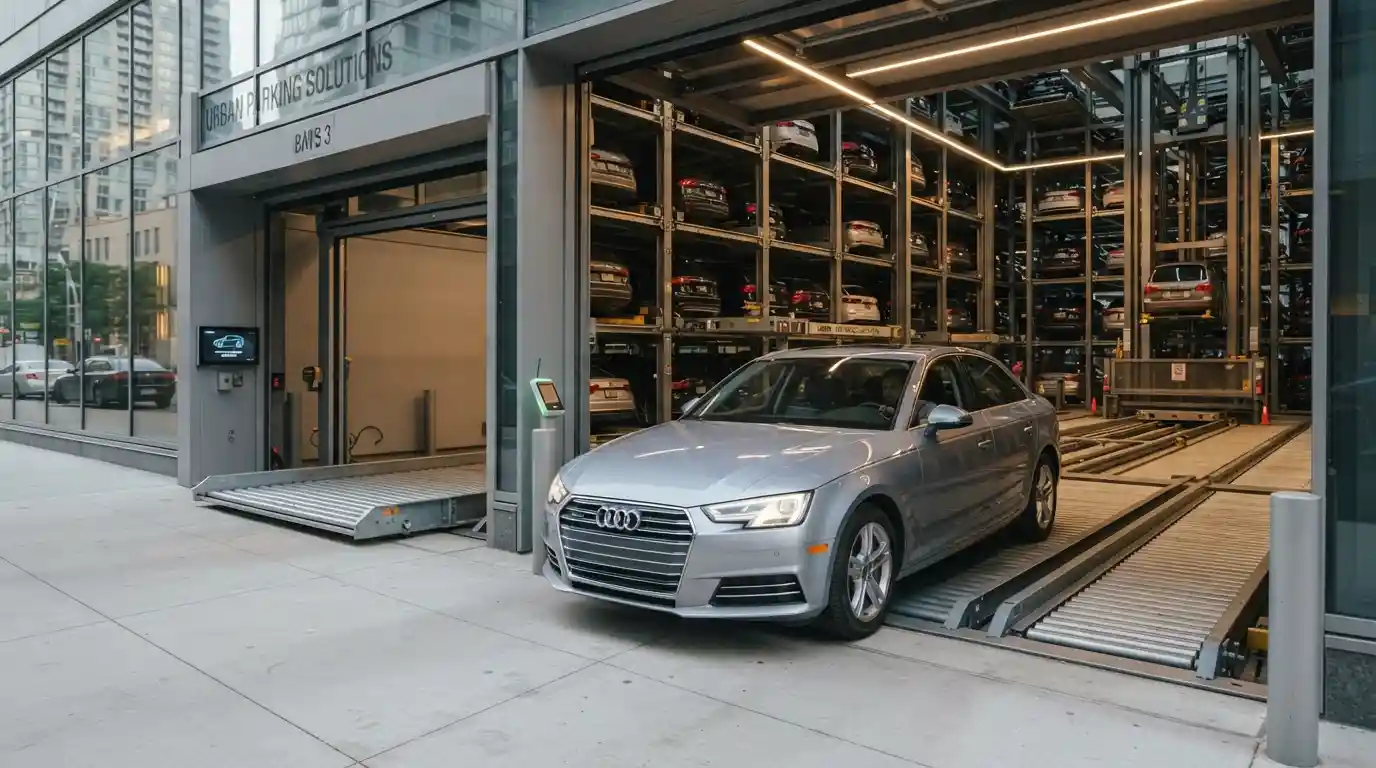
That experience started to change when I began looking into automated parking systems using RFID technology. Instead of treating parking as a manual chore, these systems combine sensors, software, vehicle identification, and automated equipment to make the process faster and more organized.
The idea fits naturally into the broader movement toward smarter transportation. Electric vehicles are already changing urban mobility, as explored in how EVs are shaping the future of urban commutes, while connected technologies are becoming increasingly common in everyday environments.
My interest in automated parking eventually led to a simple conclusion: parking does not necessarily have to involve watching every movement of your vehicle.
What Is an Automated Parking System?
An automated parking system is a technology-driven parking solution designed to reduce or eliminate many of the manual steps involved in conventional parking.
Depending on the system, a driver may only need to bring the vehicle to a designated entry area. Sensors, cameras, software, mechanical equipment, and identification technologies can then work together to determine where the vehicle should go.
Some systems are designed primarily to guide drivers toward available spaces. More advanced systems can physically move or position vehicles without requiring the driver to navigate through the parking structure.
This approach is particularly useful where space is limited, parking demand is high, or operators want to improve the efficiency of a facility.
Where Does RFID Technology Fit In?
RFID stands for radio-frequency identification. The technology uses radio waves to identify an RFID tag or other compatible identifier.
In an automated parking environment, an RFID tag can be associated with a vehicle or authorized user. When the vehicle approaches a compatible RFID reader, the system can recognize the identification information without requiring the driver to manually enter a code every time.
That seemingly small improvement can make a major difference when it is incorporated into a larger parking-management platform.
Instead of thinking about RFID as the entire parking system, it is more accurate to think of it as one component within a connected ecosystem. The RFID reader identifies the vehicle, while other technologies can determine location, availability, access permissions, vehicle position, and system status.
Why RFID Makes Parking Feel Easier
The biggest advantage I noticed conceptually is the reduction of repetitive manual actions.
Traditional parking may involve tickets, keypads, payment terminals, access cards, or repeated interactions with parking attendants. RFID can streamline the identification stage by allowing compatible systems to recognize a vehicle electronically.
This is similar to the wider trend toward connected technology in homes and businesses. For example, smart home devices and connected systems demonstrate how automated identification and communication can simplify routine activities.
In parking, the same basic philosophy applies: let technology handle predictable tasks so people can spend less time managing them manually.
How an RFID Automated Parking System Works
Although implementations differ, the process can be understood through several basic stages.
1. Vehicle Identification
The process typically begins when the vehicle approaches an access point. An RFID reader detects the compatible tag associated with the vehicle.
The system can then compare the identification information with its database to determine whether the vehicle is authorized to enter.
2. Access Verification
Once the vehicle is identified, the parking management software can verify the relevant access rules.
For example, a system may distinguish between registered users, visitors, employees, residents, or temporary parking customers.
3. Space or Position Assignment
After authorization, the system determines where the vehicle should go. Depending on the facility, this could involve assigning a conventional parking space or directing the vehicle into an automated storage area.
Modern parking solutions may combine RFID with sensors, cameras, software, and other forms of automation to improve accuracy.
4. Automated Vehicle Movement
In fully automated facilities, mechanical equipment can move the vehicle into the assigned location.
The exact mechanism varies. Some facilities use platforms, lifts, conveyors, robotic systems, or combinations of these technologies.
The driver therefore does not need to spend several minutes maneuvering around a crowded parking structure.
5. Retrieval
When the driver is ready to leave, the system identifies the stored vehicle and initiates the retrieval process.
The vehicle can then be brought to an appropriate pickup area, reducing the need for the driver to walk through a large parking facility searching for the correct space.
RFID Is Only One Part of the Technology
One mistake people can make when discussing automated parking is assuming that RFID alone creates an intelligent parking facility.
It does not.
RFID is primarily useful for identification and access. A complete automated parking system can require a much larger technology stack.
That may include:
- RFID readers and vehicle tags
- Parking sensors
- Vehicle-position detection
- Cameras and visual monitoring
- Parking management software
- Automated gates
- Mechanical vehicle-handling equipment
- Payment and account-management systems
- Safety sensors
- Network connectivity
- Centralized system monitoring
This combination reflects the broader shift toward integrated technology. Businesses exploring digital transformation in business services are making similar changes by connecting traditionally separate processes through software and automation.
Why I Stopped Thinking About Parking the Same Way
The most interesting part of automated parking is not the machinery itself. It is the change in the driver’s experience.
Traditional parking requires continuous human attention. You watch the road, look for spaces, judge distances, maneuver around obstacles, and remember where the vehicle is located.
An automated environment changes that relationship.
The driver interacts with the system primarily at defined points, while the technology handles many of the repetitive operational steps.
That same philosophy appears across modern transportation. Vehicle ownership itself is changing, with car subscription services offering alternatives to conventional ownership models.
The common theme is convenience: technology is increasingly being used to remove friction from transportation.
Major Benefits of Automated Parking Systems
Better Use of Parking Space
Automated parking can potentially use available space more efficiently than conventional layouts.
Traditional parking structures need room for ramps, driving lanes, doors, pedestrian movement, and vehicle maneuvering. Automated systems can reduce some of these requirements depending on their design.
This can be particularly valuable in dense urban environments where land is expensive and parking demand is high.
Less Driver Stress
Parking in a crowded facility can be frustrating. Narrow spaces, traffic, poor visibility, and impatient drivers can make the experience unnecessarily stressful.
Automation can reduce the amount of manual maneuvering required from the driver.
Faster Vehicle Identification
RFID can make vehicle recognition more convenient by allowing a compatible reader to identify an authorized tag electronically.
This can reduce dependence on manually entering credentials or repeatedly interacting with access equipment.
Improved Operational Control
A centralized parking platform can provide operators with better visibility into vehicle movements, available spaces, access events, and system conditions.
This is part of a much larger technology trend. Modern industrial and operational systems increasingly depend on connected platforms, as demonstrated by technologies discussed in business technology and innovation.
Potential Reduction in Unnecessary Circulation
Drivers searching for parking can spend considerable time circulating through a facility. An automated or intelligently managed system can reduce unnecessary vehicle movement by assigning spaces or handling storage more systematically.
Security and Access Control
Parking is not only about convenience. Security is another important consideration.
RFID-based identification can help parking operators distinguish between authorized and unauthorized vehicles. When integrated with access-control software, the system can maintain records of entry and exit events.
However, RFID should not be treated as a complete security solution. A robust parking environment may combine electronic identification with cameras, barriers, software permissions, physical security, and operational procedures.
This layered approach is consistent with the wider development of connected security systems. For example, modern home security services increasingly combine multiple technologies rather than relying on one device.
What Happens When Technology Fails?
This is one question that should never be ignored when discussing automation.
Automated parking systems depend on hardware, software, electricity, communication networks, and mechanical components. Any of these elements can potentially experience a fault.
That means a professionally designed system needs appropriate backup procedures and safety mechanisms.
Operators should consider questions such as:
- What happens during a power interruption?
- How are vehicles retrieved if a component fails?
- How does the system detect an obstruction?
- What happens if an RFID tag cannot be read?
- Is there a manual override?
- How are maintenance alerts handled?
- How quickly can technicians respond to failures?
Automation should reduce operational problems, not simply move them from drivers to maintenance teams.
RFID Versus Traditional Parking Access
Traditional parking access commonly relies on tickets, payment cards, keypads, or manually operated barriers.
RFID-based access can provide a more seamless experience because identification can occur electronically as the vehicle approaches the reader.
| Feature | Traditional Parking | RFID-Enabled Parking |
|---|---|---|
| Vehicle identification | Manual ticket or credential | Electronic tag recognition |
| Driver interaction | Often repeated | Can be reduced |
| Access control | Ticket or attendant based | Software and RFID enabled |
| Automation potential | Limited | High when integrated with other systems |
| Data collection | May be fragmented | Can be centrally managed |
The important distinction is that RFID does not automatically make a parking facility fully autonomous. It becomes significantly more powerful when connected to the rest of the parking infrastructure.
Automated Parking and Electric Vehicles
The growth of electric vehicles makes the parking conversation even more interesting.
As EV adoption grows, parking facilities may increasingly need to accommodate charging infrastructure alongside conventional parking requirements.
A smarter parking platform could potentially connect vehicle identification, parking allocation, charging availability, and payment processes into a more integrated experience.
This creates an interesting connection between automated parking and the broader evolution of transportation described in the future of urban EV commuting.
Future parking facilities may not simply be places where vehicles wait. They could become connected mobility hubs where vehicles are identified, parked, charged, retrieved, and managed through coordinated digital systems.
The Role of Smart Infrastructure
Automated parking makes the most sense when it is considered part of a larger smart-infrastructure strategy.
Buildings are becoming more connected. Vehicles are becoming more intelligent. Payment systems are becoming increasingly digital. Businesses are using software to automate operational decisions.
Parking sits directly at the intersection of these trends.
Technologies such as smart connected equipment show how physical infrastructure can increasingly communicate with digital systems.
Similarly, developments in enterprise IT integration demonstrate why isolated technologies are becoming less useful than connected platforms.
Where Automated Parking Can Be Especially Useful
Automated parking technology can be considered for several environments.
Urban Parking Facilities
Dense cities often have limited land availability. Automated systems may allow operators to make better use of constrained spaces.
Residential Buildings
Apartment and condominium developments can benefit from controlled vehicle access and organized parking management.
Commercial Buildings
Office buildings can use automated identification and access systems to manage employee and visitor parking.
Hotels
Hotels may use technology-driven parking solutions to create a smoother arrival and departure experience for guests.
Transportation Hubs
Large facilities near airports, stations, or other transportation centers can potentially benefit from systems that organize high volumes of vehicles.
For travelers, parking itself is already an important part of the journey. The Dubai airport car parking guide is an example of how parking fees, terminals, and access can become significant travel considerations.
What Automated Parking Does Not Solve
Automation is powerful, but it is not a magic solution.
A poorly designed parking facility can still have capacity limitations. RFID readers can still experience technical problems. Mechanical systems require maintenance. Software requires updates. Users still need clear instructions.
There are also financial considerations. Installing automated equipment can require substantially more planning and investment than creating a conventional parking area.
Operators therefore need to evaluate the complete lifecycle rather than focusing only on the convenience offered to drivers.
Maintenance Is Critical
Any automated parking system is only as reliable as its maintenance program.
RFID readers need to function correctly. Sensors must provide accurate information. Mechanical components need inspection. Software and network systems need monitoring.
This is where experience in vehicle and equipment maintenance remains important. Related automotive service topics such as vehicle electrical services demonstrate how modern vehicles increasingly depend on sophisticated electronic systems.
Professional maintenance should therefore be treated as a core part of an automated parking strategy rather than an afterthought.
Could Automated Parking Become the New Normal?
I believe automated parking has strong potential, particularly as vehicles and buildings become more connected.
However, widespread adoption will depend on several factors:
- Installation costs
- Reliability
- Maintenance requirements
- Available space
- Local building requirements
- User acceptance
- Integration with existing parking infrastructure
- Cybersecurity and data management
The technology will be most compelling when it delivers a noticeably better experience without creating new complications for drivers or operators.
The Bigger Picture: Cars Are Becoming Part of Connected Systems
Automated parking is interesting because it demonstrates something bigger than a convenient way to store a vehicle.
The modern automobile is increasingly becoming part of a connected technological environment.
Vehicles communicate with charging systems, navigation platforms, payment systems, mobile applications, security infrastructure, and increasingly intelligent buildings.
Parking is simply another piece of that ecosystem.
The evolution of connected technology can also be seen in advanced consumer electronics. For example, advanced home audio technology illustrates how physical devices increasingly depend on sophisticated digital control and integration.
In the same way, future parking systems may become less visible to users while becoming more sophisticated behind the scenes.
My Final Take on RFID Automated Parking
Why did I quit watching cars park?
Because the most interesting future of parking may involve letting intelligent systems handle the repetitive parts.
RFID technology provides a useful foundation for identifying vehicles and managing access. When combined with sensors, software, mechanical systems, cameras, and connected infrastructure, it can become part of a much broader automated parking solution.
The goal is not to remove humans from the process completely. The goal is to make parking more convenient, organized, secure, and efficient.
As smart transportation continues to develop, automated parking could become an increasingly normal part of the driving experience. The same technological shift that is transforming EVs, connected buildings, digital payments, and intelligent infrastructure is also changing what happens after a vehicle reaches its destination.
For drivers, that could mean fewer frustrating parking searches, less manual maneuvering, and a much simpler relationship with one of the most routine parts of modern transportation.
The future of parking may not be about becoming better at parking a car. It may be about needing to park it manually in the first place.