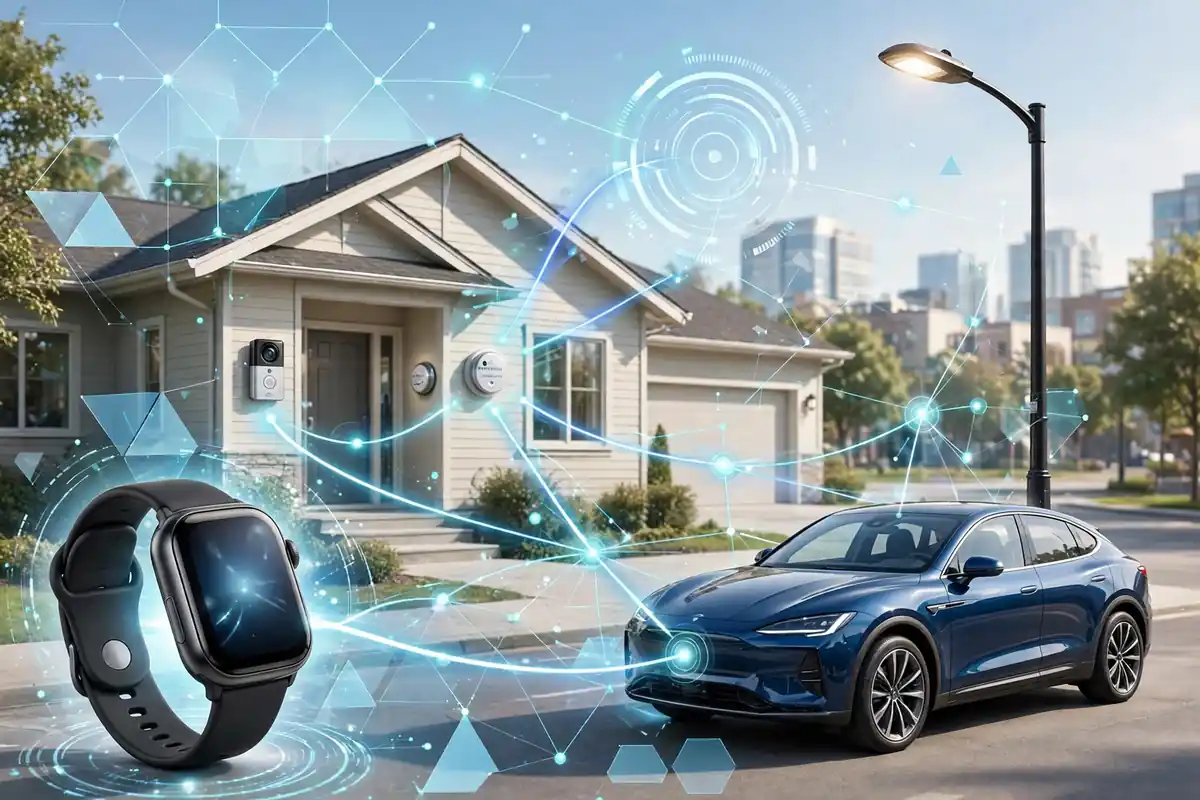
Your watch talks to your phone, your doorbell talks to the cloud, and your fridge may be quietly keeping a grocery list. This network of chatty objects has a name, and if you have wondered what is internet of things iot really means beyond the buzzword, this guide explains it with everyday examples. The short version: the Internet of Things means ordinary physical objects fitted with sensors, software, and a connection, so they can collect and exchange data.
That definition covers an enormous range, from a fitness band to a factory robot. What unites them is the pattern: sense something in the physical world, send the data somewhere, and act on it, sometimes automatically. Once you see the pattern, you start noticing it everywhere, which is the real answer to what is internet of things iot in daily life.
What Is Internet of Things (IoT) and How It Works
Every IoT system has four parts. Sensors or tags gather information, such as temperature, motion, location, or a heartbeat. A connection, usually Wi-Fi, Bluetooth, or a cellular network, carries that data. Software processes it, often in the cloud, and an interface, usually an app, shows you the results or triggers an action. A smart thermostat senses temperature, sends it to an app, learns your schedule, and adjusts the heating without being asked.
Businesses run the same loop at industrial scale. The systems behind digital transformation in business services often begin with sensors on equipment, feeding data that predicts breakdowns before they happen. Even a single building block like RFID technology in automated parking is IoT in miniature: tags sense a car’s arrival, data flows to a system, and the gate acts on it.
IoT in Your Home
Home devices are the most visible face of IoT. Smart speakers, bulbs, plugs, thermostats, doorbells, and appliances all qualify, including the comfort tech in smart ceiling fan technology and the gadgets in innovative smart home devices you did not know you needed. Together they let a house respond to schedules, voices, and events rather than waiting for switches.
The convenience is real, and so is the management. Each device is a small computer needing updates and a strong password. The layered approach described in smarter home security services treats cameras, locks, and sensors as one system to protect, which is exactly how IoT should be handled at home: as a network, not a drawer of separate gadgets.
IoT in Health, Cities, and Industry
Wearables are health IoT you wear voluntarily: watches and rings tracking sleep, heart rate, and activity, sharing summaries with apps and sometimes with doctors. Hospitals use connected monitors and asset trackers so staff can find equipment and patients faster. The stakes and the privacy questions are higher here, which is why health IoT develops under tighter rules than living-room gadgets.
Cities deploy IoT for traffic lights that adapt to flow, bins that report when they are full, and streetlights that notice their own failures. Industry goes furthest: factories wire machines with sensors that predict maintenance, track inventory, and control quality automatically. This is the practical machinery behind grand stories like NASA’s plans for human missions to Mars, where thousands of sensors reporting constantly is not a luxury but the only way anything works at that distance.
The Benefits, Stated Plainly
IoT earns its keep in three ways. It saves effort, through automation like thermostats and irrigation that run themselves. It saves money, through early warnings: a leak sensor costs little and can prevent a ruined floor, and a monitored machine fails on a schedule instead of mid-production. And it creates new abilities entirely, from a watch detecting a fall and calling for help to a farmer watering only the dry corner of a field.
Money itself is becoming an IoT-adjacent system. The world of digital payment wallets and the trends in how fintech is changing business depend on connected devices verifying, paying, and recording automatically, from a tap of a watch to a car paying for its own parking and charging.
The Risks and Honest Concerns
Every connected object is also a potential doorway. Cheap devices with default passwords have been recruited into botnets, and data collection can outrun what owners realize they agreed to. The defenses are unglamorous and effective: buy reputable brands, change default credentials, keep firmware updated, and put gadgets on a guest Wi-Fi network where your router allows it.
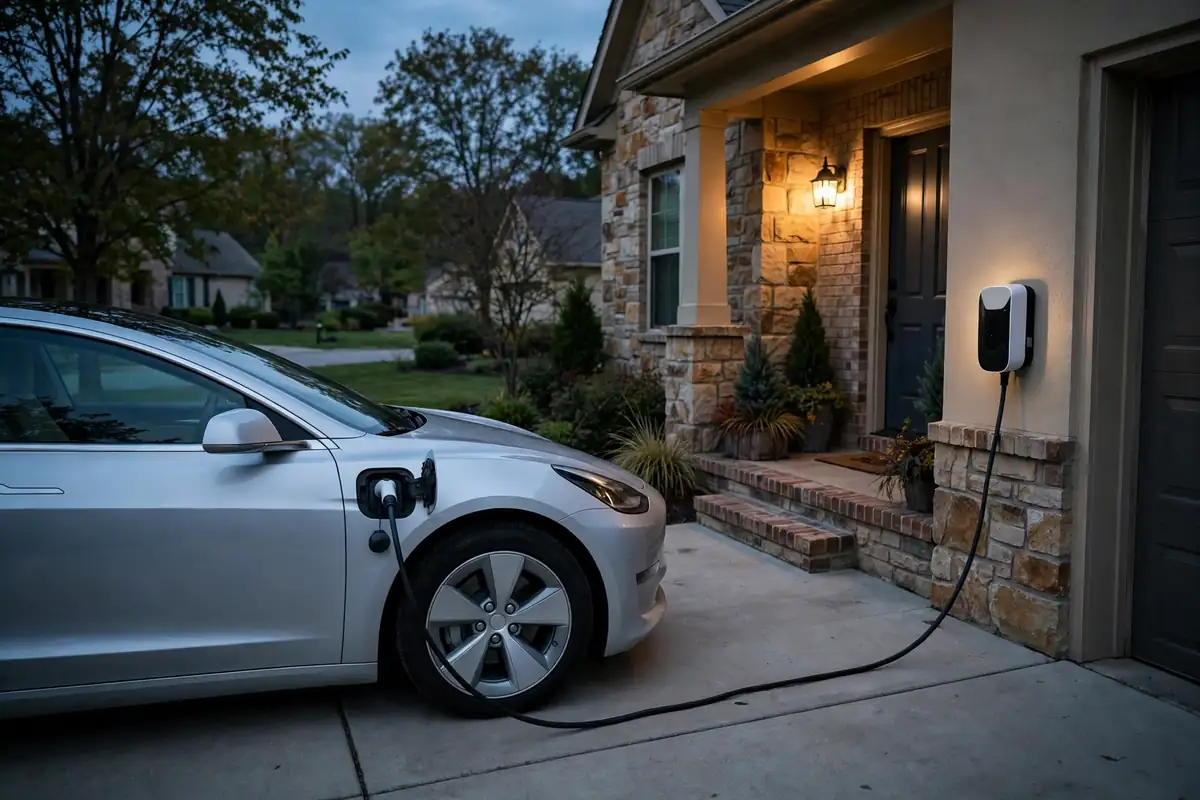
Scale adds a second concern: dependence. When the cloud service behind a device shuts down, the device can become useless, which has already happened to several smart home products. Prefer devices that keep basic functions locally, a principle the builders of AI apps acting as personal assistants and platforms covered in technology’s role in financial growth are slowly learning to respect, and one that matters in vehicles too, as EVs reshape urban commuting with fleets of connected cars reporting to their makers.
A Day in an IoT Life
Follow the pattern through an ordinary day. Your watch tracks your sleep and wakes you in a light phase. The thermostat, knowing your schedule, has the house warm before your feet hit the floor. Your car reports traffic and reroutes you, paying the parking charge automatically when you arrive. At work, the badge reader logs entry, the warehouse shelves report low stock, and a pump across town quietly tells its maintenance team it will need attention next week, not an emergency today.
None of these moments feels like “using the Internet of Things.” That invisibility is the sign of maturity: IoT succeeds when it disappears into objects doing their jobs slightly better than before. The buzzword fades, and what remains is infrastructure, as unremarkable and essential as plumbing.
The Standards Quietly Fixing the Mess
Early IoT earned a reputation for incompatibility: every brand its own app, hub, and account. Industry standards are repairing that. Matter, a common language for smart home devices, and Thread, the low-power mesh network many of them speak, mean products from rival brands increasingly work together out of the box. Similar standardization efforts run through industrial IoT, where factories refuse to be locked into one vendor’s ecosystem.
For buyers, the lesson is practical: prefer devices that support the open standards of their category, and they will still be useful when you change phones, assistants, or brands. Interoperability is what turns a pile of gadgets into a system, and a system into something that quietly serves you for a decade.
5G, Edge Computing, and Where IoT Goes Next
Two trends will shape the next decade of connected devices. The first is faster, denser networks: 5G lets sensors and vehicles exchange data with very low delay, which matters when the “thing” is moving at highway speed or controlling machinery. The second is edge computing, where processing moves from distant data centers into the device or a local hub. Edge processing means a camera can recognize a package delivery without sending your video to the cloud, improving both speed and privacy at once.
Together, these trends answer the main criticisms of early IoT. Devices become quicker, less dependent on distant servers, and more private by design. The doorbell that thinks locally, the car that decides locally, and the factory that keeps its data on-site are all the same idea arriving at once: intelligence moving closer to where life actually happens.
Children growing up now will find all of this unremarkable. A house that reports a leak, a car that books its own service, and a watch that notices an irregular heartbeat will read to them the way indoor plumbing reads to us: simply how things work. The task for today’s buyers is to build that normality on trustworthy foundations, choosing devices and standards that respect the people living among them.
Start small if you are buying in: one or two well-chosen devices from reputable brands will teach you more about your own needs than any amount of research.
Frequently Asked Questions
Is my smartphone part of the Internet of Things?
Usually smartphones are considered the controller rather than a “thing,” since IoT refers to objects that were not traditionally computers. Your phone is the remote and dashboard for most of your IoT devices.
How many IoT devices are there?
Estimates vary by definition, but the count runs into the tens of billions worldwide and keeps growing as cars, appliances, and industrial equipment come standard with connections.
Do IoT devices work without the internet?
Many keep basic local functions, like a thermostat holding its schedule, but remote control, voice assistants, and cloud features need a connection. Truly offline smart devices exist but are less common.
Key Takeaways
So, what is internet of things iot? It is the pattern of physical objects sensing, connecting, and acting on data, from your doorbell to a factory floor. The benefits are automation, early warnings, and abilities that did not exist before. The responsibilities are updates, passwords, and buying devices you can trust. Understand the pattern and the connected world stops being a buzzword and starts being a system you can judge, choose, and control.